


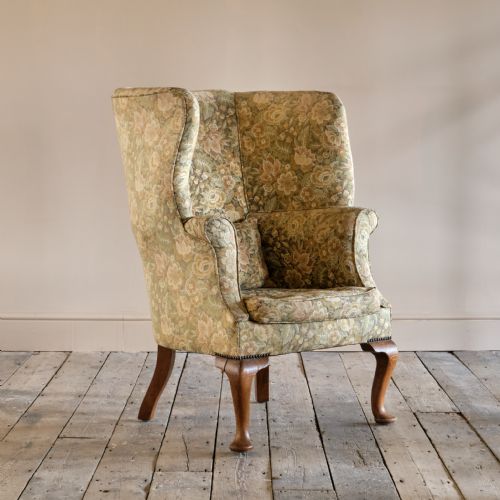


Patterned Fabric Wing Chair
A patterned fabric wing chair brings historic draught-excluding comfort into a room, offering deep seats and sheltering sides.
Patterned Fabric Wing Chair
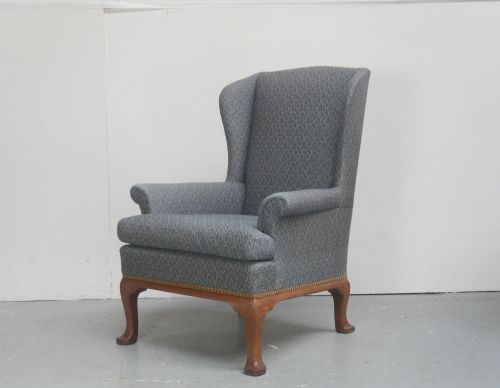
When you search for a patterned fabric wing chair, you encounter a seating form designed to shield the sitter from draughts by enclosing the head and shoulders in protective upholstered cheeks. The examples appearing here span centuries of British domestic life, stretching from the Georgian era through the Victorian period and into the Edwardian years.
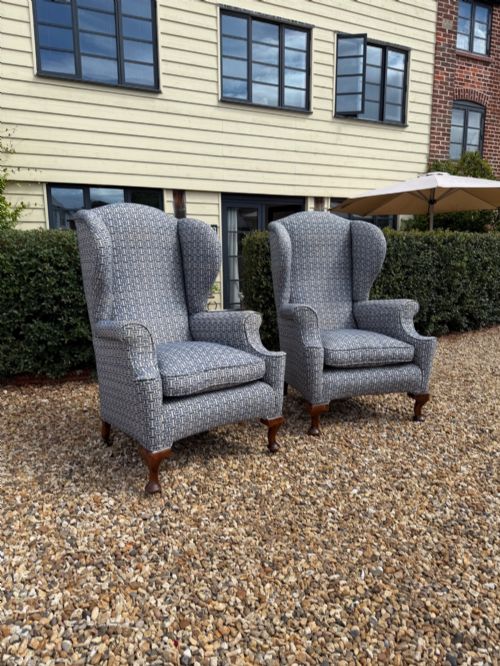
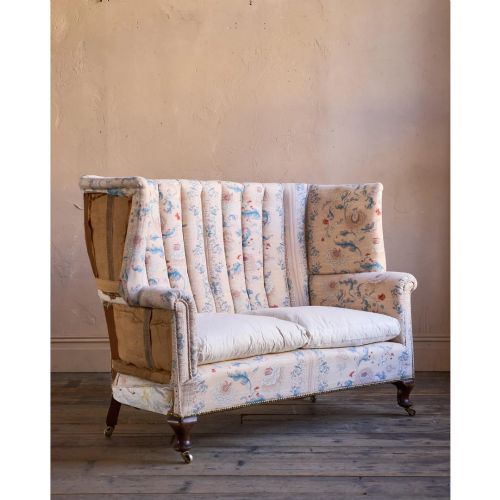
Most pieces you meet on this page take the form of individual armchairs, though variants include barrel backed armchairs and occasional wingback sofas. The frames derive from traditional styles such as Queen Anne and George III, executed in proportions intended for the fireside or the drawing room.
Makers recorded in these listings range from notable firms like Whytock & Reid and Howard & Sons to unrecorded workshops of the nineteenth and early twentieth centuries. The upholstery deployed across these pieces utilises textiles, damask, tapestry, recycled cotton, and assorted patterned fabrics.
How they were made
The underlying skeletons rely upon sturdy timbers, predominantly mahogany, walnut, and oak, joined to support the substantial weight of deep padding and heavy textile coverings. Brass fittings occasionally appear on castors or structural hardware, securing mobility and stability for the heavy frames.
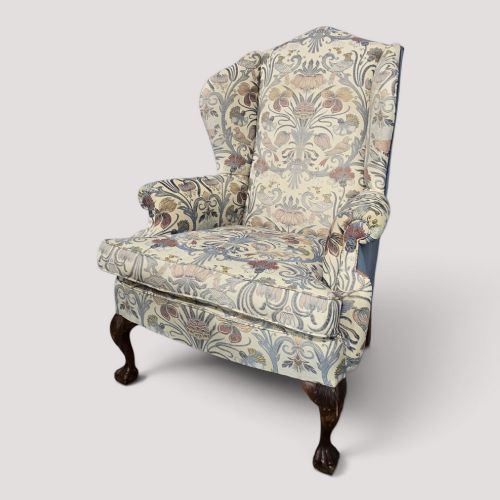
The visible surfaces rely on textiles, with damask fabric, tapestry fabric, and general patterned fabric stretched across the high backs and scrolling arms. Traditional stuffing methods give the wings their characteristic stiffness and shape, creating the enclosed profile essential to the form.
One box seat wing sofa offers hidden utility, concealing storage space beneath an upholstered seating plane designed for domestic comfort.
What varies in quality
The distinction between ordinary and exceptional pieces rests upon the integrity of the wooden frame beneath the textile, particularly the precision of the joinery in the legs and wings. Subtleties in the carving of the walnut or mahogany framework separate standard workshop production from the output of distinguished makers.
Upholstery choices and the execution of the patterned fabric further define the grade of the piece, as does the preservation of original structural elements. Proportion and balance in the height of the wings and the rake of the back dictate the visual success of the chair.
Whytock & Reid·Howard & Sons
The Patterned Fabric Wing Chair Glossary
- Wingback
- An armchair featuring projecting side panels designed to trap heat and block cold air from the sitter's back and head. This characteristic silhouette defines the entire form.
- Damask fabric
- A reversible figured textile woven on a jacquard loom, frequently utilised for formal upholstery on period seating. It provides subtle sheen and texture.
- Barrel back
- A seating variation where the upholstered arms curve continuously into a semicircular backrest. This design offers heightened enclosure compared to flat-backed variants.
- Tapestry fabric
- A heavy, hand- or machine-woven textile depicting pictorial or floral scenes. It brings dense colour and traditional weight to period chairs.
- Box seat
- A seat construction featuring a deep, square-edged cushion or foundation. This form provides additional internal space, sometimes housing storage compartments beneath.
Patterned Fabric Wing Chair: Frequently Asked Questions
What is a wing chair?
A wing chair is an upholstered armchair featuring high side panels, known as wings, attached to the backrest. These panels originally served to shield the occupant from drafts near open fires.
Today, the form remains a prominent seating choice for living spaces, combining traditional timber frames with varied textile coverings.
How old is my wing chair?
Dating a wing chair requires examining the timber species, structural joinery, and stylistic cues from periods such as the Georgian, Victorian, or Edwardian eras. Certain pieces incorporate revival styles that mimic earlier centuries.
Makers' marks, where present on the wooden frame or under upholstery, provide definitive clues to origin and approximate decade of manufacture.
How do I choose patterned fabric?
Selecting a patterned fabric involves balancing the visual weight of the design with the proportions of the armchair and the surrounding room. Traditional options recorded on this page include damask, tapestry, and printed cotton textiles.
Consider how the scale of the pattern interacts with the sweeping curves of the wings and the exposed timber legs.
Where were wing chairs placed?
Historically, wing chairs stood beside hearths and fireplaces where their enclosed sides could capture heat and block cold drafts from hallways. They also served in drawing rooms and studies for reading and conversation.
Their substantial presence makes them natural focal points within domestic interiors, whether paired with sofas or set alone.