



Galle Floral Vase
A galle floral vase brings Art Nouveau glasswork into the room through layered cameo carving and botanical motifs.

Galle Floral Vase
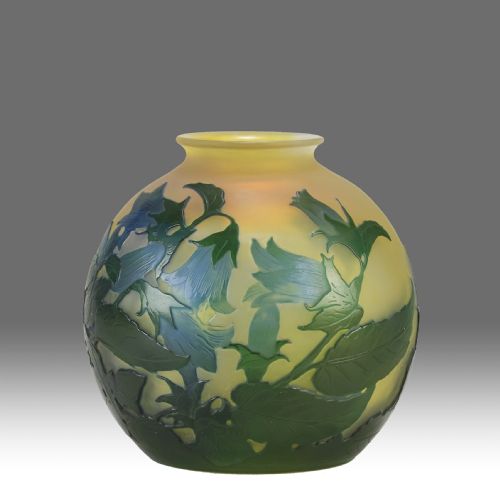
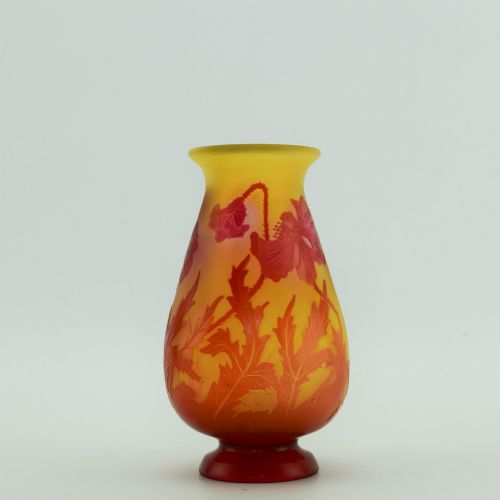
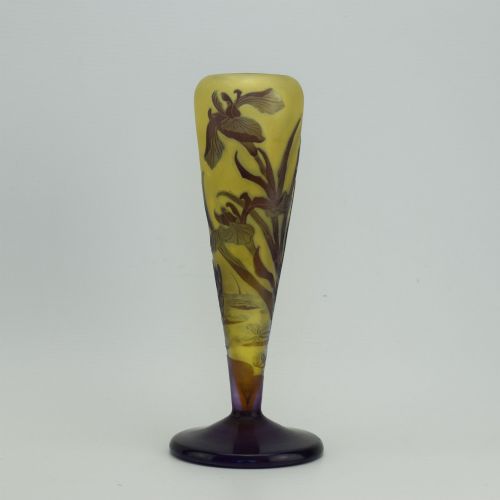
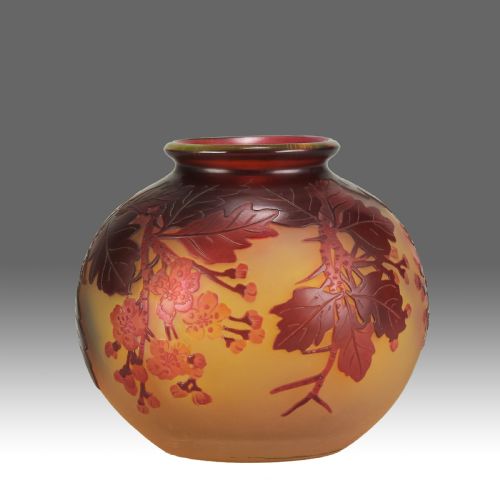
When someone searches for a galle floral vase, they are looking for French Art Nouveau glassware shaped into vessels like banjo vases, footed pieces, and tall cylinders. These objects display botanical motifs such as campanula, poppies, iris, cornflowers, apple blossom, honeysuckle, hydrangea, begonias, clematis, ferns, and blue flowers.
The versions most commonly met on this page date from the early 20th century, specifically around 1900 to 1930. They utilise cameo glass techniques, frosted glass, acid-etched glass, blown glass, and souffle or blow-out methods.
Makers and signatures associated with these pieces include Emile Gallé, whose work defines the category. The forms range from standard floral arrangements to large exhibition-scale items.
How they were made
Makers produced a galle floral vase using blown glass foundations layered with multiple colours to create depth. Acid-etching and cameo glass techniques then cut away the outer layers to reveal the botanical designs underneath.
Frosted glass treatments softened the background textures, while souffle or blow-out methods expanded the glass into moulds to shape complex organic contours before final hand-finishing.
Some vases are named after modest garden weeds like cornflowers, proving that humble botany inspires fine glass.
What varies in quality
The depth and precision of the acid-etching separate standard production from more ambitious output. Multi-layered cameo carving creates sharper contrasts and more intricate botanical detail than simpler two-layer versions.
Scale and ambition also define the hierarchy of pieces, with large vases and souffle techniques representing greater technical difficulty than standard blown cylinders.
Emile Gallé
The Galle Floral Vase Glossary
- Cameo Glass
- A method of creating designs by carving or acid-etching through fused layers of contrasting glass colours. This technique allows the background and foreground to show distinct hues.
- Acid-Etched Glass
- A process where hydrofluoric acid eats away unprotected glass surfaces to create designs or matte textures. It replaced much manual wheel-carving in the early twentieth century.
- Frosted Glass
- A translucent surface texture produced by acid treatment or sandblasting. It diffuses light and mutes background glare behind carved motifs.
- Souffle Glass
- A technique where glass is blown into a metal mesh cage or mould to expand and texture the surface. It creates distinctive bulbous silhouettes known as blow-out vases.
- Art Nouveau
- An international decorative style characterised by flowing, asymmetrical organic lines inspired by plants and natural forms. It dominated European design around nineteen hundred.
Galle Floral Vase: Frequently Asked Questions
What is a galle floral vase?
A galle floral vase is an Art Nouveau glass vessel created in France, featuring carved botanical motifs using cameo techniques.
These pieces typically date from the early twentieth century and showcase subjects like clematis, iris, and poppies.
How do I date a galle floral vase?
Dating relies on the style of the signature, the complexity of the glass layering, and the manufacturing period recorded between nineteen hundred and nineteen thirty.
Archival records and specific floral motifs also help narrow down the decade of production.
Where were they made?
These vases were produced in Nancy, France, during the height of the Art Nouveau movement by Emile Gallé and his workshop.
The region remained a primary centre for French art glass innovation.
How should I display a galle floral vase?
Place the vase in a position where natural light can pass through the cameo glass layers to reveal the carved botanical colours.
Keeping the piece away from direct, high-heat sunlight protects the integrity of the coloured glass.