


French Walnut Secretary
A french walnut secretary is a practical writing cabinet designed to conceal correspondence behind a drop-down flap or roll top.
French Walnut Secretary
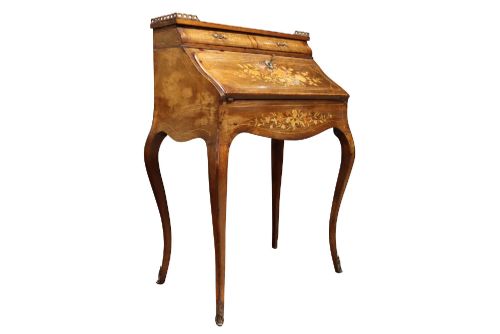
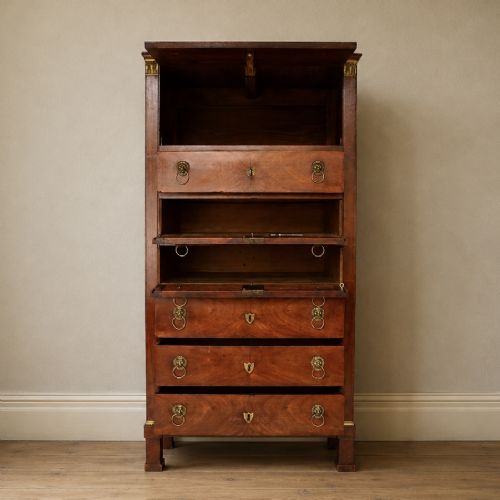
A french walnut secretary encompasses a variety of writing furniture, from tall secretaire abattant cabinets to delicate ladies writing desks and bonheur-du-jour forms. These pieces serve as functional desks with specialised compartments for paper and letters, often fitted with a fold-down writing surface.
The selections encountered span several distinct periods, most notably the nineteenth century alongside eighteenth-century examples and twentieth-century interpretations. Revival styles dominate the offering, particularly Louis XV and Louis XVI designs, which bring traditional continental elegance to domestic spaces.
Makers utilised rich timbers and elaborate surface decoration to elevate these writing desks from simple furniture to statement pieces. Buyers frequently encounter variations that include superstructure cabinets, mirrored doors, or open writing ledges tailored for personal correspondence.
Distinguishing Quality
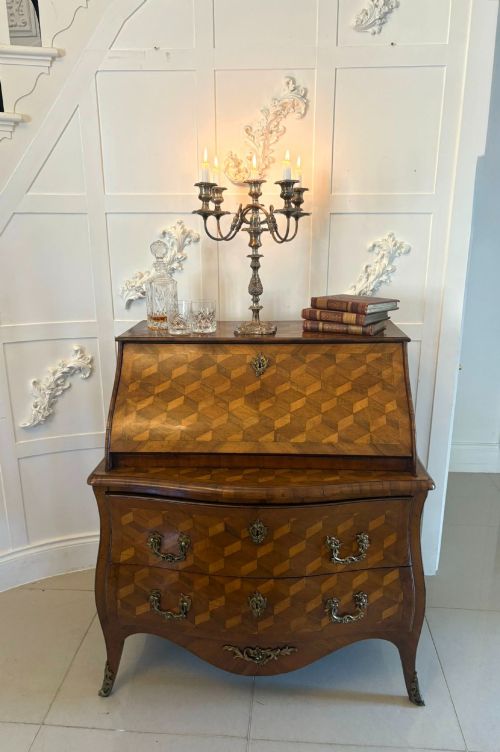
The standard of a french walnut secretary depends significantly on the precision of its marquetry inlay and the depth of the timber figuring. Exemplary pieces display seamless wood matching across curved bombe surfaces and drawer fronts.
Hardware integration separates standard production from superior examples, particularly the crispness of cast ormolu mounts and bronze details. The smoothness of the drop-down writing flap action and the complexity of the interior drawer arrangement also indicate the maker's original investment of time and skill.
Listings feature walnut, burr walnut, and rosewood timbers enhanced by marquetry inlay, marble tops, and ormolu mounts across various nineteenth-century revival styles.
The French Walnut Secretary Glossary
- Secrétaire abattant
- A tall, upright cabinet featuring a hinged fall-front writing panel that conceals a fitted interior of small drawers and pigeonholes. This form maximises vertical storage while providing a stable writing surface.
- Bonheur-du-jour
- A light ladies writing desk featuring a small set of drawers or a cabinet on the upper surface. This form gained popularity during the eighteenth century and remained a favourite for intimate correspondence.
- Marquetry inlay
- A decorative technique where thin veneers of various coloured woods are pieced together to form pictorial or geometric designs. Artisans apply these veneers to the exterior carcase to create striking visual contrast.
- Ormolu
- Gilt bronze ornamentation applied to the corners, feet, and key escutcheons of fine furniture. This material provides a bright metallic contrast against dark walnut timber.
- Parquetry
- A geometric mosaic of wood pieces used for surface decoration, typically forming repeating patterns such as cubes or chequers. It differs from marquetry through its strict geometric arrangement.
French Walnut Secretary: Frequently Asked Questions
What is a secretaire abattant?
A secretaire abattant is an upright writing cabinet with a vertical fall-front panel that drops down to form a desk surface. Behind this flap lie numerous small compartments for letters and stationery.
This tall format allows the piece to occupy minimal floor space while providing substantial enclosed storage for papers and documents.
How do I use a bonheur-du-jour?
A bonheur-du-jour functions as a compact writing desk, traditionally utilised in a boudoir or drawing room for morning correspondence. The upper tiers provide neat storage for inkwells, sealing wax, and paper.
In a modern interior, these desks serve well as independent writing stations or display tables in a living space or study.
How do I distinguish Louis XV and Louis XVI styles?
Louis XV revival pieces, often termed rococo revival, display asymmetrical curves, cabriole legs, and flowing organic bronze mounts. They embrace softness and movement in their overall silhouette.
Louis XVI pieces introduce straight lines, symmetrical parquetry, fluted tapered legs, and neoclassical restraint. The transition reflects a shift from undulating curves to architectural geometry.
Are marble tops original to these desks?
Heavy marble slabs frequently top nineteenth-century upright secretaires and cabinets to provide a durable, cool surface and a sense of architectural solidity. These slabs sit directly onto the wooden carcase.
While some tops have been replaced during restoration work, original marble matches the exact profile and proportions of the cabinet base.