
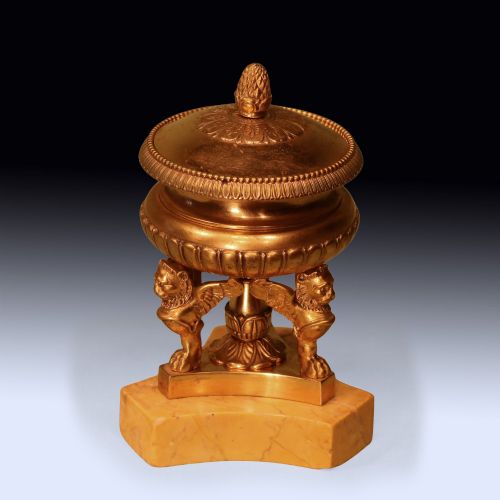


French Urn Set
A French urn set brings symmetry and Continental character to a mantelpiece, usually comprising a central clock flanked by matching vases or ewers.
French Urn Set
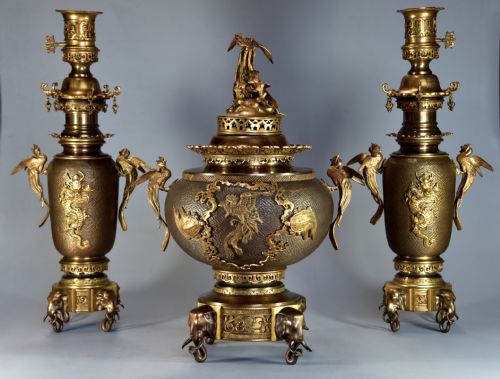
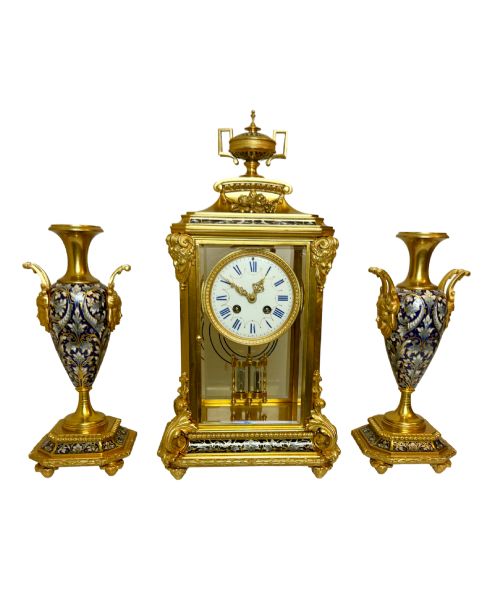
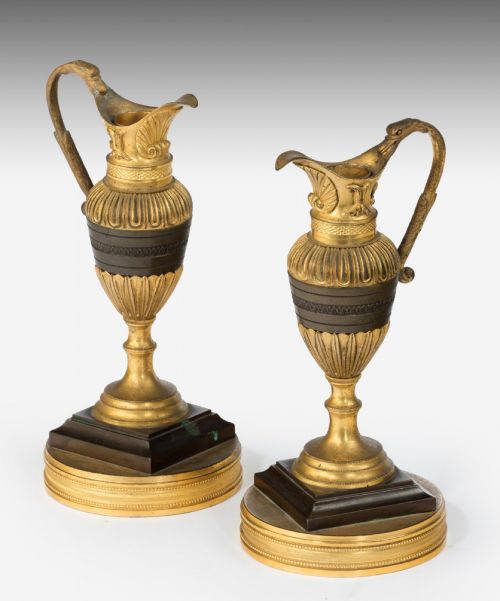
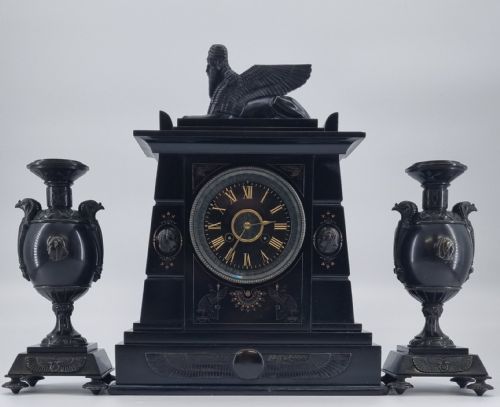
When someone searches for a French urn set, they are looking at multi-piece mantel garnitures typically consisting of a central clock accompanied by a pair of matching side urns, vases, or ewers. These ensembles originated to create a balanced decorative scheme on drawing room mantelpieces and console tables during the nineteenth and early twentieth centuries.
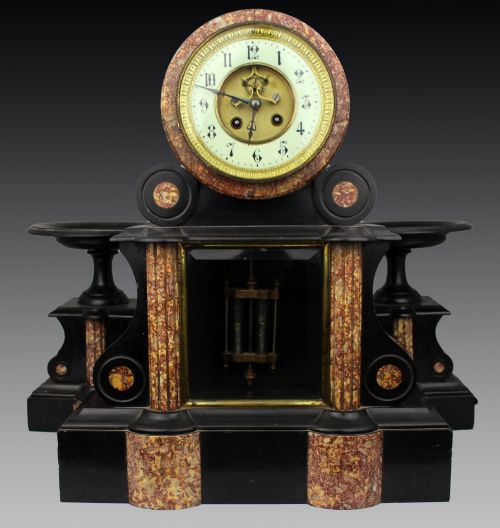
The versions most commonly met on this page date from the nineteenth century, spanning periods from the 1850s through to 1900, with occasional early twentieth-century examples reaching into the art deco era. Forms vary from elaborate clock garnitures with champleve enamel or porcelain panels to pairs of bronze, marble, or terracotta vases designed to sit in direct symmetry.
How they were made
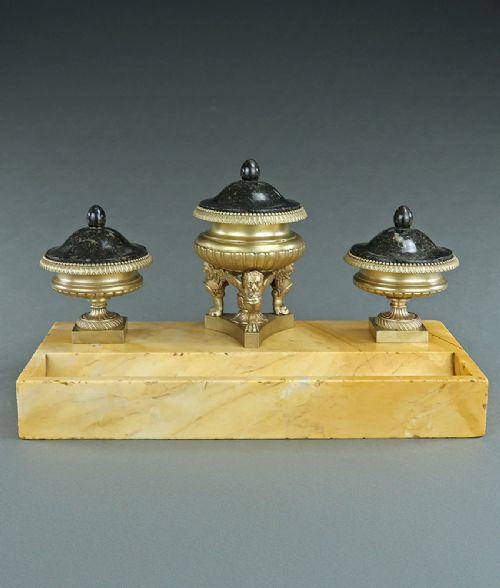
Maker workshops combined cast metals like ormolu, gilt bronze, and brass with natural stones including black marble, Sienna marble, and onyx. Artisans cast the metal components in sections, hand-chased the surface details, and applied fire gilding or patination before mounting them on stone plinths.
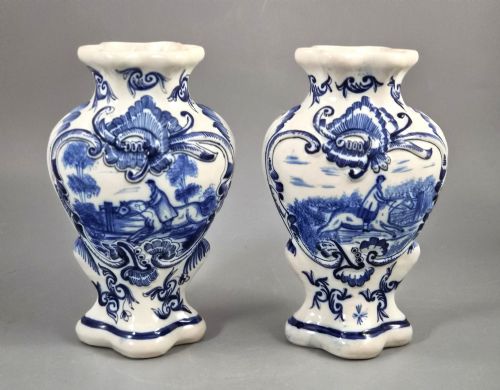
Ceramic elements relied on porcelain bodies, often painted by hand with pastoral or floral scenes, or finished in rich cobalt glazes with gilded accents. Some sets incorporated delicate glass domes to protect the delicate porcelain bodies and clock mechanisms from dust.
Object types recorded include mantel clocks, clock garnitures, decorative vases, inkwells, and confit pots.
What varies in quality
Quality in a French urn set rests on the crispness of the bronze casting and the depth of the fire gilding rather than a shiny finish. Superior examples show finely chased acanthus leaves and crisp scrollwork where human hands have refined the metal after casting.
The harmony between the central clock and the side urns dictates the overall success of the ensemble, as lesser sets mix components post-manufacture. Hand-painted porcelain panels with detailed brushwork and undamaged champleve enamel elevate a set above mass-produced alternatives.
Fourmaintraux Courquin at Desvres·A.D Mougin·Vincenti of Paris·KPM Berlin·Japy Freres
The French Urn Set Glossary
- Garniture
- A set of matching decorative objects, typically three pieces comprising a centrepiece and two flanking vessels.
- Ormolu
- Gilt bronze, where finely powdered gold is applied to a bronze base using a mercury amalgamation technique.
- Champleve
- An enamelling technique where troughs are dug into a metal surface and filled with vitreous enamel before firing.
- Ewer
- A large jug with a wide spout and a shaped handle, often produced as a decorative ornamental piece rather than for use.
- Japonisme
- A nineteenth-century style reflecting the influence of Japanese art and design on European decorative objects.
French Urn Set: Frequently Asked Questions
What is a clock garniture?
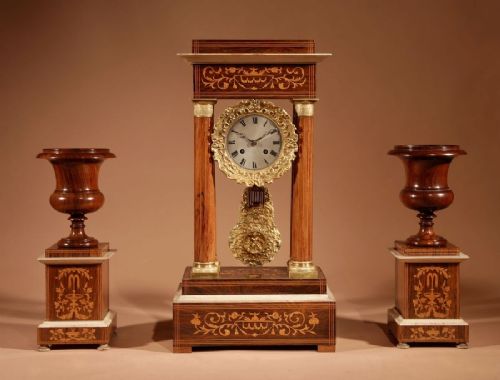
A clock garniture is a matched set of three or more decorative objects designed to be displayed together on a mantelpiece. The centrepiece is invariably a clock, while the matching side pieces are often urns, vases, or ewers.
These sets were conceived to provide absolute symmetry in nineteenth-century interior decoration. The side pieces repeat the motifs, materials, and palette of the central clock to unify the room's decor.
Where were these sets placed?
They were traditionally positioned on the mantelpiece above a fireplace, framed by the chimney breast and often reflected in an overmantel mirror. This placement allowed the reflective qualities of the ormolu and marble to catch the flickering light of the room.
Beyond the fireplace, larger sets found homes on console tables, sideboards, or dedicated pedestals in reception rooms and grand hallways. Their balanced proportions drew the eye towards the centre of the wall arrangement.
How do I identify the period?
Period identification relies on observing the stylistic vocabulary, such as the exuberant curves of Rococo revival or the strict symmetry of Neo-classical and Louis XVI designs. The choice of materials, from early nineteenth-century ormolu to later art deco forms, also signals the era of manufacture.
Maker marks stamped onto the clock movements or porcelain undersides offer definitive dating clues. Comparing the casting techniques and enamel work helps distinguish mid-nineteenth-century craftsmanship from later reproductions.