

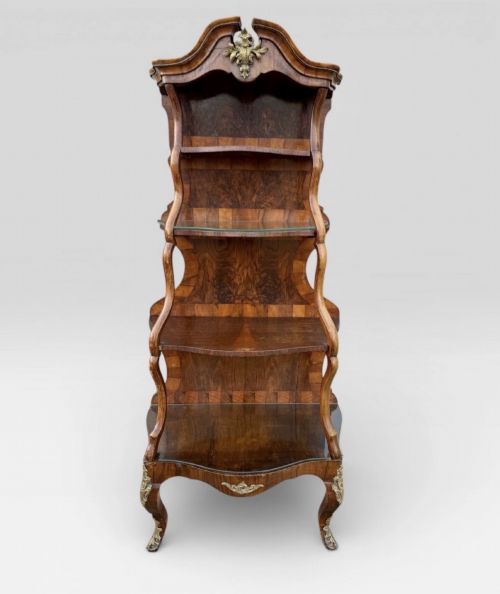


French Style Walnut Etagere
These french style walnut etagere pieces are multi-tiered display stands designed to showcase ornaments and small objects with distinct continental elegance.
French Style Walnut Etagere
A french style walnut etagere stands as a multi-tiered piece of furniture primarily utilised for display and occasional use within the principal rooms of a house. These tiered stands trace their origins through the Victorian and Edwardian periods, adopting French Louis XV Style and Rococo Revival influences.
Most examples found here present two or three tiers, occasionally taking the form of a whatnot, side table, or specialised music cabinet. The framework relies on rich walnut timber, frequently enhanced by decorative veneers that catch the eye from across a room.
How they were made
Cabinet makers constructed these pieces using solid walnut and intricate marquetry veneers, laying down floral or geometric patterns across the tiers. Satinwood is often introduced to create contrasting inlay details within the primary walnut ground.
Metal mounts in brass, ormolu, gilt bronze, and gilt metal accent the corners, edges, and legs, while delicate galleries contain the open shelves. Glass panels or mirrored backs appear in specific cabinet variants to reflect light through the display space.
Listings feature walnut construction combined with brass, ormolu, and glass across Victorian and Edwardian periods.
What varies in quality
The sophistication of the marquetry inlay and the crispness of the cast metal mounts separate standard production from superior work. Finer examples display meticulous control in the timber grain and precise fitting of the metal galleries.
Proportion and structural grace also dictate value, with diminutive or serpentine forms commanding attention for their balanced silhouettes. The integration of maker signatures, such as the work associated with Gabriel Viardot, elevates the standing of a piece considerably.
Gabriel Viardot·Donald Ross
The French Style Walnut Etagere Glossary
- Marquetry
- Decorative inlay work where small pieces of veneer are fitted together to form pictorial or geometric designs. This technique decorates the top surfaces and shelves of finer walnut pieces.
- Ormolu
- Gilded bronze mounts applied to furniture edges and feet for decorative effect. The technique involves mercury gilding on bronze to create a bright metallic finish.
- Whatnot
- A Victorian term for an open set of shelves used for storing or displaying bric-a-brac. It shares a similar function to the etagere.
- Serpentine
- A furniture contour that curves inward and outward in a wave-like motion. This shaping appears on the edges of tables and etageres.
French Style Walnut Etagere: Frequently Asked Questions
What is a french style walnut etagere used for?
These pieces function primarily as open display stands for porcelain, small silver, and decorative objects in a drawing room or salon. The multiple tiers allow for structured arrangement without dominating the floor space.
Historically, they served as decorative centerpieces or corner accents where homeowners could exhibit their curated collections to guests. Today, they perform the same decorative role in period and eclectic interiors.
How do I date a walnut etagere?
Dating relies on examining the timber construction, the style of the mounts, and the complexity of the marquetry. Pieces from the mid nineteenth century often show heavier brass framing and robust Victorian walnut framing.
Later Edwardian versions may exhibit lighter gilt metal mounts and refined inlay techniques. Comparing the stylistic cues to known Victorian and Edwardian manufacturing traits helps narrow the decade of origin.
Are these pieces fragile?
The slender uprights and multi-tiered structure mean these stands require sensible placement away from heavy traffic areas. They are designed for decorative display rather than heavy storage.
Treating the walnut surfaces with standard wax care and avoiding excess weight on upper tiers ensures the structural joints remain stable over time.
What distinguishes an etagere from a whatnot?
The terms often overlap in nineteenth-century listings, though etageres frequently lean toward French aesthetic influences with lighter framing and ornamental mounts. Whatnots can possess a slightly more utilitarian Victorian character.
Both provide open tiers for display, but an etagere often incorporates specific French revival detailing such as serpentine edges and elaborate floral marquetry.