

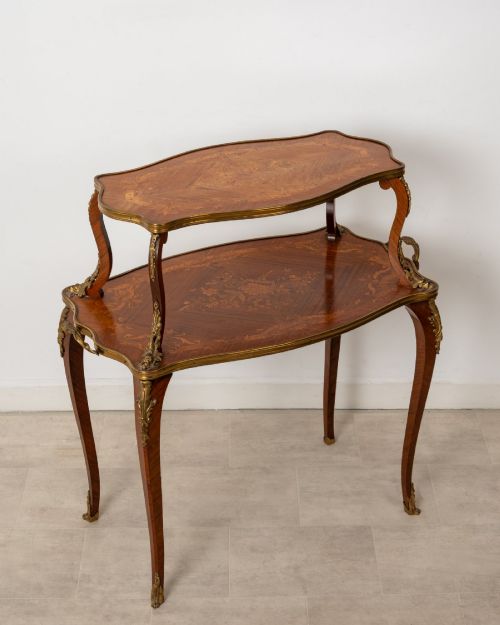
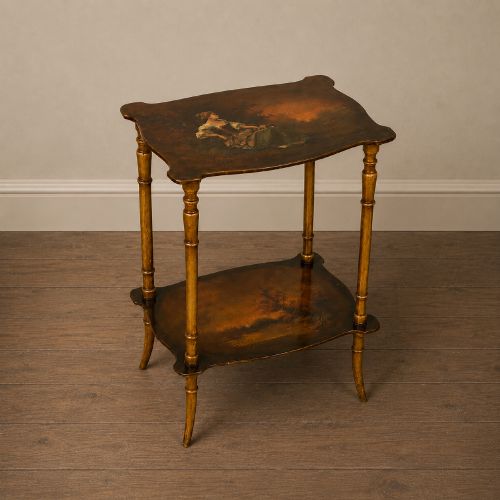
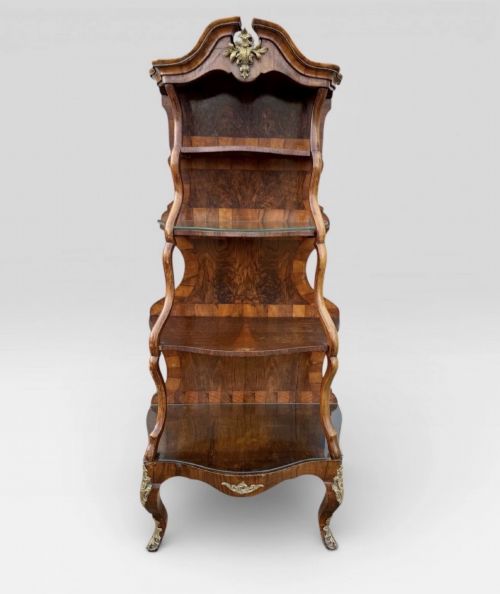


French Rococo Etagere
A french rococo etagere brings soaring tiers and fluid, organic curves into a room, offering both display space and undeniable decorative presence.
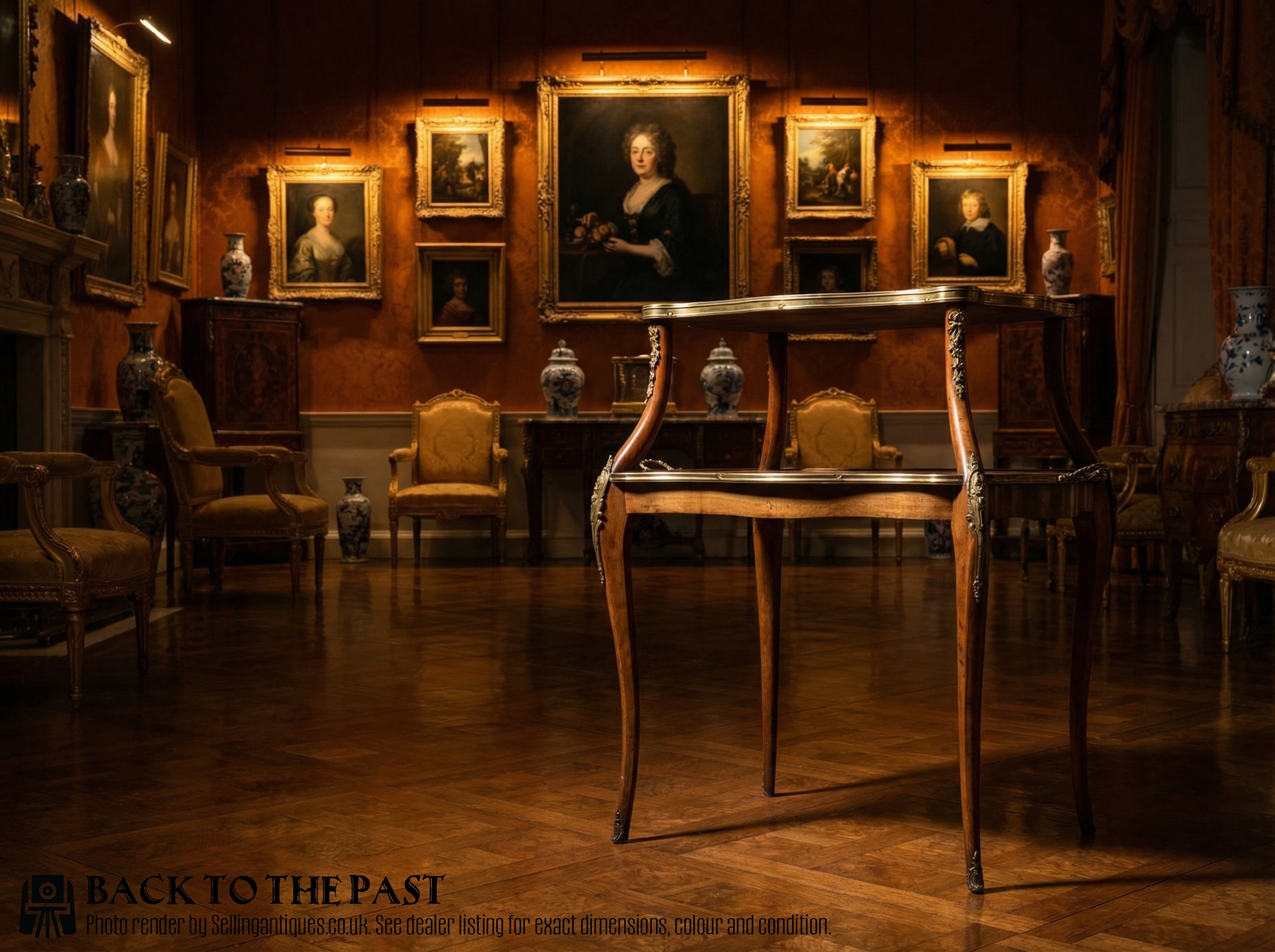
French Rococo Etagere
When you search for a french rococo etagere, you are looking at multi-tiered shelving units and side tables designed with the spirited asymmetry and natural motifs characteristic of the style. These pieces draw on French Louis XV style, Rococo revival, and French Chateau aesthetics to create graceful vertical storage.
The versions most commonly met on this page span the nineteenth century, including pieces from eighteen ninety, nineteen hundred, nineteen twenty, the Edwardian period, and Victorian eras. They appear in forms ranging from wall shelves and tier tables to serpentine whatnots and marquetry-inlaid two-tier side tables.
Makers such as Edwards and Roberts contributed refined examples with marquetry inlaid decoration during the late nineteenth century. Whether standing on the floor or mounted to the wall, these tiers function equally well as bookcases, display cabinets, and occasional tables.
Materials and construction methods
The framework of these pieces relies on woods such as walnut, kingwood, and carved giltwood, often enriched with intricate marquetry inlaid decoration. Artisans shaped these timbers to create serpentine profiles and flowing structural lines.
Decorative surfaces receive lavish attention through the application of ormolu mounts, brass details, gold leaf, gesso, and painted finishes. Glass elements and parcel gilt accents further enhance the reflective, ornate quality typical of the revival period.
French Rococo Etagere Retail Price Guide 2026
Typical asking prices for french rococo etagere among the pieces listed under this phrase on Sellingantiques today, from the lower quarter to the upper quarter. They describe what is for sale here now, not the wider market.
Materials recorded include ormolu, walnut, kingwood, glass, brass, giltwood, gesso, and gold leaf.
Distinguishing quality in tiered furniture
Quality rests upon the crispness of the woodcarving and the precision of the marquetry inlay across the tiers. Pieces that exhibit fluid, deeply carved giltwood or masterly cabinet work command attention through their sculptural weight and proportion.
The integration of metal mounts, whether ormolu or brass, dictates the refinement of the piece. Superior examples show meticulous casting and secure fitting to the walnut or kingwood structure, elevating standard shelving into high decorative art.
Edwards & Roberts
The French Rococo Etagere Glossary
- Ormolu
- Gilded bronze or brass applied as mounts and decorative flourishes on furniture. This technique imparts a rich metallic lustre that highlights the curves of the design.
- Marquetry
- The art of applying pieces of veneer to a structure to form decorative patterns and pictures. Makers utilise contrasting timbers like kingwood and walnut to achieve tonal depth.
- Serpentine
- A furniture shape featuring a wavy outline with a convex centre flanked by concave ends. This contour adds dynamic movement to tables and whatnots.
- Giltwood
- Wood that has been treated with gold leaf or gold paint to give a metallic sheen. It forms the structural and decorative base for ornate wall shelves and display units.
French Rococo Etagere: Frequently Asked Questions
What is an etagere?
An etagere is a piece of furniture made with open shelves, designed specifically for displaying ornaments, books, and small treasured objects.
These tiers allow items to be viewed from multiple angles, making the structure both decorative and practical in a sitting room.
How do I use an etagere at home?
You can place a floor-standing etagere against a wall or use a smaller two-tier version as an occasional side table beside a sofa.
Wall-mounted shelves offer a way to display collections without taking up valuable floor space in compact rooms.
How do I date a french rococo etagere?
Dating relies on examining the timber, construction techniques, and stylistic revivals, with pieces on this page spanning the nineteenth and early twentieth centuries.
Maker signatures, such as those by Edwards and Roberts, help pinpoint specific decades during the late nineteenth century.
What is the difference between an etagere and a whatnot?
An etagere and a whatnot both refer to open-shelved display furniture, though the terms often overlap depending on the maker and period.
Both forms provide tiered surfaces, but whatnots frequently incorporate serpentine shapes and compartments suited for varied collections.