

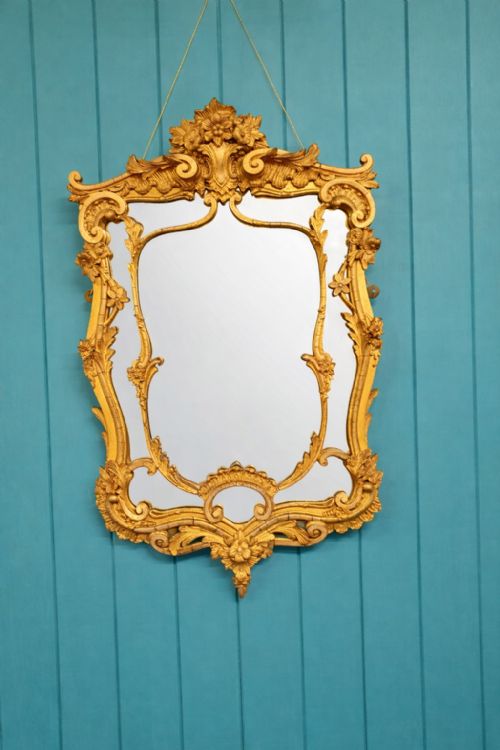
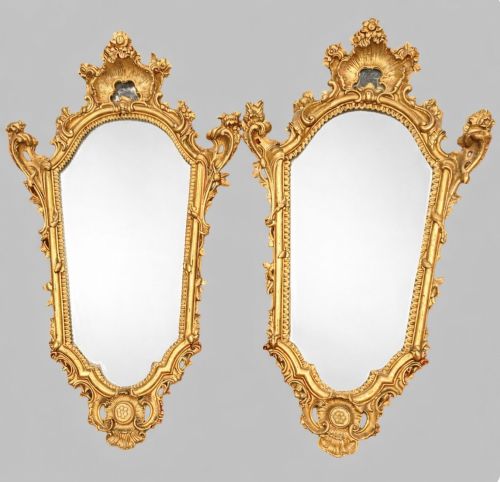


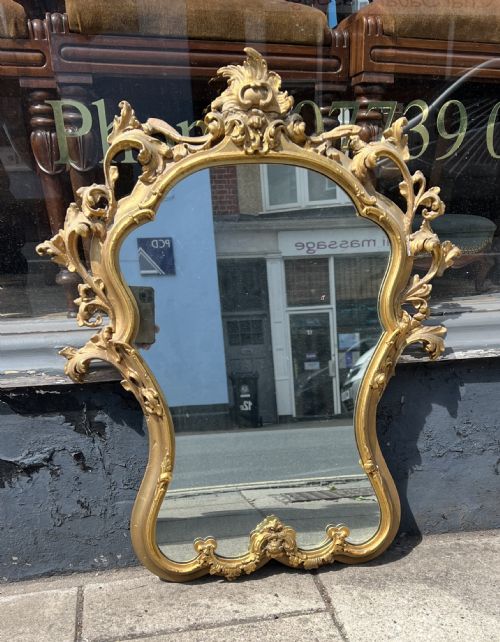


French Rocaille Gilt Mirror
These French rocaille gilt mirrors bring dynamic carved movement and bright reflective light into a room.
French Rocaille Gilt Mirror
A French rocaille gilt mirror is a decorative wall hanging defined by ornate scrollwork, asymmetry and gilded surfaces. When you search for this phrase, you find wall mirrors and pairs of mirrors spanning the eighteenth, nineteenth and early twentieth centuries. The examples on this page predominantly follow the French Rococo, Louis XV and Rococo Revival styles.
The selection ranges from carved wood and gesso frames to cast bronze and giltwood constructions. Many pieces display the characteristic shaped tops and elaborate floral or scroll motifs typical of nineteenth-century revivals and earlier periods. Each mirror serves as a prominent focal point, combining functional glass with sculptural decorative framing.
How they were made
The frames rely heavily on carved wood, gesso and giltwood, utilising gold leaf and silver leaf to achieve a luminous metallic finish. Artisans carved intricate botanical and scroll details directly into the wood before applying layers of gesso to prepare the surface for gilding. Bronze components also appear, shaped through casting to create durable, highly detailed mounts and frames.
Mirror glass is set within these shaped frames, often following the irregular, flowing contours dictated by the rocaille aesthetic. The combination of carved wood, applied gesso and delicate metallic leaf required specialist craftsmanship to balance structural support with ornate visual lightness.
Listings feature items spanning the eighteenth, nineteenth and early twentieth centuries, utilising materials including giltwood, gesso, carved wood and bronze.
What varies in quality
The depth and crispness of the carving distinguish finer examples from simpler production. Superior frames show hand-carved detail in the wood and gesso where scrollwork and asymmetrical motifs remain sharp and well-defined. Lesser quality pieces may rely on moulded composition rather than skilled hand-carving, resulting in softer edges and less dimensionality.
The quality of the gilding also sets pieces apart, with genuine gold leaf or silver leaf offering a warmer, richer lustre than plain metallic paint. Preservation of the original surface finish directly influences the integrity of the object, as thick or repeated over-gilding obscures the underlying craftsmanship.
The French Rocaille Gilt Mirror Glossary
- Rocaille
- An eighteenth-century ornamental style inspired by shell work, pebbles and scrolling water forms. It forms the basis of the asymmetrical, flowing designs seen on these mirrors.
- Gesso
- A plaster-like mixture applied to wood frames to create a smooth surface for gilding. Artisans carved fine details directly into this layer before applying leaf.
- Giltwood
- Timber that has been coated with gold leaf or metallic powder. It provides the signature bright finish characteristic of these decorative frames.
- Louis XV Manner
- A design style recalling the French court of the mid-eighteenth century. Pieces in this manner feature curved lines, naturalistic floral motifs and pronounced asymmetry.
- Silver Leaf
- Extremely thin sheets of beaten silver applied to a prepared frame. It creates a cooler, silvery metallic sheen distinct from gold leaf.
French Rocaille Gilt Mirror: Frequently Asked Questions
Where should I hang a French rocaille gilt mirror?
These mirrors suit prominent locations such as above a mantelpiece, in a hallway or across from a window to amplify natural light. Their decorative frames make them natural centrepieces in a room.
Ensure the wall construction safely supports the weight of carved wood and gesso frames, particularly for larger examples.
How do I clean the mirror glass?
Apply a mild glass cleaner to a soft cloth rather than spraying directly onto the glass. This prevents moisture from seeping behind the plate or damaging the surrounding gilt frame.
Keep moisture well away from the gesso and gold leaf surfaces to preserve the historic finish.
How can I tell a nineteenth-century revival piece from an eighteenth-century original?
Examine the construction methods, backboards and the composition of the gesso and wood. Eighteenth-century pieces typically show period-specific joinery and hand-wrought fixings.
Revival pieces from the Victorian era or around nineteen hundred often adopt the style with heavier construction or different wood preparation.