



French Revival Bureau
These french revival bureau pieces bring continental elegance to writing tasks through serpentine forms, rich veneers and gilt metal mounts.
French Revival Bureau
A french revival bureau encompasses writing tables, bureau plats, and cabinet forms such as the bonheur du jour and secretaire abattant, originating largely in the nineteenth century and Victorian eras. These items draw heavily upon Louis XV and Louis XVI design vocabularies, translated through both French cabinetmakers and British makers working in a continental manner.
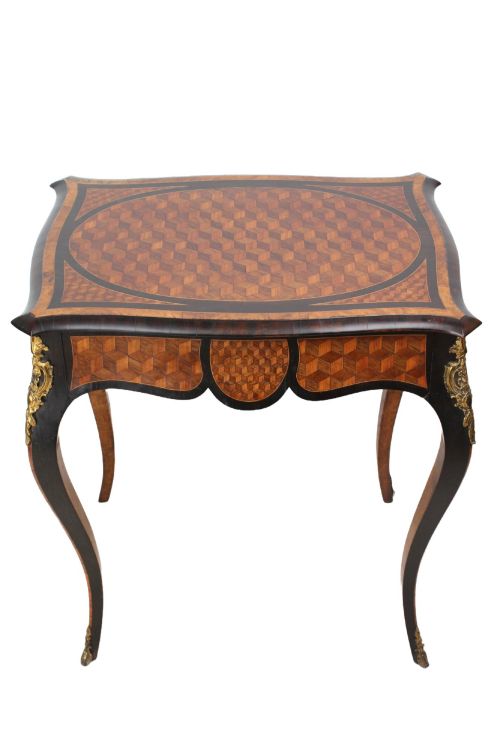
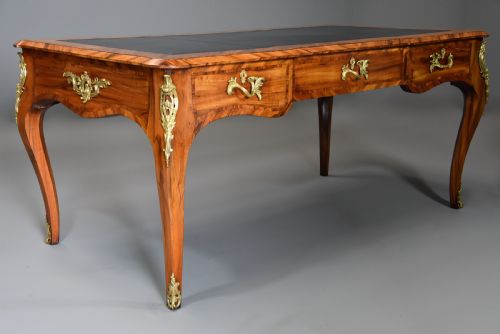
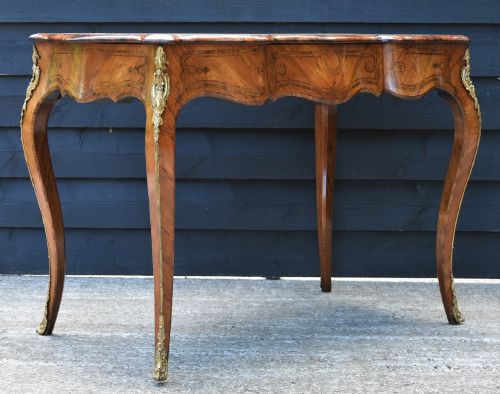
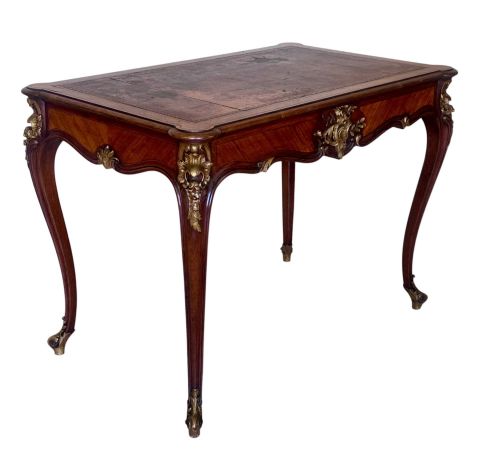
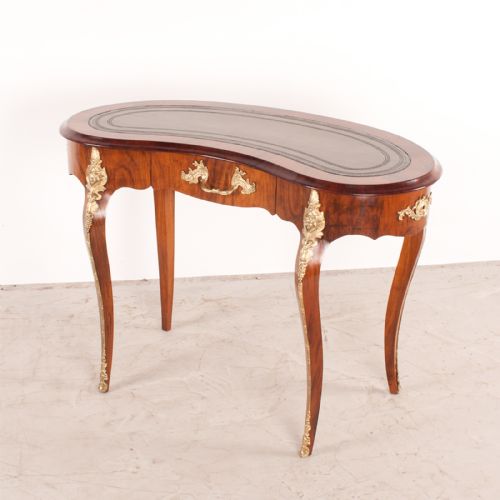
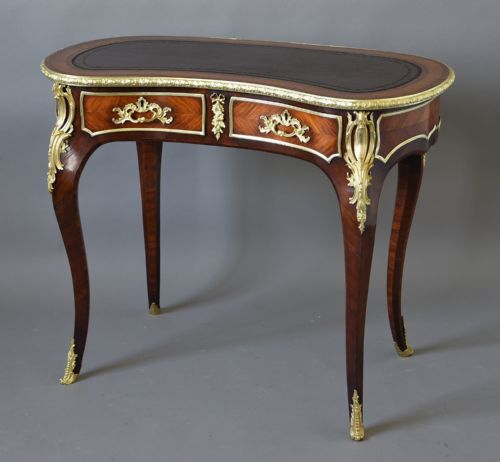
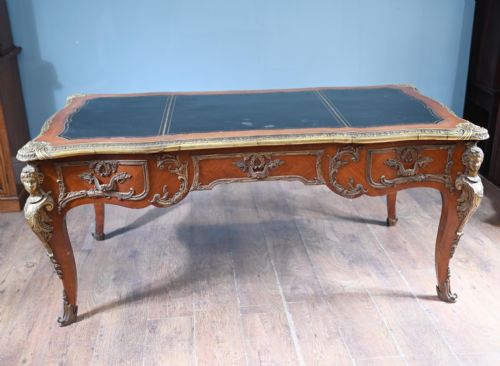
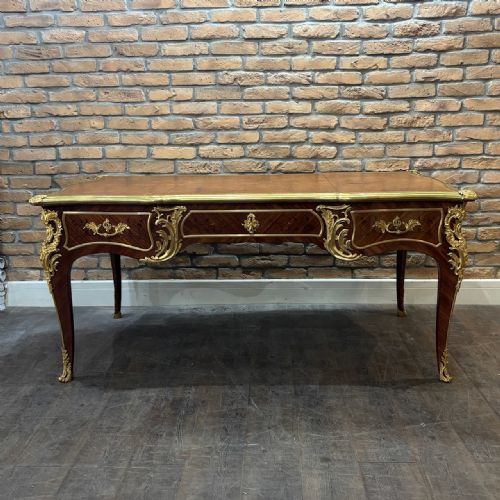
The pieces on this page lean heavily toward kidney-shaped writing tables and serpentine desks inlaid with marquetry or parquetry. Collectors encounter compact ladies' desks alongside substantial bureau plats designed for the centre of a room.
Materials and Techniques
Construction relies upon cabinet woods such as kingwood, walnut, burr walnut, rosewood, and mahogany, often enhanced by intricate parquetry and floral marquetry patterns. Finer examples incorporate exotic woods, satinwood, and calamander.
Gilded bronze and ormolu mounts punctuate corners, framing elements, and handles, frequently paired with inset leather writing surfaces and occasionally porcelain plaques or painted Vernis Martin panels.
Several desks manage to hide secret compartments behind their decorative veneers, preserving nineteenth-century hiding spots for private letters.
Markers of Distinction
Differentiation lies in the crispness of the bronze or ormolu casting and the precision of the timber inlay. Superior pieces display hand-chased mounts and meticulously matched veneer grains across serpentine curves.
Attribution to documented makers such as Gillows, Edwards & Roberts, or Maison Millet elevates an example, as does the integration of specialist decorative elements like hand-painted panels and quality porcelain plaques.
JAS Shoolbred·CH. Jeanselme & Co·Donald Ross·Edwards & Roberts·Maison Millet·Gillows·Alphonse Tahan
The French Revival Bureau Glossary
- Bureau plat
- A freestanding writing table, typically with drawers in the frieze, finished on all sides for placement in the middle of a room.
- Bonheur du jour
- A light lady's writing desk featuring a small cabinet or set of drawers and pigeonholes on the upper surface.
- Ormolu
- Gilded bronze used for decorative mounts, feet, and handles on cabinet furniture.
- Vernis Martin
- A type of simulated Japanese lacquer developed in eighteenth-century France and emulated in later revival pieces.
- Marquetry
- Decorative patterns formed by inserting pieces of wood, veneer, or shell into a solid wood ground.
- Parquetry
- Geometric wood inlay forming repetitive patterns such as cubes or chequers across a surface.
French Revival Bureau: Frequently Asked Questions
What is a bureau plat?
A bureau plat is a flat-topped writing table designed to sit in the centre of a room rather than against a wall. These tables generally feature drawers within the frieze and decorative mounts.
Originating in France, the form remains popular for modern study spaces where a freestanding desk is preferred.
How do I identify Louis XV style?
Louis XV style pieces are defined by asymmetrical curves, serpentine outlines, and floral marquetry. Ormolu mounts typically take organic, scrollwork shapes.
This aesthetic avoids straight lines in favour of flowing contours derived from nature.
Where should I place a bonheur du jour?
A bonheur du jour suits smaller rooms, boudoirs, or corners where a full-sized desk would overwhelm the space. The upper cabinet provides tidy storage for correspondence and stationery.
Because many examples are finished on the reverse, they can also float away from the wall.
What is Vernis Martin?
Vernis Martin refers to a lustrous resin varnish developed to imitate Asian lacquerware. In revival pieces, painted panels using this technique often adorn cabinet doors and fall fronts.
This decorative finish adds pictorial colour alongside wood veneers and metal mounts.