




French Parquetry Bed
A french parquetry bed brings intricate geometric wood veneers and classical revival styling into the bedroom, offering substantial scale alongside fine cabinetmaking.
French Parquetry Bed
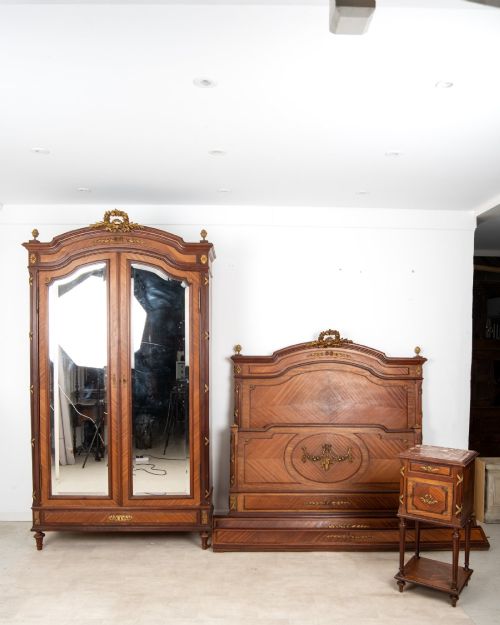
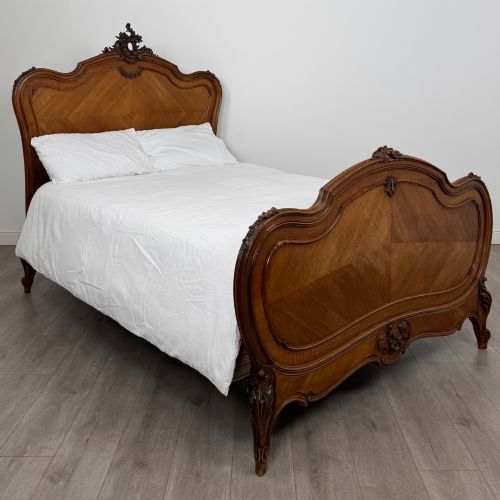
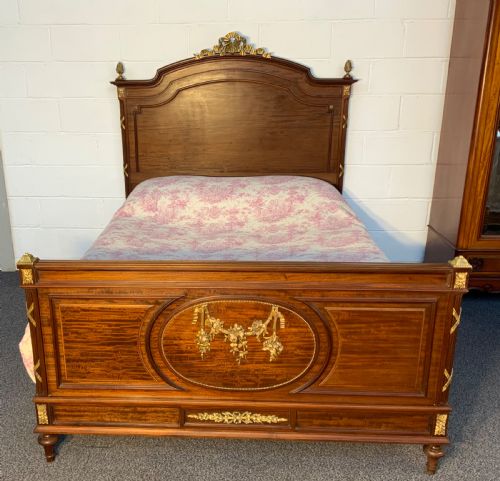
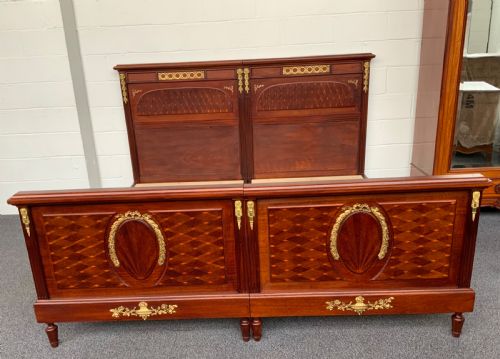
A french parquetry bed is a substantial timber frame featuring geometric wood veneer patterns on headboards, footboards, and side rails. These pieces emerge primarily from the nineteenth and early twentieth centuries, spanning periods from Victorian and Edwardian decades back through earlier stylistic revivals. The form appears in double, king, and emperor sizes, occasionally accompanied by matching bedside cabinets or larger bedroom suites.
The aesthetic draws heavily on Louis XVI, Louis XV, and Empire revivals, alongside French provincial and chateau interpretations. Buyers encounter these beds in rich dark woods as well as lighter fruitwood tones, often accented with gilt bronze mounts or brass detailing. The construction accommodates standard modern mattress sizes while retaining traditional proportions and decorative woodwork.
Materials and Construction
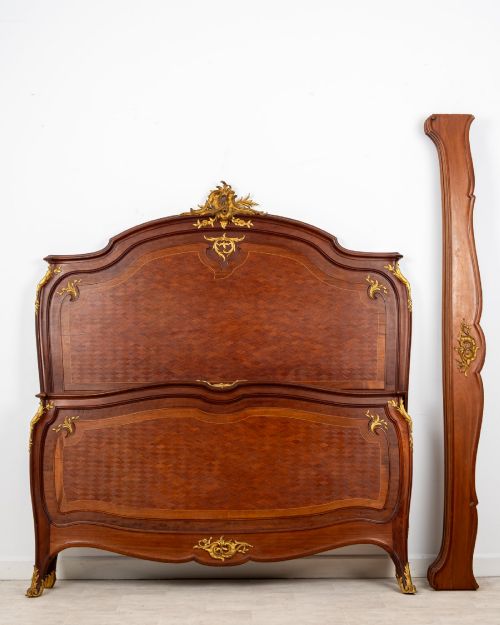
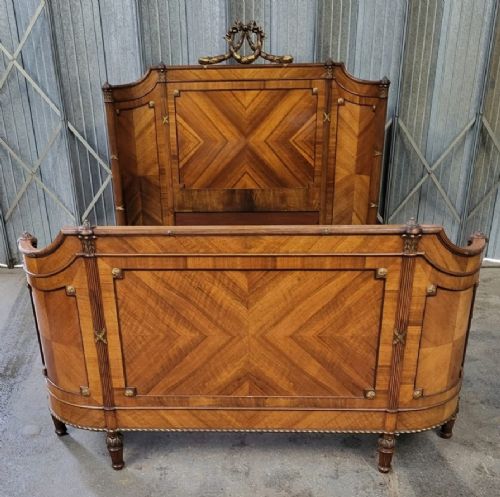
Cabinetmakers constructed these frames using solid secondary timbers as a carcase for decorative veneers including kingwood, walnut, mahogany, fruitwood, and tulipwood. Artisans meticulously cut small wood pieces into geometric tiles to form the parquetry patterns across the flat surfaces of the bed panels. Quarter veneering and marquetry techniques also appear, creating symmetrical grain patterns and floral motifs across the headboards and footboards.
Metal ornamentation played a major role in the assembly, utilising ormolu and cast brass mounts to highlight the structural corners and framing elements. Joinery relied on traditional heavy bed bolts and tenons to ensure the large wooden frames could be dismantled and reassembled securely. Parcel gilt highlights and hand-painted floral panels occasionally complete the decorative surface treatment.
The recorded periods span the nineteenth century through the early decades of the twentieth century.
Evaluating Quality
Quality rests primarily in the precision of the parquetry layout and the selection of the timber veneers. Superior examples display tight, symmetrical geometric patterns executed in desirable exotic woods like kingwood and rosewood without lifting or major shrinkage. The integration of the decorative wood panels with the structural frame marks the difference between standard production and exceptional cabinet work.
The standard of metalwork further separates pieces across the range, with finely chased ormolu mounts indicating higher workshop standards than simple stamped brass. Carved wooden elements, where present, show crisp detailing and depth rather than soft, machine-milled edges. Cohesion between the bedstead and any matching bedside cabinets or suites also elevates the overall standing of the piece.
Gillows
The French Parquetry Bed Glossary
- Parquetry
- A geometric mosaic of wood veneers used for decorative floors and furniture surfaces. It relies on precise angles to form repeating patterns.
- Ormolu
- Gilded bronze applied to furniture mounts and decorative hardware. This technique was widely utilised during neoclassical revivals.
- Veneer
- A thin slice of figured wood applied over a stable secondary timber base. This method allows artisans to display decorative grain without structural warping.
- Louis XVI Style
- A neoclassical design movement characterised by straight lines, symmetry, and classical motifs. It strongly influences many nineteenth-century bed frames.
French Parquetry Bed: Frequently Asked Questions
Will a french parquetry bed fit modern mattresses?
Most surviving bedframes accommodate standard mattress dimensions such as double, king, or emperor sizes, though internal rails occasionally require minor adjustment for modern slats.
Buyers should verify the exact internal length and width dimensions provided in individual listings before sourcing a mattress.
How do I care for antique parquetry surfaces?
Maintenance requires regular dusting with a soft, dry cloth and the occasional application of a quality microcrystalline wax to nourish the timber veneer.
Avoid placing these beds near direct heat sources or strong sunlight, which can dry out the old timbers and cause the veneer tiles to lift.
Are these beds easy to assemble?
These large bedsteads typically dismantle into four primary components consisting of the headboard, footboard, and two side rails. Assembly relies on heavy internal metal bed bolts that secure the frame corners together with a standard spanner.
Two people are generally required for setup due to the substantial weight of solid hardwood and panel construction.
How do I identify the period of a bed?
Dating relies on examining the underlying construction timbers, the style of the brass or ormolu mounts, and the specific revival aesthetic of the carved woodwork. Nineteenth-century examples often feature hand-cut joinery elements and older secondary woods behind the decorative veneers.
Comparing the stylistic cues to documented periods like Louis XVI revival or nineteenth-century Victorian helps narrow down the decade of manufacture.