
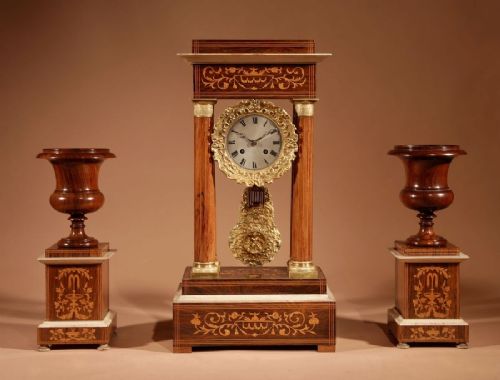
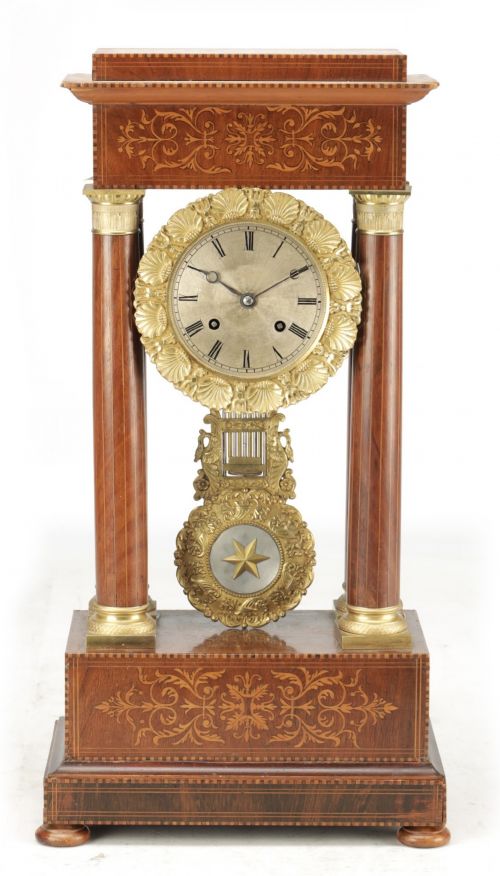
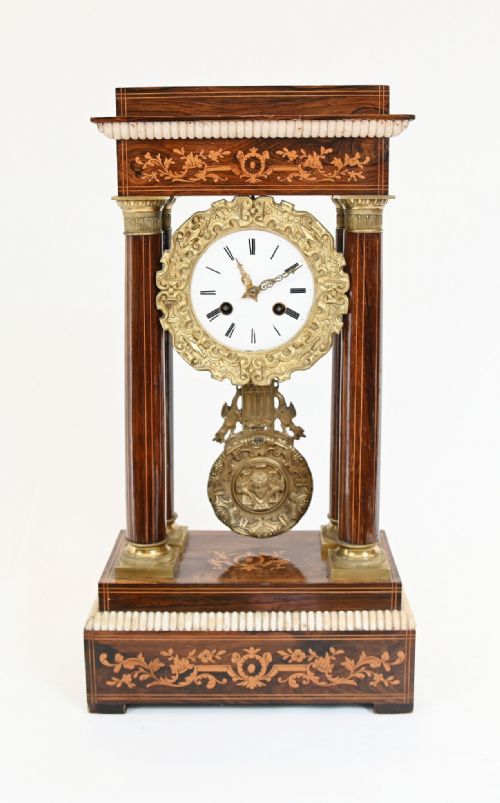


French Ormolu Column Clock
A french ormolu column clock brings neoclassical architectural proportion to a mantelpiece, offering striking gilt metalwork alongside precision horology.
Materials and construction methods
The structural framework relies heavily on timber columns or marble pillars supporting a horizontal entablature above the clock movement.
Gilding applied to bronze or brass components creates the bright golden sheen characteristic of ormolu, while dial faces commonly utilise enamel, glass, or cut crystal details.
Distinctions in quality and execution
The fineness of the cast brass or gilt bronze enrichment determines the visual depth of the architectural mounts, separating standard production from exceptional pieces.
Cabinetwork precision, particularly in rosewood, lemon wood inlay, and marquetry on the portico base, indicates the workshop skill behind the clock.
The integrity of the dial, whether enamel or silvered, along with the retention of original gilding and matched garnitures, elevates a piece.
Some nineteenth-century portico clocks hid their pendulums swinging quietly between marble pillars just to mesmerize Victorian guests.
Breguet·Benson
The French Ormolu Column Clock Glossary
- Ormolu
- A gilded bronze finish achieved through the application of a mercury-gold amalgam to cast metal. This historical technique produces a deep, durable metallic lustre.
- Portico clock
- A mantel clock designed with four or more architectural columns supporting the top case. The pendulum typically swings visibly between these upright pillars.
- Garniture
- A set comprising a central clock accompanied by matching decorative side pieces such as candelabra or vases. These arrangements traditionally decorated mantelpieces in pairs or trios.
- Fusee
- A conical pulley used within clock movements to maintain equal driving force as the mainspring unwinds. It ensures consistent timekeeping across the winding cycle.
French Ormolu Column Clock: Frequently Asked Questions
How do I wind a portico clock safely?
Insert the key gently into the winding arbor and turn it steadily until resistance is felt, avoiding any sudden movements that might strain the mainspring.
Ensure you do not overwind the mechanism, as this can damage the internal tension components and disrupt the clock's timing accuracy.
Where should I place my column clock?
Select a stable, level surface such as a mantelpiece or heavy sideboard away from direct sunlight, excessive heat sources, and damp draughts.
A solid foundation is essential because uneven surfaces can cause the pendulum to strike the inside of the case and stop the movement.
How do I distinguish Charles X from Victorian examples?
Charles X pieces usually date from the 1820s and 1830s, displaying crisp neoclassical restraint, delicate ormolu mounts, and lighter timbers like lemon wood inlay.
Victorian interpretations from the 1870s and 1880s often incorporate heavier marble bases, richer rosewood veneers, or varied Revival styles influenced by later tastes.
What is a mystery clock?
A mystery clock is an uncommon horological design where the connection between the movement and the hands appears concealed or unexplained.
These pieces showcase ingenious mechanical craftsmanship that puzzles the observer by making hands move without obvious gear trains.