
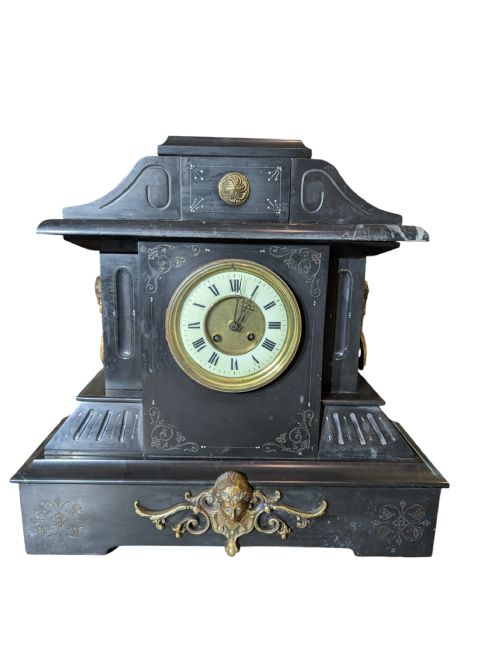


Classical Architectural Mantle Clock
A classical architectural mantle clock brings monumental stone columns and bronze porticos right onto your mantelpiece.
Classical Architectural Mantle Clock
A classical architectural mantle clock takes its design cues from ancient temples and grand public buildings, scaled down for domestic interiors. When exploring a classical architectural mantle clock on this page, you will encounter substantial case designs spanning the Victorian era and the nineteenth century.
The dominant forms are heavy structural pieces created from black slate and marble, alongside occasional portico designs in wood or bronze. These items reflect a Victorian fascination with classical antiquity, often combining severe architectural facades with precise mechanical movements.
How they were made
Maker workshops utilised dense stones like black marble and slate, cutting and polishing massive blocks to simulate monumental masonry. Workshops also employed gilt bronze and patinated bronze for decorative columns, bezels, and dial surrounds.
Movements were typically eight-day mechanical units, sometimes sourced from Paris makers and housed within substantial stone or wood housings. Dials were frequently silvered or enamelled, protected behind heavy bevelled glass doors.
The selection spans the Victorian period, French Empire styles, and Neoclassical architectural designs.
What varies in quality
Quality rests heavily on the architectural ambition of the stone cutting and the crispness of any bronze mounts. Pieces featuring disciplined proportions and integrated garnitures stand apart from simpler domestic timepieces.
The prestige of the movement maker also elevates a piece, particularly when signed by known Parisian or London workshops. Heavier marble cases with intricate inlaid detailing represent the upper tier of surviving examples.
Philippes Paris·Baby and Jannings·Benson Ludgate Hill London
The Classical Architectural Mantle Clock Glossary
- Portico Clock
- A clock featuring a distinct frame supported by architectural columns, resembling a classic temple portico. These often utilise mahogany or marble cases with a suspended pendulum visible through the central opening.
- Mantel Clock
- A clock designed to sit on a shelf or mantelpiece above a fireplace. They are primarily driven by spring or weight movements enclosed within decorative housings.
- Black Slate
- A dense metamorphic rock heavily utilised by nineteenth-century clockmakers to imitate grand Egyptian or classical black marble. It takes a high polish and provides a stable, weighty foundation for architectural facades.
- Gilt Bronze
- Bronze metal coated with a thin layer of gold using traditional fire-gilding or electroplating methods. This finish brings a rich metallic lustre to decorative mounts and architectural details.
- Eight Day Movement
- A mechanical clock movement that requires winding approximately once a week. This denotes a reliable standard of domestic horology found in better quality nineteenth-century pieces.
Classical Architectural Mantle Clock: Frequently Asked Questions
How do I wind an eight day movement?
Use the provided key to turn the winding arbors on the dial face until you feel firm resistance. Take care not to overwind the mainspring.
Most nineteenth-century mechanical clocks require a steady, gentle hand to maintain proper tension without damaging the internal gears.
Where should I place a heavy marble clock?
Position the piece on a sturdy, level surface such as a heavy sideboard or a reinforced mantelpiece. The considerable weight of marble and slate requires stable structural support.
Avoid placing these timepieces near direct heat sources or damp exterior walls to protect the stone and the internal metal movement.
How do I date a Victorian architectural clock?
Examine the style of the numerals, the materials used in the case construction, and any maker signatures on the dial or backplate. Victorian pieces frequently employ black slate, marble, and classical revival motifs.
Signatures from known London retailers or Paris makers can often help narrow down the exact decade of production.
Why do some clocks have matching garnitures?
Matching garnitures, such as side urns or vases, were created to flank the central clock and complete a balanced decorative scheme on a mantel. They share the same marble, slate, or bronze materials.
Sets provide a unified neoclassical aesthetic designed to dominate the focal point of a formal Victorian reception room.