




French Marquetry Timepiece
A french marquetry timepiece brings together fine timber and precision mechanics, offering both functional timekeeping and striking nineteenth-century cabinet work.
French Marquetry Timepiece
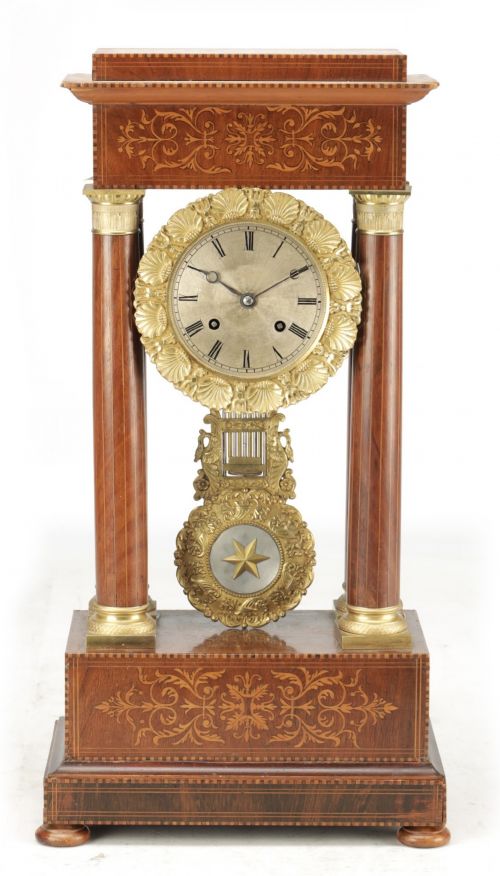
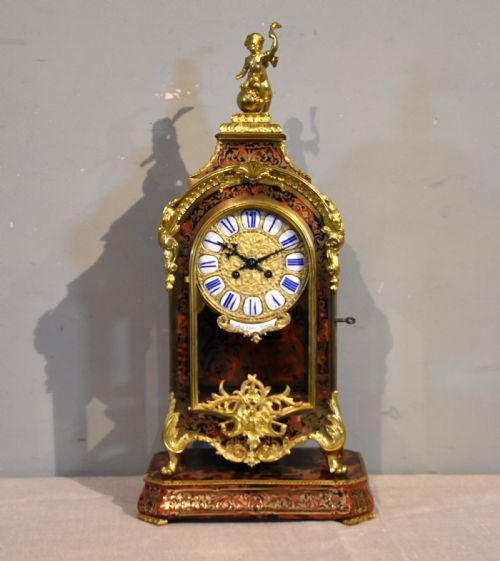
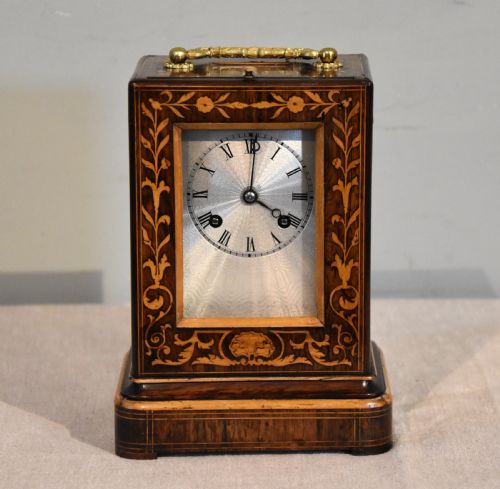
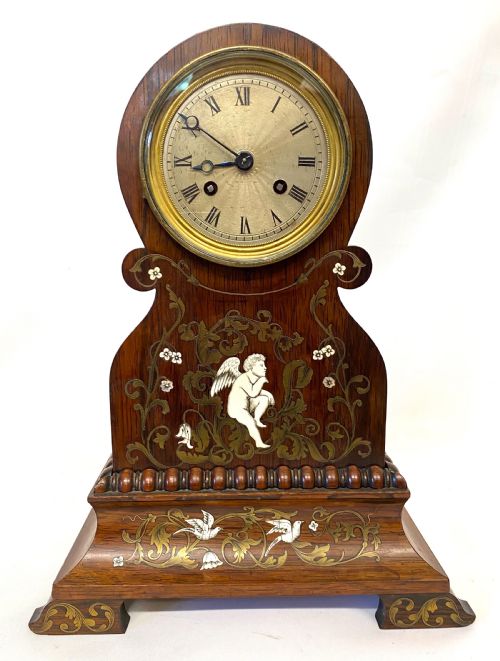
A french marquetry timepiece is a decorative clock housed in a wooden case ornamented with detailed wood veneers, tortoise shell, or brass inlay. These objects primarily take the form of mantel clocks, portico clocks, and wall clocks designed to sit in prominent rooms. Most examples seen here date from the nineteenth century, spanning periods such as the Victorian era, French Restoration, and Napoleon III.
The assortment on this page relies heavily on rosewood cases enriched with satinwood, lemon wood, and tortoiseshell veneers. Makers and makers' workshops incorporated contrasting timbers and metal mounts to create ornate surface patterns that catch the light. Buyers encounter both classic Parisian Boulle work featuring cut brass and simpler inlaid rosewood designs.
Mantel clocks form the majority of the available shapes, alongside architectural portico clocks and occasional wall-mounted formats. These pieces reflect revival styles including Louis XV, Rococo, and Empire, demonstrating the nineteenth-century appetite for historical design. Each variation uses specific decorative vocabularies to establish its visual presence.
Distinctions in quality
The standard of a french marquetry timepiece depends on the precision of the veneer work and the crispness of the cast ormolu mounts. Finer examples display tight alignment between contrasting woods and metals, maintaining smooth transitions across curved surfaces. The depth of the engraving on brass inlay and the quality of the enamel dial further separate standard production from superior workshop output.
Signed movements by known makers elevate the standing of a piece, linking the decorative case with documented horological skill. The harmony between the architectural proportions of the portico or mantel case and the intricacy of the surface decoration dictates the overall impact of the clock.
Periods span the Victorian era, the nineteenth century, and specific years from 1800 to 1890.
Henry Marc·Dumont·Malecot of Paris
The French Marquetry Timepiece Glossary
- Marquetry
- The art of applying fitted pieces of veneer to a structure to form decorative patterns and pictures. This technique uses contrasting woods and materials like brass to create surface ornamentation.
- Ormolu
- Gilded bronze applied to furniture and clock cases for decorative effect. The metal is cast and chased to produce ornate mounts and feet.
- Portico clock
- A mantel clock featuring an architectural case supported by columns. This style gained popularity during the nineteenth century.
- Boulle
- A form of marquetry developed in France using tortoiseshell and brass inlay. Pieces decorated in this manner exhibit contrasting dark shells and shining metal patterns.
- Timepiece
- A clock that indicates the time without a striking mechanism. Many domestic examples operate solely to show hours and minutes.
French Marquetry Timepiece: Frequently Asked Questions
How do I identify Boulle work?
Boulle work consists of intricate patterns formed from cut brass and tortoiseshell inlaid into a dark wooden background. The technique creates a striking contrast between the polished metal and the mottled shell.
Master craftsmen developed this method in France, and nineteenth-century clockmakers revived the style for mantel clocks.
Where should I place a mantel clock?
Mantel clocks suit stable horizontal surfaces such as fireplace mantels, sideboards, or console tables where they can be viewed easily. They need a level foundation to ensure the mechanical movement operates correctly.
Keep these clocks away from direct sunlight and damp environments to protect the wooden veneers and brass components.
What is the difference between a timepiece and a clock?
In horological terms, a timepiece is a clock that tells the time without incorporating a striking mechanism for hours or quarters. It focuses purely on the visual display of the hours and minutes.
Many decorative nineteenth-century examples were built as simple timepieces to sit quietly in a drawing room or office.