
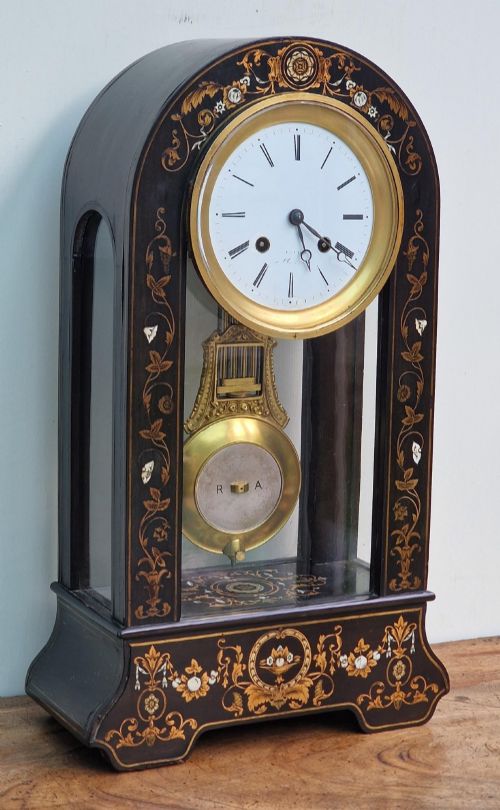
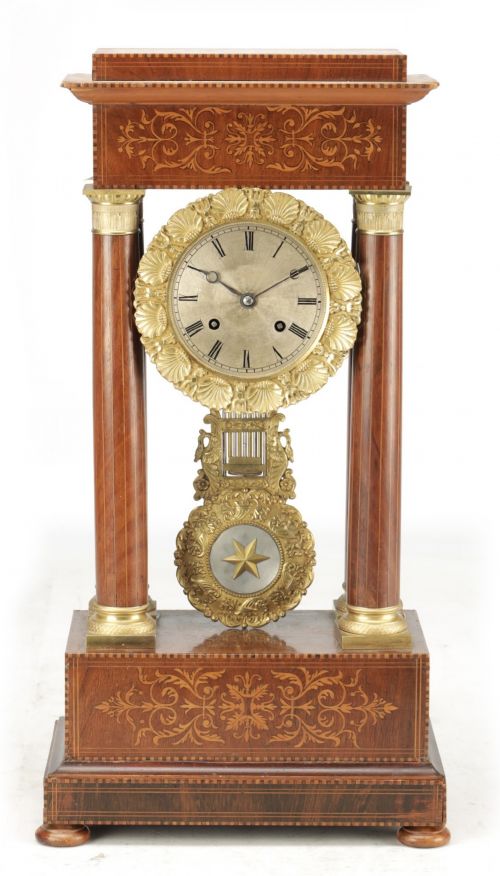


Floral Inlay Mantel Clock
These floral inlay mantel clock pieces combine timekeeping with delicate floral marquetry, offering a functional centrepiece for the mantel.
Floral Inlay Mantel Clock
A floral inlay mantel clock sits on a shelf or fireplace mantel, combining a mechanical timepiece with ornamental woodwork. These domestic clocks range from compact Edwardian pieces to ornate nineteenth-century French models.
Most examples on this page date from the nineteenth century into the Edwardian period, often reflecting French or British cabinet-making traditions. Buyers encounter shapes ranging from traditional arched wooden cases to architectural portico designs.
Materials such as mahogany, rosewood, and satinwood provide the primary structure for these clocks, while marquetry inlay introduces floral motifs in contrasting timbers. Brass bezels, enamel dials, and glass covers complete the typical construction.
Materials and construction methods
Cabinet-makers constructed the wooden cases using dense hardwoods like mahogany and rosewood, applying contrasting boxwood or satinwood for fine detail work. Marquetry cutters sliced thin veneers to assemble intricate floral patterns directly into the wood surface.
Clockmakers fitted mechanical movements behind glass-covered enamel dials, frequently housing them within polished wooden or gilt bronze housings. Brass feet, bezels, and cast ornaments added structural definition and metallic contrast to the timber.
Some mantel clocks included a thermometer alongside the dial, ensuring you knew the temperature while ignoring the time.
Distinguishing quality in craftsmanship
The precision of the floral marquetry dictates much of the visual value, where tighter joints and varied timber tones separate superior work from simpler decoration. Finely cut veneers display natural grain variation that creates depth within the floral petals and stems.
The sophistication of the clock movement and the casting quality of the brass fittings also separate standard items from finer workshop output. Cases featuring integrated thermometers or signed dials by known makers represent the upper tier of surviving examples.
Henry Marc·Savory and Fils A Paris·Malecot of Paris
The Floral Inlay Mantel Clock Glossary
- Marquetry inlay
- The art of applying small pieces of veneer to a structure to form decorative patterns. This technique creates the floral motifs seen across the wooden cases.
- Portico clock
- A monumental clock design featuring supporting columns flanking the central dial. This architectural style emerged strongly during the nineteenth century.
- Enamel dial
- A metal dial face coated with fused glass powder to create a smooth, white surface. Numerals are typically painted by hand onto this glossy finish.
- Bezel
- The metal ring that holds the glass cover in front of the clock dial. It often hinges open to allow hand-setting.
Floral Inlay Mantel Clock: Frequently Asked Questions
What periods do these clocks cover?
These clocks span the nineteenth century and the Edwardian era, incorporating periods such as the Victorian age and the Art Nouveau movement.
Craftsmen working across France and Britain produced these mantel pieces between eighteen-sixty and nineteen-hundred.
How do I wind the movement?
Mechanical movements require a matching winding key inserted into arbors on the enamel dial face. Turning the key tensions the internal springs.
Care must be taken not to over-wind the clock to ensure the mechanism operates smoothly.
What woods are used for the cases?
Cabinet-makers utilised dense timbers like rosewood and mahogany for the primary case structures. Lighter woods such as satinwood and boxwood provided contrast for the floral marquetry.
These natural materials were polished to highlight the grain behind the glass and brass fittings.
Are all these clocks French?
The selection includes both French and British pieces from the nineteenth and early twentieth centuries. French workshops produced many of the rosewood and portico designs.
British cabinet-makers also contributed mahogany and inlaid Edwardian mantel clocks to this tradition.