
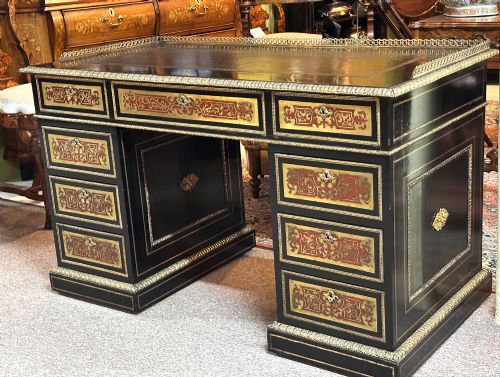
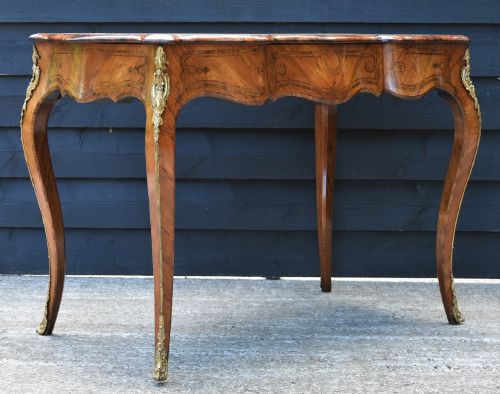
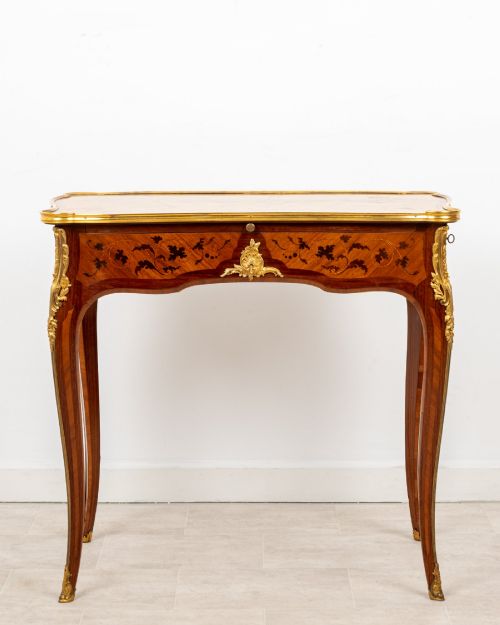
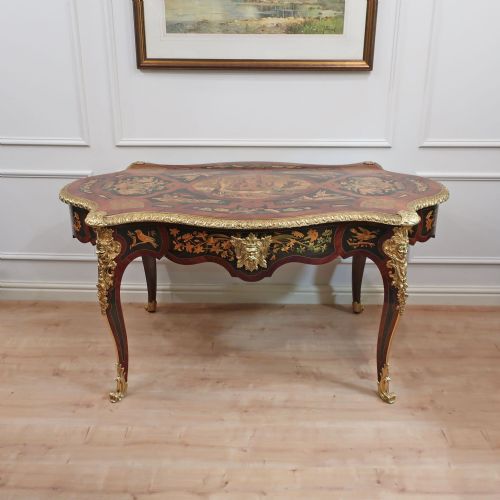
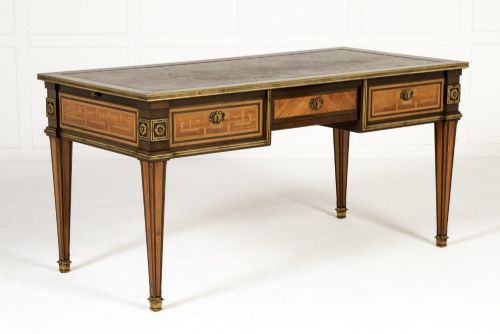


French Marquetry Bureau Plat
A French marquetry bureau plat brings sophisticated cabinet work and tailored writing surfaces into a room.
French Marquetry Bureau Plat
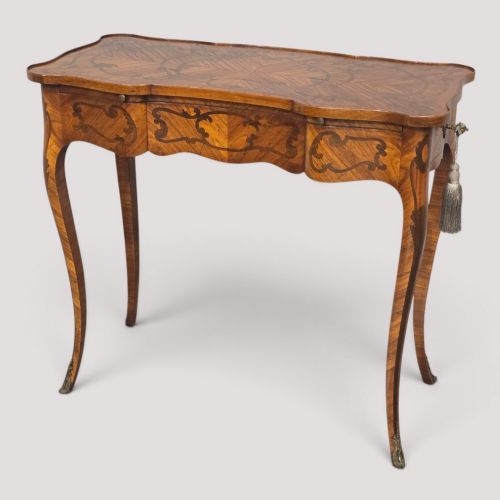
A French marquetry bureau plat functions as a freestanding writing table or centre desk designed for placement in the middle of a room rather than against a wall. These tables typically feature a finished back and polished surfaces on all sides.
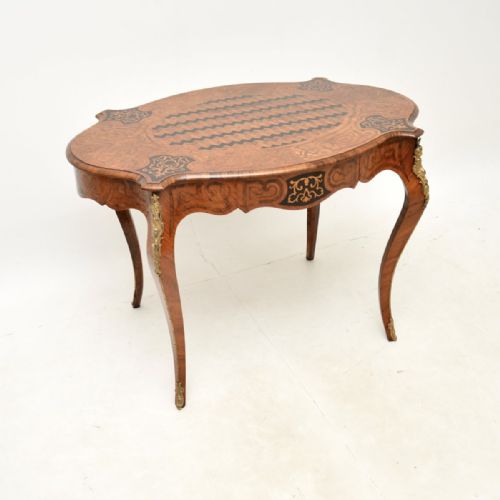
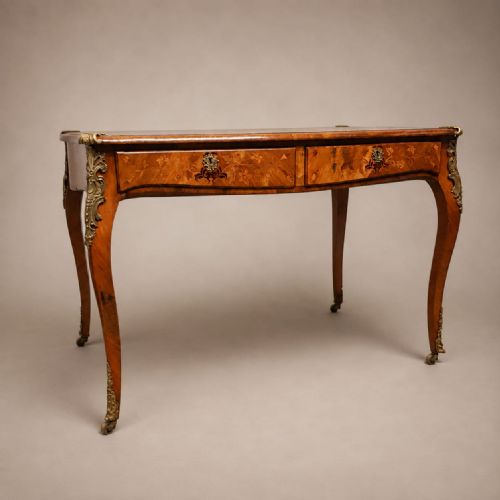
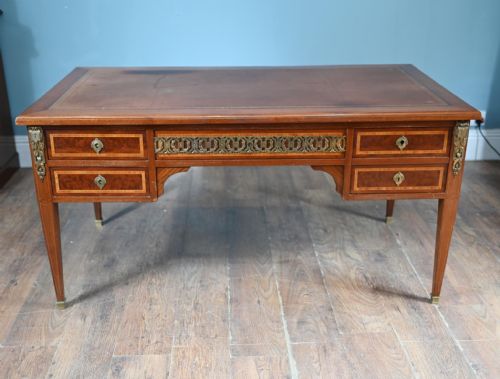
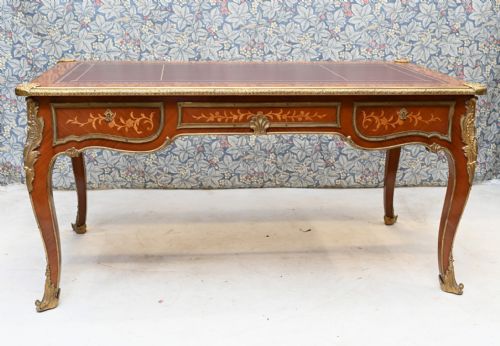
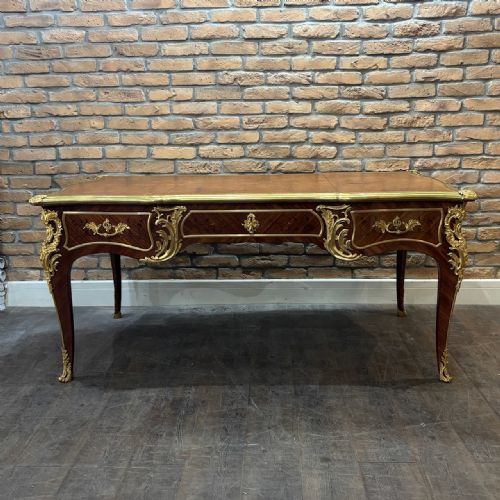
The most common examples on this page follow Louis XV and Louis XVI revival styles, characterised by serpentine contours or straight neoclassical lines. Makers often utilised walnut, kingwood, rosewood, and tulipwood veneers laid in elaborate floral or geometric patterns.
How They Were Made
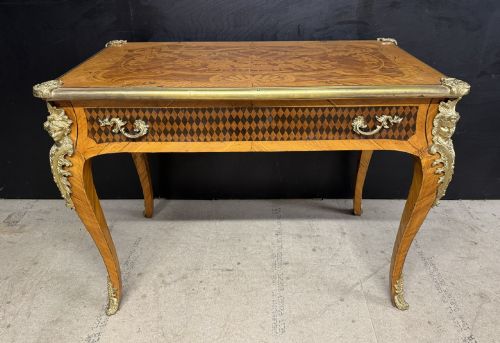
Cabinet makers constructed these desks using hardwood carcases overlaid with fine veneers of kingwood, walnut, rosewood, and satinwood, cut and fitted together to form intricate marquetry pictures. Brass and tortoiseshell inlay also appear in Boulle work examples.
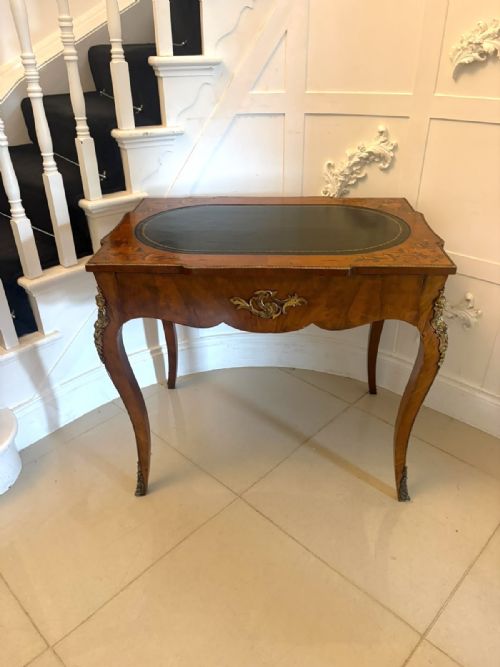
Casters, corner mounts, sabots, and drawer pulls cast in ormolu or gilt bronze provide structural reinforcement and decorative contrast to the timber. Leather inserts inset into the writing surface supply a smooth plane for correspondence.
Listings span the nineteenth and twentieth centuries, featuring walnut, kingwood, rosewood, satinwood, and calamander alongside ormolu mounts and leather writing surfaces.
What Varies in Quality
The precision and complexity of the marquetry cutting define the upper tier of execution, where varied timber grains depict naturalistic flowers or scrolling foliage without gaps or heavy filler. Lesser pieces rely on repetitive geometric bands with minimal hand-shading.
The weight, crispness, and hand-chasing of the ormolu mounts indicate the workshop standard. Well-cast mounts fit snugly against the curved timber contours, whereas commercial productions show softer detail and simpler finishing.
Durand·Francoise Linke·Maison Millet
The French Marquetry Bureau Plat Glossary
- Bureau plat
- A freestanding writing table fitted with one or more drawers in the frieze. These tables became popular during the eighteenth century and remain the standard form for this search.
- Marquetry
- The art of applying small pieces of veneer to a structure to form decorative patterns or pictorial scenes. Makers select woods of contrasting natural colours to achieve depth.
- Ormolu
- Gilt bronze mounts applied to furniture edges and feet. The technique involves treating brass or bronze with a gold amalgam before firing.
- Boulle work
- Marquetry composed of tortoiseshell and brass inlay developed in France. André-Charles Boulle perfected this method during the reign of Louis XIV.
- Kingwood
- A dense, heavy timber featuring rich dark brown colouring with lighter golden streaks. It frequently appears in eighteenth-century and nineteenth-century French revival furniture.
French Marquetry Bureau Plat: Frequently Asked Questions
Can I use a bureau plat as a modern desk?
These tables provide a functional surface for writing and laptop use, provided the writing height matches your chair. Most historic examples offer shallow frieze drawers rather than deep modern filing space.
Protecting the leather insert with a desk blotter prevents ink stains and surface scratches during daily work. Placing the desk away from direct sunlight preserves the natural colour of the kingwood or walnut veneers.
How do I distinguish Louis XV from Louis XVI style?
Louis XV pieces display sweeping serpentine curves, cabriole legs, and asymmetrical rococo mounts. The overall silhouette appears organic and flowing.
Louis XVI pieces exhibit restrained rectilinear geometry, tapered fluted legs, and neoclassical symmetry. Ormolu mounts on these tables often incorporate ribbon twists and acanthus leaves.
How should I care for nineteenth-century veneer?
Maintain stable room humidity and avoid placing the desk near direct heat sources or air vents. Extreme temperature shifts cause timber to expand and veneers to lift.
Apply a microcrystalline wax periodically to nourish the timber and protect the polished finish. Dust the marquetry gently with a soft dry cloth.