
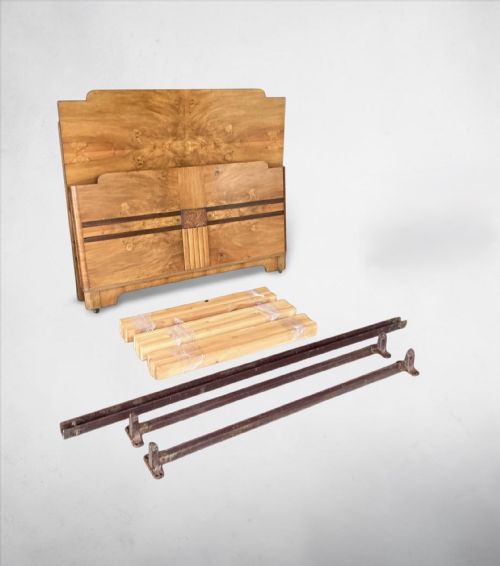


French Marquetry Bedstead
A French marquetry bedstead brings patterned wood veneers and classic continental scale to a bedroom.
French Marquetry Bedstead
A french marquetry bedstead is a substantial sleeping frame decorated with detailed wood veneer patterns, taking forms such as double and king sizes. Buyers encounter examples originating across several decades, spanning the nineteenth century through the art deco period.
The selection on this page centres on beds and bedsteads, occasionally accompanied by matching bedside cabinets or marble top nightstands. These pieces range from early nineteenth century antiques to twentieth century revivals of Louis styles.
How they were made
Cabinetmakers constructed these frames using solid woods such as mahogany, walnut, and fruitwood, applying fine veneers to create decorative surfaces. Ormolu mounts and marble elements appear alongside wood veneers to provide contrast and structure.
The decorative marquetry relies on precise cutting and fitting of contrasting timbers, including burr walnut and fruitwood veneers. Steel components also support the structural integrity of these large sleeping frames.
Some beds come equipped with an ensuite marble top nightstand for midnight water.
What varies in quality
Quality rests in the intricacy of the wood veneers and the precision of the marquetry patterns across the headboard and footboard. Pieces featuring coordinated bedside cabinets or ormolu mounts demonstrate a higher level of original design ambition.
The choice of primary timber, from plain mahogany to burr walnut, dictates the visual weight and finish of the bedstead. Finer examples display seamless integration between the structural frame and the decorative surface work.
Louis Majorelle
The French Marquetry Bedstead Glossary
- Marquetry
- The art of applying decorative pieces of veneer to a structure to form intricate designs. This technique defines the visual character of the bedstead surface.
- Ormolu
- Gilded bronze mounts applied for decorative effect on furniture. These metallic details accent the wooden frames.
- Burr walnut
- Wood taken from a walnut tree growth, yielding swirling grain patterns. Cabinetmakers utilise this timber for high status veneer work.
- Fruitwood
- Dense timber derived from fruit bearing trees, often used in contrasting marquetry details. It offers a smooth texture and warm tone.
- Louis XVI revival
- A nineteenth century design movement reviving eighteenth century French classical motifs. Pieces in this style feature restrained straight lines and classical proportions.
French Marquetry Bedstead: Frequently Asked Questions
What sizes are available?
These beds appear primarily in double and king sizes to suit modern bedrooms.
Dimensions vary by period, so check specific listings for exact mattress measurements.
How do I identify the style?
Styles range from nineteenth century revivals to twentieth century art deco and art nouveau forms.
Look at the veneer patterns and mount details to determine the design period.
Are bedside cabinets included?
Some listings offer matching bedside cabinets or marble top nightstands alongside the bedstead.
Check individual descriptions to see if companion pieces form part of the suite.
What woods were used?
Construction relies on timbers such as walnut, mahogany, and fruitwood.
Burr walnut veneers and ormolu mounts provide the primary decorative elements.