
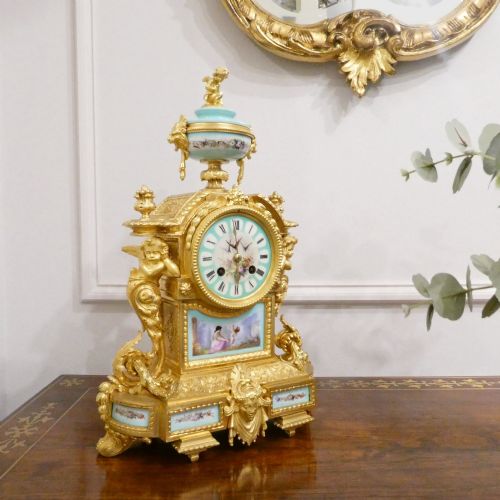
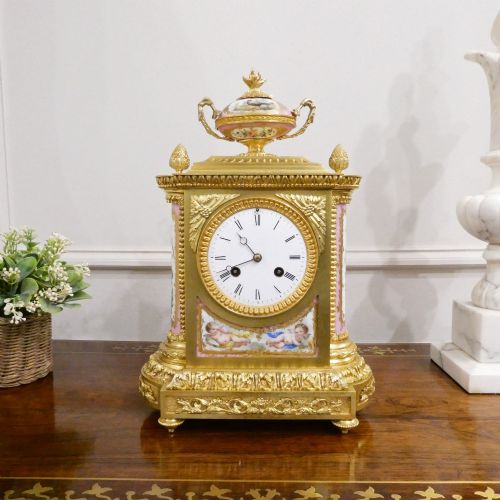
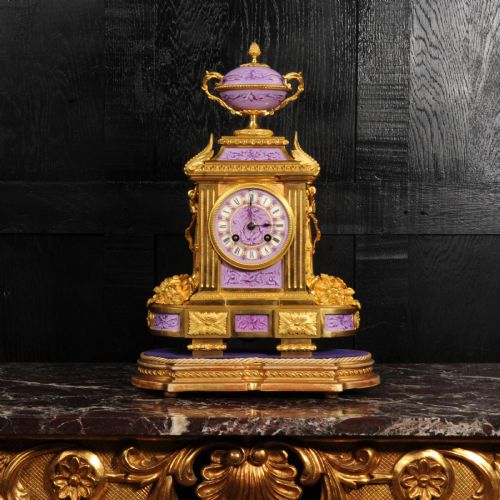
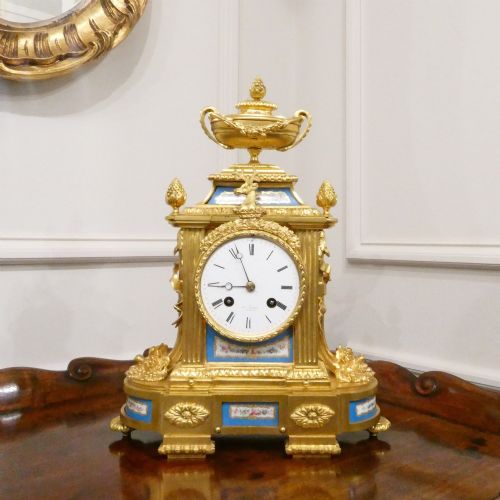


French Louis XVI Style Clock
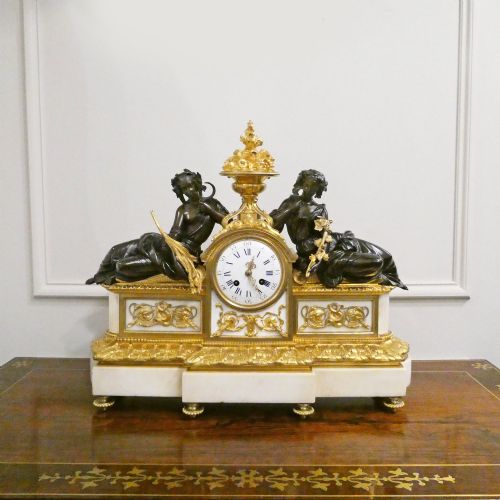
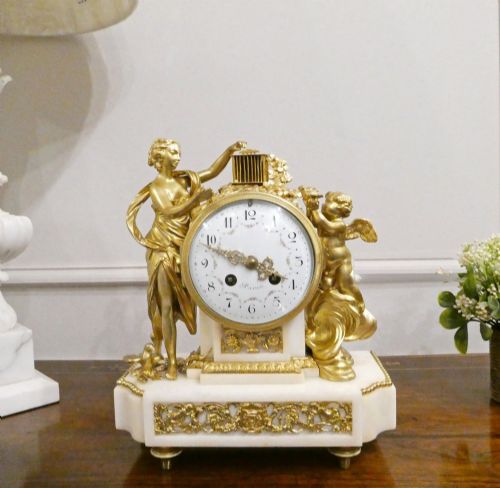
When you search for french louis xvi style clock, you are looking at nineteenth-century decorative timepieces shaped by classical symmetry and ornate gilt mounts.
French Louis XVI Style Clock
A french louis xvi style clock typically takes the form of a mantel clock, wall clock, or desk clock, frequently accompanied by matching garniture sets. These pieces date predominantly from the nineteenth century, including specific decades such as the eighteen-eighties, eighteen-sixties, and Victorian era.
The dominant aesthetic draws heavily on Louis XVI revivalism, translating eighteenth-century classical restraint into nineteenth-century opulence. Buyers encounter objects ranging from substantial marble cartel wall clocks to delicate porcelain-mounted mantel pieces designed to anchor a room.
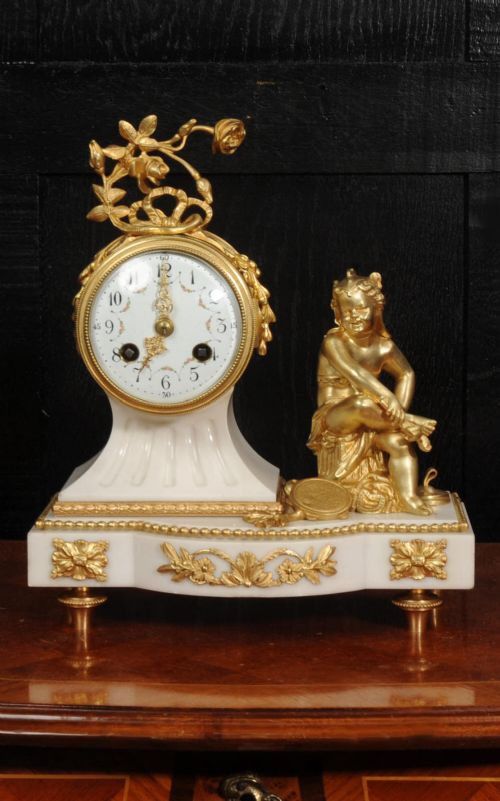
Most examples originate from French workshops and retail establishments, reflecting continental horological traditions of the period. Their forms incorporate architectural columns, urns, and figural elements such as doves or cherubs.
How they were made
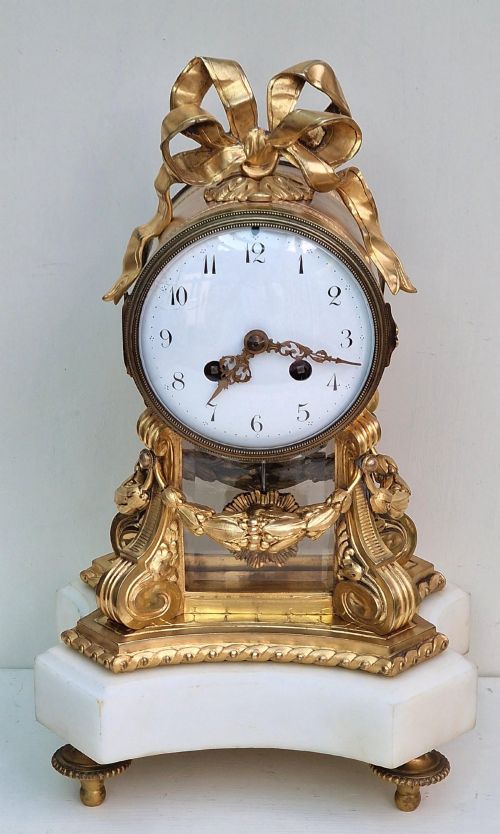
The construction relies fundamentally upon cast gilt bronze or ormolu, combined with natural stones such as white marble, rouge marble, and sienna marble. These metallic mounts are chased and gilded to produce a bright finish that contrasts with the stone bodies.
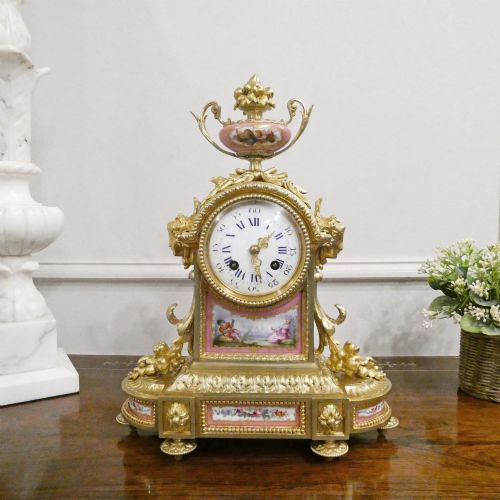
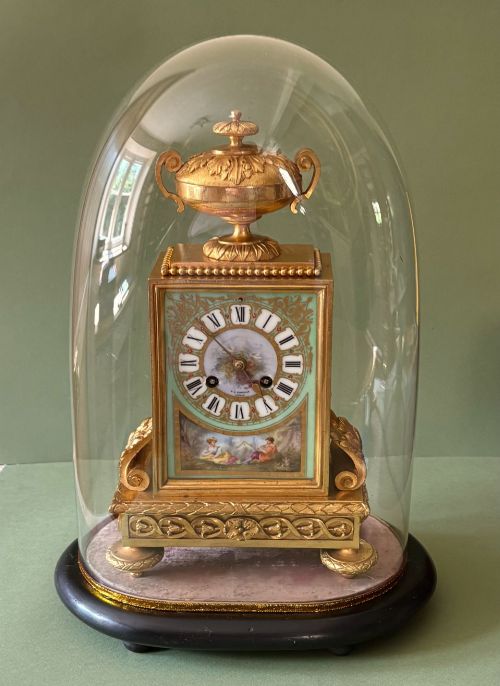
Dials and decorative panels frequently utilise porcelain, often painted with enamel numerals and floral motifs, sometimes associated with Sèvres factories. Brass mechanisms power the eight-day movements housed within these heavy metallic and lithic enclosures.
Listings feature eighteenth-century revival styles executed in gilt bronze, ormolu, various marbles, and Sèvres porcelain.
What varies in quality
The distinction between standard production and exceptional craftsmanship rests in the crispness of the bronze chasing and the depth of the fire-gilding. Superior examples display sharply defined acanthus leaves and classical motifs rather than soft, cast-over surfaces.
Integration of materials dictates upper-tier status, where porcelain plaques match the precision of the dial and marble bases are selected for their rich veining. The involvement of recognised clockmakers and retailers adds historical weight to the physical execution.
Jean-Baptiste Delettrez·Achille Brocot·Henry Marc·Japy Freres·Vincenti·Le Roy Et Fils·H Luppens Paris·Hausburg·Samuel Marti·Henri Picard
The French Louis XVI Style Clock Glossary
- Ormolu
- Gilded bronze produced by applying an amalgam of gold and mercury to a bronze base and heating it. This technique creates a durable, warm metallic lustre characteristic of fine nineteenth-century clocks.
- Garniture set
- A clock accompanied by matching side ornaments such as vases or candelabra designed to be displayed together on a mantelpiece. These sets unify the decorative scheme of a room.
- Cartel clock
- A wall-mounted clock housed in an ornate case made of gilt bronze or wood. They display symmetrical classical scrolls and foliage typical of revival aesthetics.
- Lyre clock
- A timepiece shaped in the form of a classical musical lyre, often constructed from porcelain and gilt bronze mounts. The pendulum is frequently visible through an aperture in the centre of the instrument.
- Enamel dial
- A clock face made by fusing powdered glass onto a metal substrate at high temperatures. This creates a smooth, glossy surface resistant to discolouration over time.
French Louis XVI Style Clock: Frequently Asked Questions
How do I wind an eight day clock?
Insert the winding key into the appropriate arbour on the dial face and turn it gently until resistance is felt. Care must be taken not to overwind the mainspring.
Most nineteenth-century movements require this attention roughly once a week to maintain accurate timekeeping.
Where should I place a marble mantel clock?
Position the clock on a stable, level surface such as a fireplace mantel or a heavy sideboard. The substantial weight of marble and bronze requires robust support.
Keep the piece away from direct sunlight and damp environments to protect the gilt surfaces and enamel dials.
What is a clock garniture?
A clock garniture consists of the central timepiece flanked by matching decorative objects, usually vases, urns, or candelabra. These companion pieces complete a balanced decorative arrangement.
They share the same materials and stylistic motifs as the main clock body.
How do I identify a Louis XVI style clock?
Look for classical architectural elements, straight lines, symmetry, and motifs such as ribbons, urns, and fluted columns. These details distinguish the style from the more asymmetrical rococo revival.
The use of gilt bronze mounts paired with white or coloured marble is also characteristic.