

French Leather Desk
When you search for a french leather desk, you enter a world of nineteenth-century bureau plats and partner tables defined by supple leather inserts and gilt mounts.
French Leather Desk
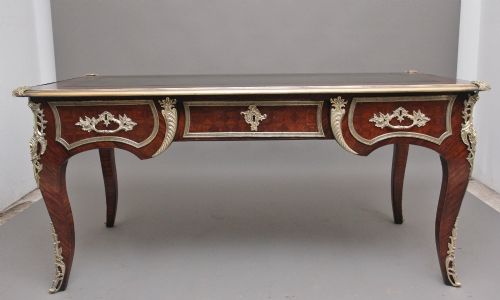
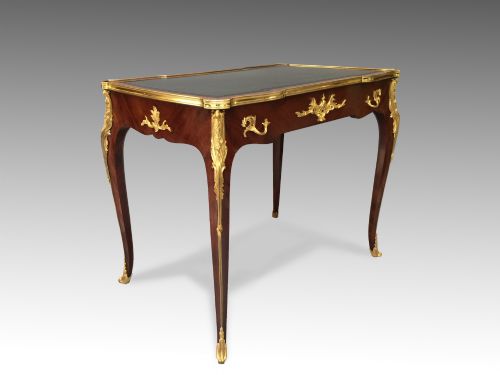
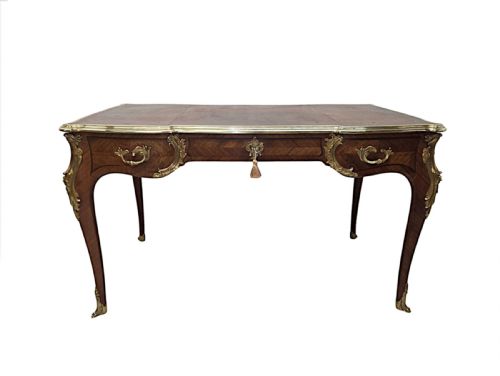
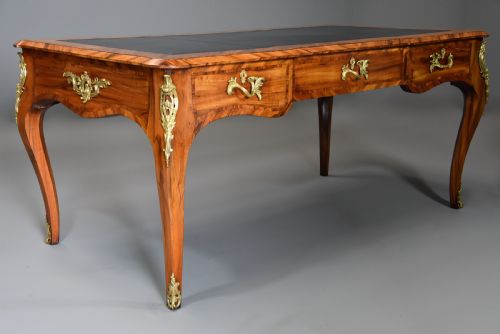
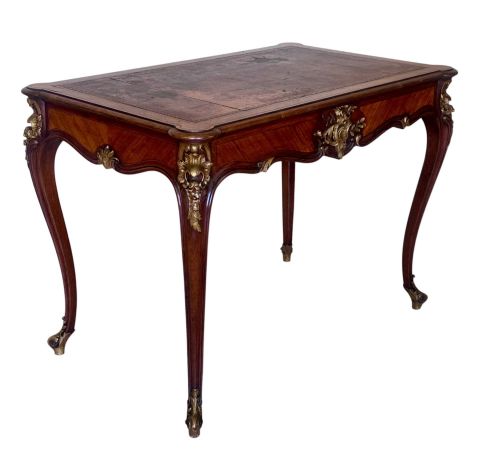
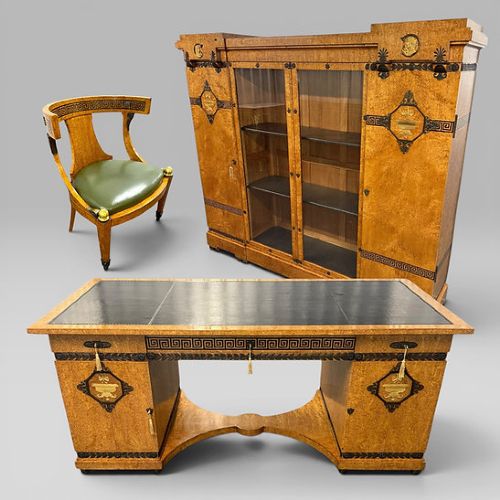
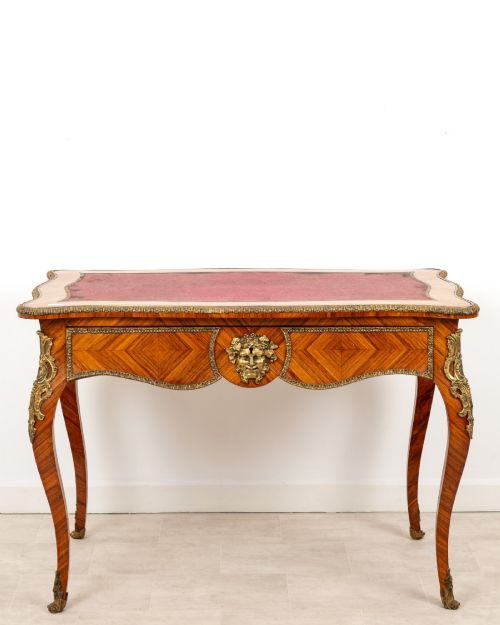
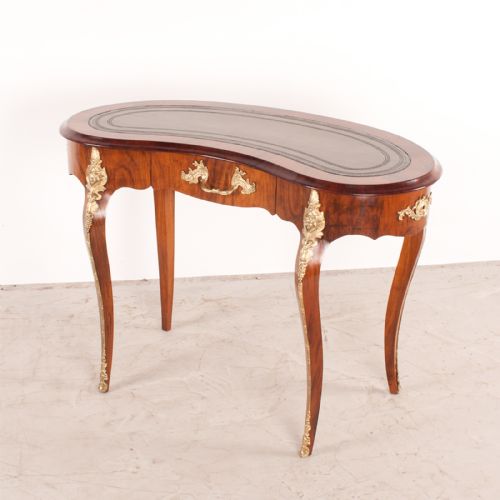
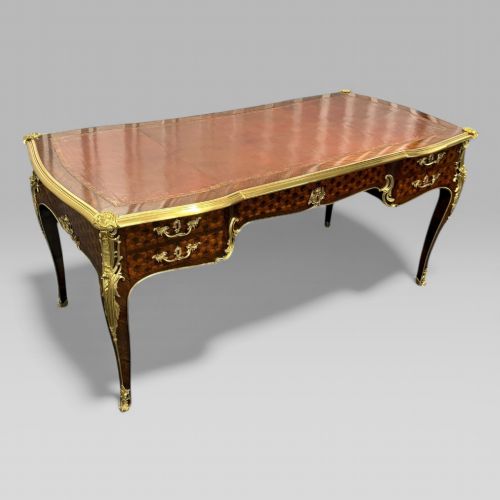
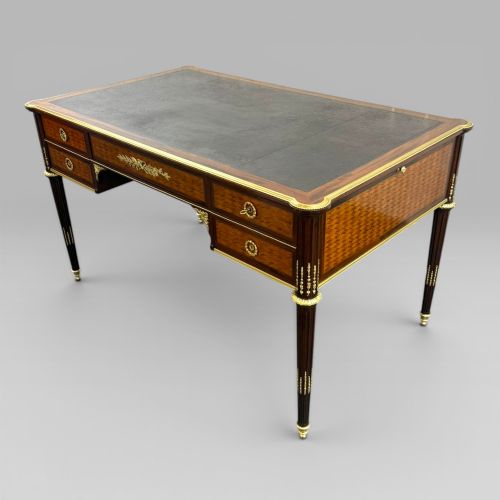
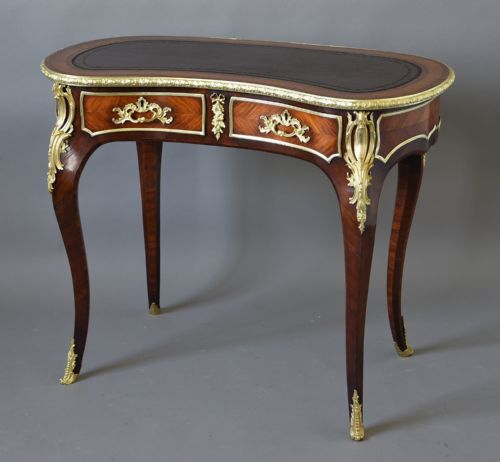
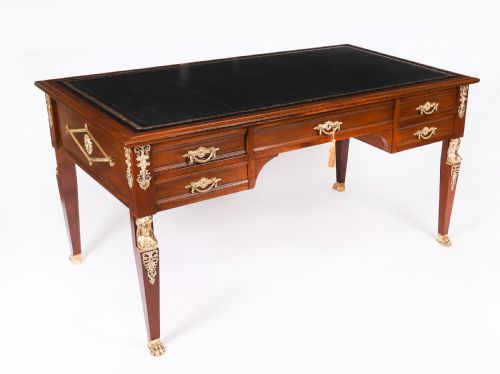
A french leather desk typically takes the form of a freestanding bureau plat or a kidney-shaped writing table designed to sit centrally within a room rather than against a wall. These pieces frequently emerge from nineteenth-century workshops, drawing upon Louis XV, Louis XVI, and Empire revival idioms.
Makers adapted these historical vocabularies for Victorian and Edwardian interiors, producing pedestal formats and partner desks alongside lighter writing tables. The incorporation of a leather writing surface distinguishes these forms, providing a functional writing plane framed by fine timber veneers.
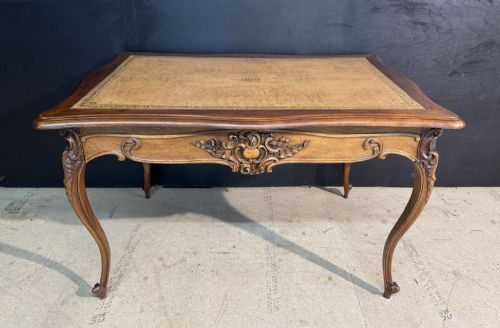
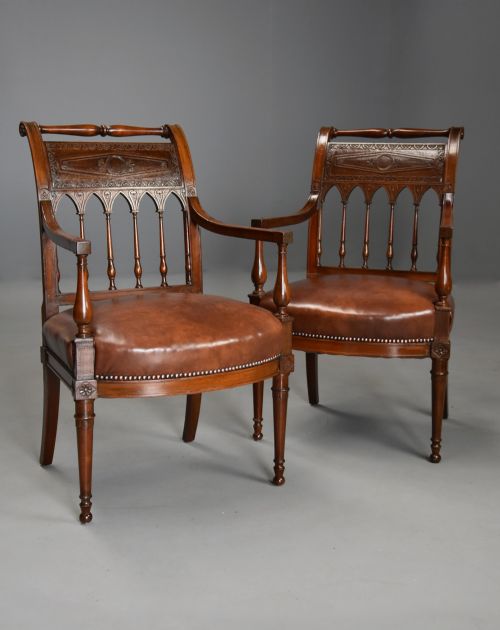
Examples on this page span walnut, mahogany, and kingwood bodies, often complemented by matching desk chairs or office sets. The scale ranges from compact boudoir tables to large library desks intended for formal studies.
Materials and Construction
Cabinetmakers utilised dense timbers like mahogany, walnut, and kingwood as carcase foundations, frequently applying intricate marquetry, parquetry, or satiné veneers across the surfaces. These woods provided the structural stability required for large freestanding bureau plat tables and partner desks.
Cast ormolu and gilt bronze mounts embellished corners, drawer fronts, and legs, echoing neoclassical and rococo revival tastes. Leather inserts, often tooled with gold leaf, were affixed to the writing surfaces to create a durable, matte writing plane.
Brass hardware, locks, and handles completed the construction, whilst secondary woods formed internal drawer linings and framework concealed beneath the decorative exterior veneers.
Listings feature eighteenth and nineteenth-century pieces alongside early twentieth-century examples, constructed primarily from mahogany, walnut, and kingwood.
Evaluating Quality
The distinction between ordinary and exceptional pieces rests upon the crispness of the ormolu casting and the precision of the parquetry or marquetry patterns. Finer desks exhibit hand-chased bronze mounts and meticulously matched wood veneers across every elevation.
Structural integrity and the quality of the internal joinery separate standard workshop output from pieces bearing signatures of notable cabinetmakers. The weight of the timber, the smoothness of drawer action, and the depth of the hand-tooled leather insert indicate the level of care invested in the initial manufacture.
François Linke·Edwards & Roberts·CH. Jeanselme & Co·Mercier Frères·Alphonse Tahan·Henri Jacot
The French Leather Desk Glossary
- Bureau plat
- A freestanding writing table fitted with drawers, originating in France and typically featuring a leather top. This form became a staple of elite nineteenth-century interior design.
- Ormolu
- Gilded bronze mounts applied to furniture for decorative accent. The term derives from the French for ground gold.
- Parquetry
- Geometric wood inlay patterns resembling mosaics. Makers arranged contrasting timbers like kingwood and mahogany to create optical depth on desk tops.
- Marquetry
- Pictorial or decorative veneer work composed of various woods and materials. It differs from parquetry through its inclusion of floral or scroll motifs.
- Partners desk
- A large double-sided desk designed for two people to work opposite one another. These pieces feature drawers on both elevations.
French Leather Desk: Frequently Asked Questions
What is a bureau plat?
A bureau plat is a freestanding writing table equipped with drawers and a leather writing surface. These desks were designed to be viewed from all sides in the middle of a room.
They emerged in various revival styles during the nineteenth century, drawing heavily on eighteenth-century French design principles.
How do I identify a nineteenth-century piece?
Nineteenth-century construction often reveals itself through hand-cut dovetails, secondary wood choices, and the specific style of ormolu casting. Cabinetmakers of this era frequently utilised mahogany, walnut, and kingwood veneers.
Examining the locks, drawer construction, and tool marks provides further clues to the manufacturing date and origin.
Where should I place a partner desk?
Partner desks require a central room placement because they feature working drawers on both sides. They function best in spacious studies or libraries where they can be approached from any angle.
Their substantial proportions demand adequate floor space to allow chairs to pull out comfortably on all sides.
What distinguishes Louis XV and Louis XVI styles?
Louis XV furniture relies on asymmetrical curves, cabriole legs, and elaborate rococo ormolu mounts. The overall aesthetic is fluid and organic.
Louis XVI design shifts toward strict symmetry, straight tapered legs, and neoclassical straight lines inspired by classical antiquity.