
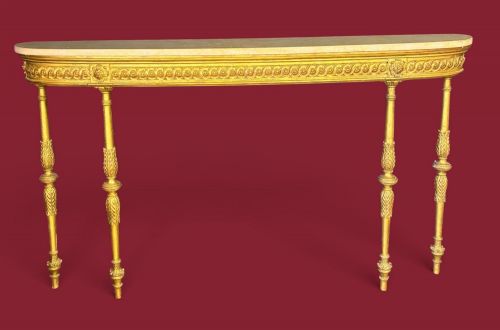


French Gilt Hall Table
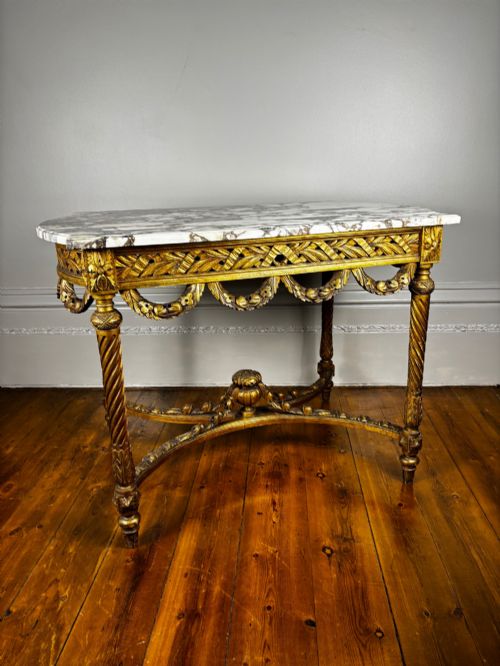
A French gilt hall table brings carved ornament and polished marble into an entrance, offering surface space and architectural presence.

French Gilt Hall Table
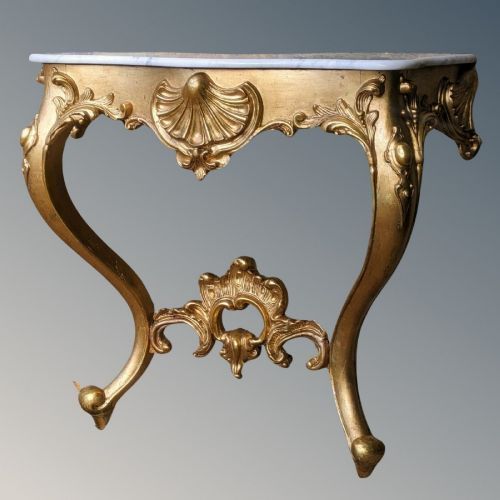
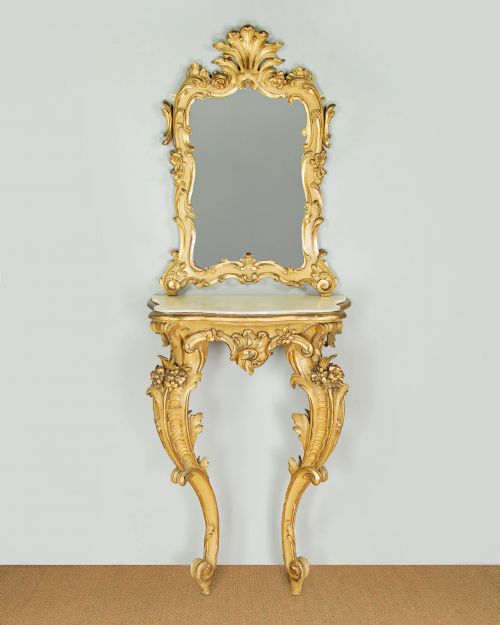
A french gilt hall table typically appears as a console table designed to stand against a wall, frequently accompanied by a matching mirror.
The selections span from the eighteenth century through the early twentieth century, incorporating revival aesthetics such as Louis XV, Louis XVI, Rococo, and Neoclassical styles.
Formations include serpentine outlines, half-moon demi-lune shapes, and oval centre tables intended to anchor a room.
How They Were Made
Carved wood structures utilise gesso and gold leaf to create the characteristic gilt finish, often paired with secondary timbers like mahogany, walnut, or kingwood.
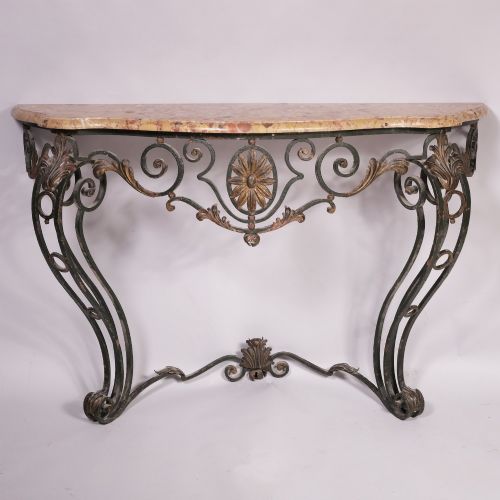
Heavy marble slabs, including white Carrara and rouge varieties, form the fitted tops, resting directly upon the carved frames.
Detailing involves ormolu mounts, brass accents, wrought iron work, and parquetry inlay executed across various revival periods.
Rams and maiden heads peer out from Victorian gilt frames, guarding the hallway with neoclassical sternness.
What Varies in Quality
Depth and crispness of the hand carving dictate the sculptural merit of the giltwood frame, distinguishing fluid organic motifs from stiffer machine-finished interpretations.
The thickness, figuring, and original matching of the marble top indicate the tier of the piece, alongside the integrity of the underlying gilding and gesso layers.
Holland + Son·Francoise Linke
The French Gilt Hall Table Glossary
- Console table
- A table designed to be fixed against a wall, frequently supported by front legs and secured with wall brackets.
- Giltwood
- Timber coated with gold leaf over a prepared gesso ground, creating a luminous metallic surface.
- Ormolu
- Gilded bronze mounts applied to furniture for decorative enrichment during the eighteenth and nineteenth centuries.
- Gueridon
- A small French table, typically circular, supported by a central pillar or multiple legs.
- Serpentine
- A curved line that undulates inwards and outwards, commonly defining the front edge of a table top.
French Gilt Hall Table: Frequently Asked Questions
Do these tables need wall fixing?
Many console tables are top-heavy due to thick marble slabs and require secure attachment to the wall for stability.
Matching mirrors often hang directly above, completing the architectural arrangement in a hallway.
How do I identify the style period?
Stylistic cues point to specific revivals, such as asymmetrical Rococo scrolls or symmetrical Neoclassical columns.
Dates range from eighteenth-century originals to later nineteenth and early twentieth-century interpretations.
Are the marble tops original?
Most tables retain their fitted marble inserts, shaped specifically to follow the serpentine or rectangular wooden frame.
Variations in marble colour, from white Carrara to deep red rouge, reflect the preferences of the period.
How should I clean giltwood?
Gilt surfaces require gentle dusting with a soft, dry brush to protect the delicate gold leaf and gesso layers.
Moisture and harsh cleaning agents can damage the historical finish permanently.