
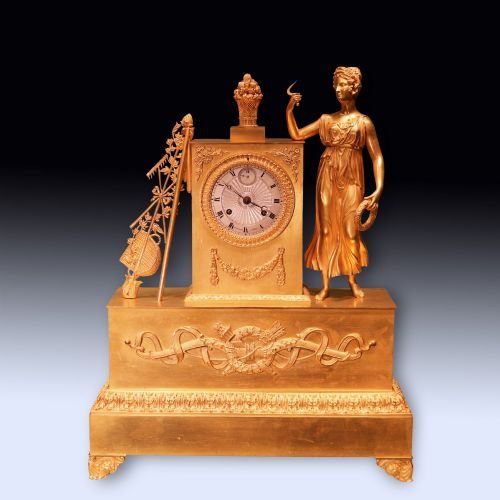


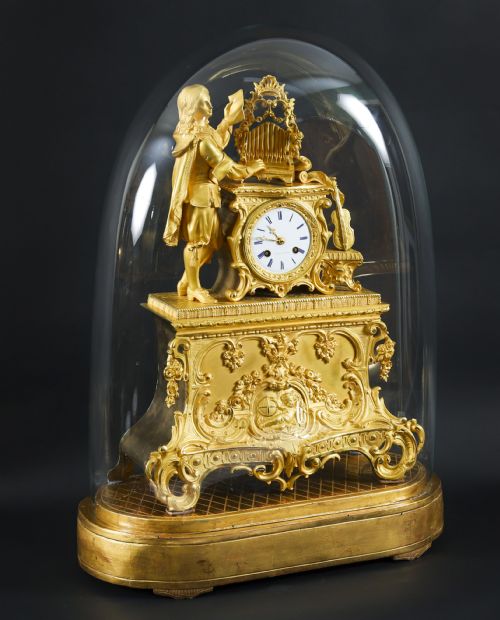


French Figural Table Clock
A french figural table clock brings classical sculpture and precision engineering together on the mantelpiece.
French Figural Table Clock
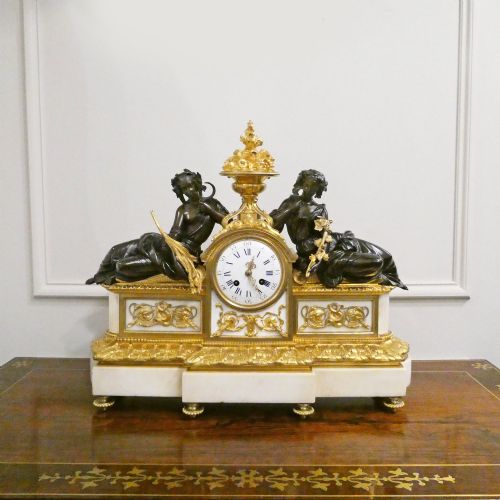
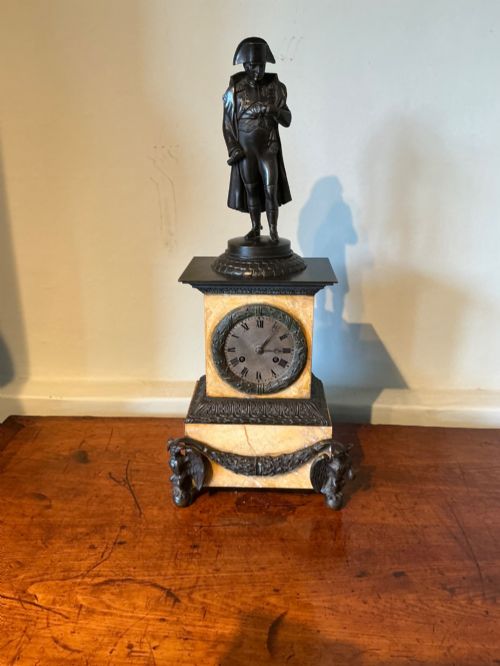
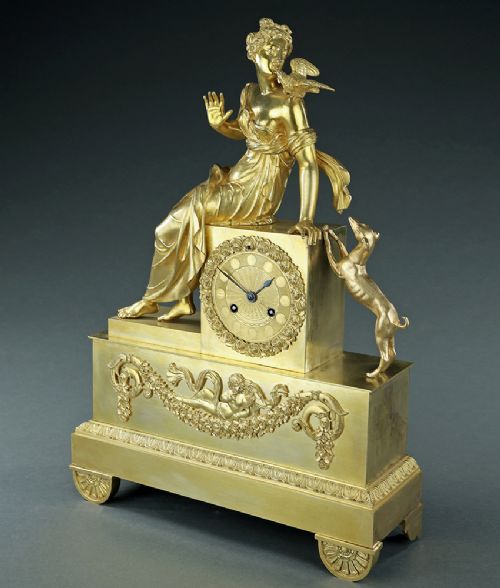
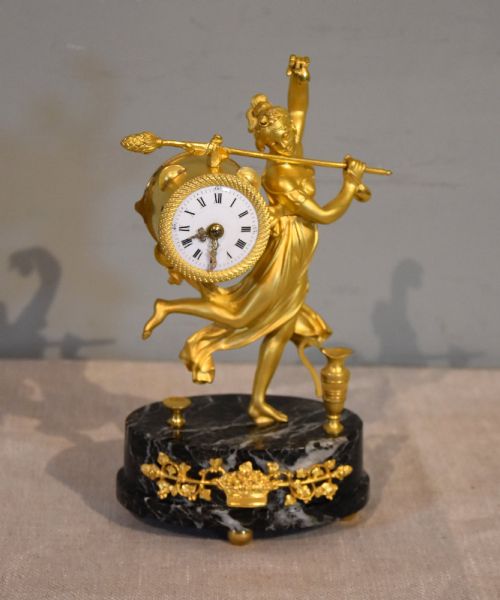
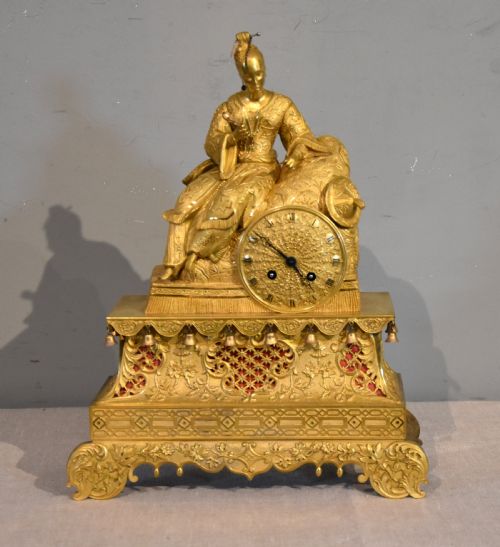
A french figural table clock combines a functional timekeeping movement with cast or sculpted figures, most commonly seen in nineteenth-century mantel and table formats. These pieces often incorporate classical allegories, mythological subjects, or historical personalities such as Napoleon cast in metal alongside the clock face.
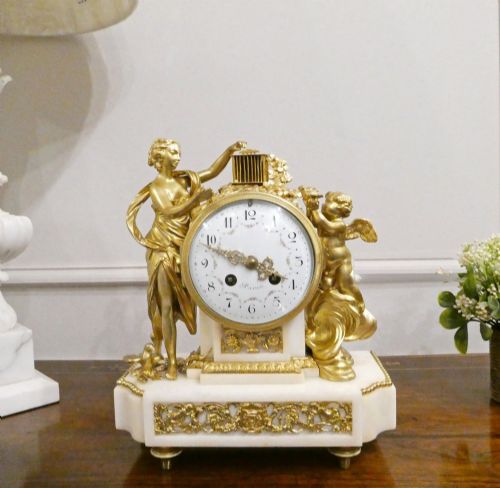
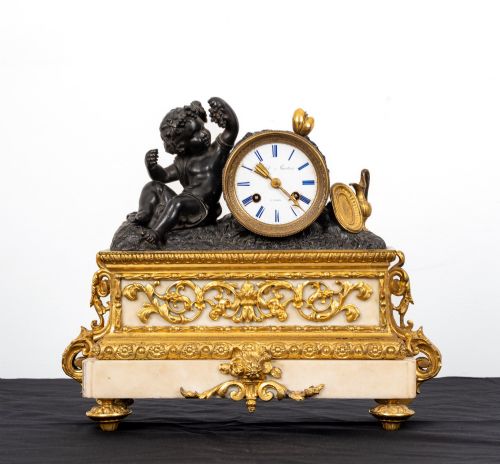
Makers housed these movements within architectural cases of marble, ormolu, and patinated bronze, frequently pairing the central clock with matching side ornaments to form a garniture set. The aesthetic draws heavily on French Empire, Louis XVI, and Rococo Revival styles, placing emphasis on ornate detail and sculptural presence.
The dial itself acts as a focal point, sometimes fashioned from hand-painted porcelain or enamel, inset into marble plinths or held aloft by bronze cherubs, maidens, and animals. Such pieces represent a fusion of horology and decorative art typical of Parisian workshops during the Victorian era.
Differentiating Quality and Craftsmanship
The refinement of the bronze casting determines the visual impact of the piece, separating crisp, hand-chased ornamentation from softer, unadorned production-line copies. Finer examples display meticulous detail in the facial expressions, drapery folds, and hair of the cast figures.
The integration between the sculptural elements and the marble base indicates the standard of manufacture, where superior workshops ensured flush joints and balanced proportions. Movement signed by established makers or Paris firms provides an additional benchmark of horological merit.
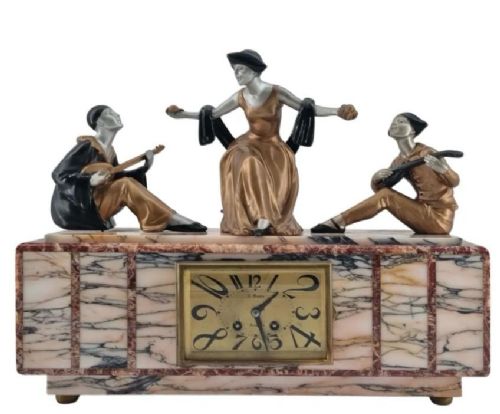
Goats and palm trees occasionally share the mantel alongside cast figures of Pierrot, Columbine, and Napoleon.
Vincenti·Siffel and Cartier·Canaillor of Paris·Japy Freres·Leroy Paris·Lemerle Charpentier·Deniere Et Fils·Victor Paillard·Bellenot Paris·John Bennett Cheapside London
The French Figural Table Clock Glossary
- Ormolu
- A technique of applying finely ground high-carat gold to a bronze object using mercury amalgamation, replaced later by electroplating.
- Patinated Bronze
- Bronze treated with chemical solutions to produce a controlled dark or greenish surface colour rather than a bright metallic finish.
- Garniture Set
- A matching set consisting of a central clock flanked by two decorative side pieces such as vases or candelabra.
- Fusee
- A conical pulley used in clock movements to maintain equal driving force as the mainspring unwinds.
French Figural Table Clock: Frequently Asked Questions
How do I wind the clock?
Most mechanical clocks require a matching key inserted into the winding holes on the dial face to tension the mainspring barrels.
Care must be taken not to overwind the mechanism, as this can strain the internal steel springs.
What maintenance do they need?
Professional servicing every few years ensures the brass gear trains remain free of old, hardened oils and dust accumulation.
Dusting the marble and ormolu with a soft, dry cloth protects the metal surfaces from tarnish and abrasion.
How can I tell the period?
Stylistic cues such as heavy Neoclassical columns, Empire laurel wreaths, or Rococo asymmetry offer the clearest indication of manufacturing era.
Maker signatures stamped onto the back of the brass movement plates often help narrow down the production decade.
Where should I place it?
A stable, level surface such as a mantelpiece or heavy sideboard provides the necessary foundation for accurate pendulum or balance wheel operation.
Direct sunlight and damp environments should be avoided to protect the delicate marble and gilded metal finishes.