
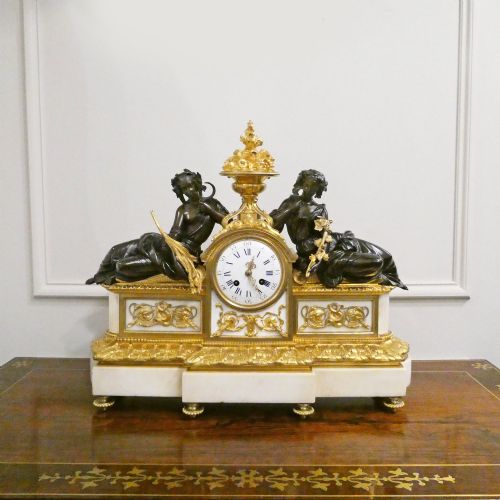
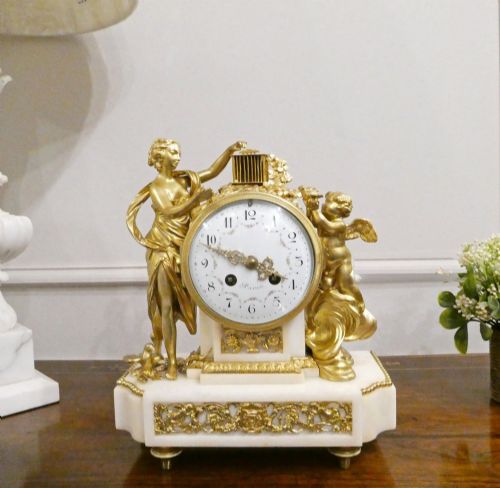
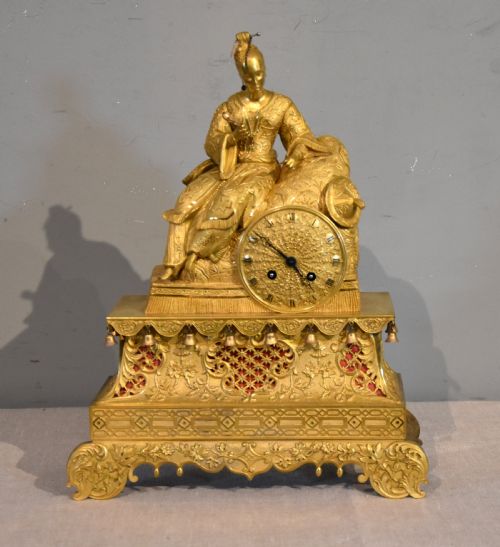
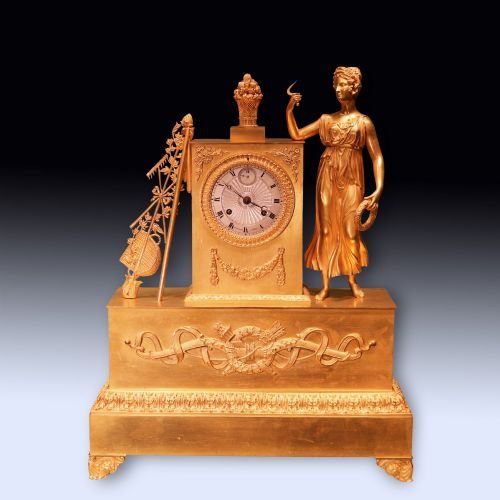

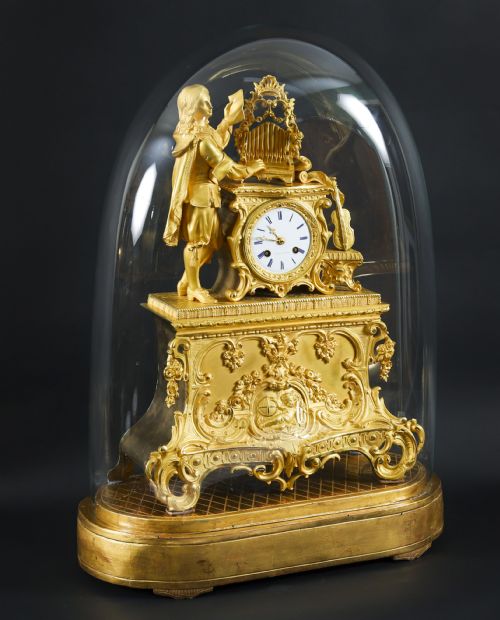


French Figural Pendule Clock
A french figural pendule clock brings the sculptural presence of nineteenth-century foundry work and precision horology straight to your mantelpiece.
French Figural Pendule Clock
A french figural pendule clock is a sculptural timepiece that combines cast metal figures with a functional clock movement, most commonly found in nineteenth-century forms. These pieces draw on French Empire, Louis XVI, and Neoclassical styles, often featuring mythological subjects or classical figures like Diana the Hunter and Cupid.
The materials recorded in these pieces include gilt bronze, ormolu, patinated bronze, marble, porcelain, and glass, paired with enamel dials. The most common manifestations on this page are mantel clocks housed in architectural marble cases or mounted with detailed animal and human figures.
How they were made
The construction relies on the combination of cast bronze, often gilded with ormolu or finished with a patinated surface, mounted onto solid marble bases. Makers utilised mercury gilding techniques in earlier periods to achieve a deep lustre, while movements were engineered to house silk suspension systems and eight-day striking mechanisms.
Enamel dials with painted numerals were integrated into the metal and stone housings, requiring precision fit between the heavy cast figures and the internal brass gear trains. Glass covers frequently protected these delicate dials, while porcelain elements added contrasting colour and texture to the metallic frames.
Diana the Hunter keeps a watchful eye over the tick of the hour, frozen in bronze with her bow.
What varies in quality
The integration between the sculptural elements and the marble or bronze base indicates the workshop standard, as does the fidelity of the movement. Pieces signed by established makers generally demonstrate superior horological engineering and heavier, more substantial casting proportions.
Vincenti·Canaillor of Paris·Leroy Paris·F Marti·Frères Raingo
The French Figural Pendule Clock Glossary
- Ormolu
- A technique of applying finely ground high-carat gold to an object of bronze. This provides a rich golden finish that defines the most decorative surfaces of nineteenth-century horology.
- Silk suspension
- A method of hanging the pendulum by a thin thread of silk rather than a steel spring. This delicate mechanism is typical of earlier nineteenth-century French movements.
- Patinated bronze
- A treated or naturally aged surface on bronze that produces a dark brown or green tone. This contrasts sharply with the bright gilding found on figural mounts.
- Empire style
- A design movement originating in early nineteenth-century France inspired by classical antiquity. It favours martial motifs, heavy bronze mounts, and strict symmetry.
- Chasing
- The manual refinement of a cast metal surface using hammers and punches. High-level chasing brings out intricate textures in hair, clothing, and foliage.
French Figural Pendule Clock: Frequently Asked Questions
How do I wind a French mantel clock?
Most of these clocks utilise an eight-day movement requiring a key to tension the springs via the dial holes.
Care must be taken not to over-wind the mechanism, turning the key steadily until resistance is felt.
What is silk suspension?
Silk suspension is a traditional method of hanging the pendulum from a thin woven silk thread rather than a metal spring.
This fragile arrangement is characteristic of better-quality nineteenth-century movements and requires careful handling during transport.
How do I tell Empire style from Neoclassical?
Empire style leans towards heavier, more authoritative classical motifs inspired by Roman military power and Napoleonic taste.
Neoclassical pieces tend to be lighter and more restrained, drawing directly from Greek aesthetic proportions and mythological subjects.
Where should I place a heavy marble clock?
These clocks require a deep, stable surface capable of supporting considerable weight from the marble and bronze components.
Level placement on a solid mantelpiece or sideboard ensures the pendulum swings evenly and the movement keeps accurate time.