
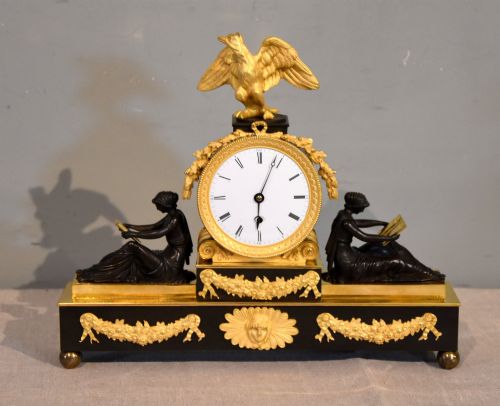
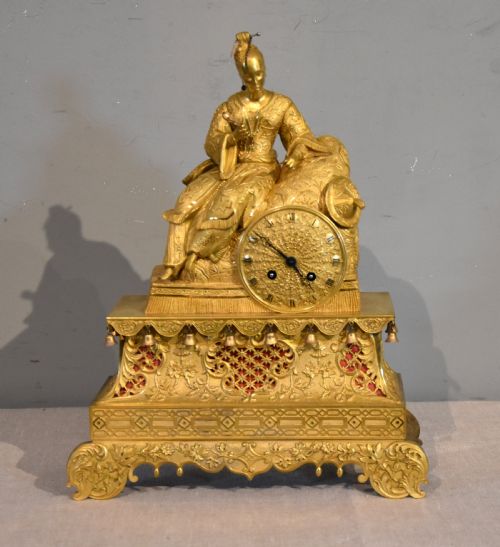
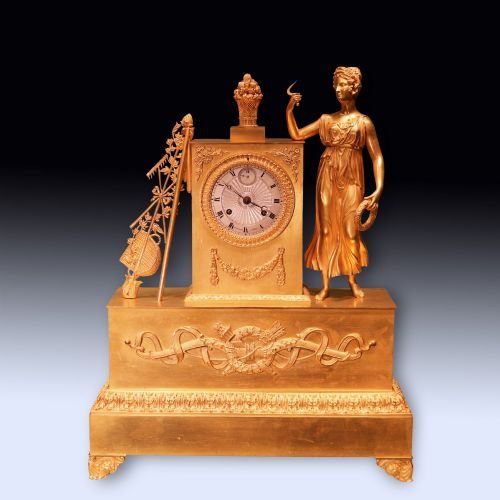


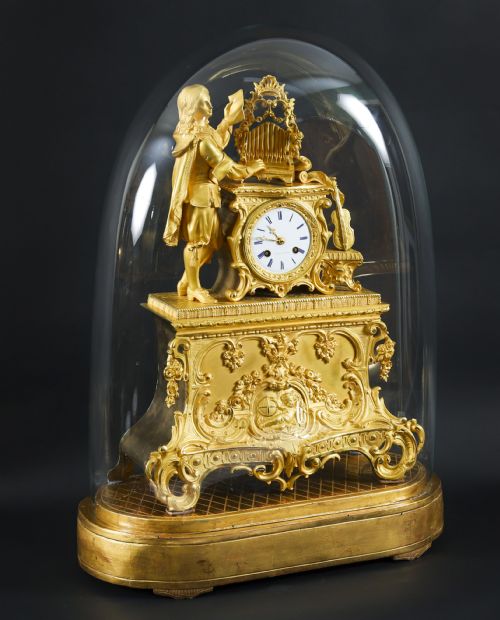


Figural Brass Mantel Clock
A figural brass mantel clock combines timekeeping with sculptural narrative, bringing Regency and Victorian characters into domestic interiors.
Figural Brass Mantel Clock
A figural brass mantel clock centres on metalwork figures drawn from classical mythology, French Rococo revivalism, and Empire tastes, often incorporating cherubs, lions, or allegorical subjects such as chastity and explorers.
Most examples originate from the nineteenth century, spanning Regency, Victorian, and later periods, and frequently pair cast brass, ormolu, or gilt bronze with marble, onyx, or enamel dials.
The format ranges from compact table clocks and miniature timepieces with chain fusee movements to three-piece clock sets flanked by garnitures or enclosed beneath glass domes.
Materials and Construction
Maker workshops utilised cast brass, ormolu, and gilt bronze for the sculptural bodies, frequently employing fire-gilding techniques to achieve a deep metallic lustre.
Mechanisms commonly rely on eight-day striking movements, single or double fusee systems, and silk suspensions, housed within heavy cases of marble, alabaster, or patinated bronze.
Enamel, porcelain panels, and hand-painted ceramic dials complete the composition, sometimes signed by prominent clockmakers on the face or movement plate.
Materials across the listings span gilt bronze, ormolu, marble, onyx, porcelain, glass, alabaster, and patinated bronze.
Assessing Craftsmanship and Detail
The integration of the sculptural subject with the movement housing distinguishes standard production pieces from signed works by notable makers such as Japy Freres, F Marti, or London watchmakers.
The inclusion of original components, such as matching garnitures, fitted glass domes, and intact enamel dials, preserves the integrity of the ensemble.
Baetens London·Canaillor of Paris·Japy Freres·Leroy Paris·Auguste Moreau·John Bennett Cheapside London·James Murray London·Henry Berkeley Square London·Perigal and Duterrau·Bently and Beck London·F Marti·Freres Raingo·P.H. Mourey
The Figural Brass Mantel Clock Glossary
- Ormolu
- A gilded bronze technique utilising a mercury amalgam to apply gold to a bronze base, producing a rich, lasting metallic finish.
- Fusee
- A conical pulley used in spring-driven clocks to maintain equal power as the mainspring unwinds, improving timekeeping accuracy.
- Silk suspension
- A method of hanging the pendulum from a fine strand of silk, common in older French striking movements.
- Garniture
- A set of decorative matching ornaments, such as vases or urns, displayed alongside a mantel clock on a fireplace or console.
- Chasing
- The hand-tooling of metal surfaces with punches and hammers to sharpen details on cast bronze and brass figures.
Figural Brass Mantel Clock: Frequently Asked Questions
What is a figural mantel clock?
A figural mantel clock is a timekeeping device featuring sculpted human, animal, or mythological characters cast in bronze, brass, or ormolu as part of the case design.
These pieces served as both functional timepieces and decorative sculptural art for nineteenth-century interiors.
How do you wind an antique clock?
Antique clocks are typically wound using a specialised key inserted into winding holes on the dial face, turning slowly until resistance is felt.
Care must be taken not to overwind the mainspring, and striking trains should be allowed to complete their sequence without interruption.
What are clock garnitures used for?
Clock garnitures are matching decorative sets, often comprising urns or candelabra, placed on either side of the mantel clock to create a balanced display.
They share the same materials and decorative styles, such as French Rococo revival or Empire gilt bronze.
How do you distinguish French and English movements?
French movements often utilise stamp marks from makers like Japy Freres or F Marti and may feature external count wheels or silk suspensions.
English examples from this era frequently employ chain fusee movements signed by London watchmakers on the backplate.