


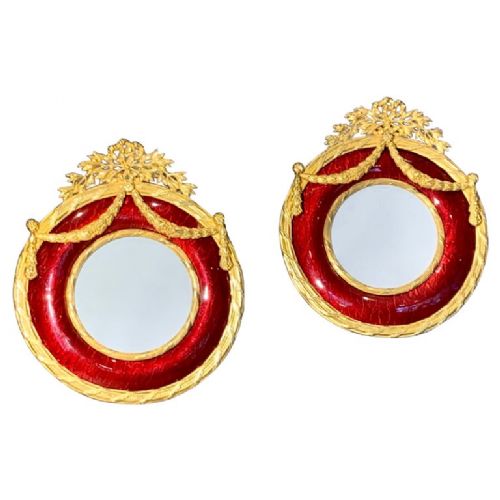
French Enamel Frame
These french enamel frame pieces combine rich metalwork and colourful vitreous decoration, offering a striking display for photographs and portraits.
French Enamel Frame
The selection extends beyond standard photograph holders to include related items such as vanity sets, table mirrors, and wall clocks sharing the same decorative vocabulary. Dating spans widely from the eighteenth century through to the early twentieth century, encompassing Napoleon III, Art Nouveau, and revival styles.
Makers and artists like Limoges and F. Bienvue appear across the broader category of enamelled works, showing the strong tradition of painted plaques alongside metal mounts. Buyers often find these pieces paired with supporting easel backs or designed for wall suspension.
How they were made
The foundation of these frames typically relies on cast bronze or brass, frequently gilded to provide a bright metallic finish that complements the coloured glass pastes. Artisans utilised techniques such as champleve, where troughs are hollowed out in the metal base and filled with powdered enamel before firing.
Painted enamel plaques, particularly associated with Limoges traditions, involve applying successive layers of pigmented glass onto a copper support and firing them multiple times. Ebonised wood and glass components are also integrated into the structural design of related items on this page.
Several frames ensure your cherished family portraits are heavily guarded by enthusiastic cast-metal cherubs and exotic birds.
What varies in quality
Quality in a french enamel frame is defined by the crispness of the cast bronze mounts and the intricacy of the enamelwork itself, such as detailed figural scenes with cherubs or birds. Pieces featuring well-preserved gilding and complex multi-coloured champleve patterns represent the higher tier of craftsmanship.
The depth and clarity of the enamel pigments, alongside the presence of signed or attributed plaques like those from Limoges, distinguish standard production items from superior works. Structural integrity, including the original easel back or hanging loop, heavily influences the overall standard of survival.
Limoges·Samson·F.Bienvue·Sellier·Longwy
The French Enamel Frame Glossary
- Champleve enamel
- An enamelling technique where troughs or cells are carved into a metal surface to hold coloured glass paste before firing. This method creates bold patterns bounded by thin lines of exposed metal.
- Gilt bronze
- Bronze metal that has been coated with a thin layer of gold, providing a durable and luminous metallic surface. It is frequently used for nineteenth-century picture frame mounts.
- Limoges
- A French city renowned for its production of enamelled copper plaques and porcelain painting. Works from this tradition often depict portraits or classical scenes.
- Ormolu
- A popular nineteenth-century term for gilded bronze mounts used in furniture, clocks, and frames. It gives objects a rich, golden appearance.
- Napoleon III style
- A heavily ornate French design aesthetic popular during the mid-nineteenth century, drawing inspiration from various historical periods including the Renaissance and Baroque.
French Enamel Frame: Frequently Asked Questions
How do I date a french enamel frame?
Dating relies heavily on the prevailing decorative style, such as Napoleon III revival or Art Nouveau curves, combined with the manufacturing techniques of the metal mount. Nineteenth-century examples frequently employ cast gilt bronze paired with champleve enamel.
Examining the reverse side, hardware, and any artist signatures or attribution marks helps narrow down the decade of production between the eighteenth and early twentieth centuries.
What is champleve enamel?
Champleve is a technique where artisans gouge or carve depressed channels into a metal base like copper or bronze. These hollows are then packed with powdered coloured glass and fired until fused.
The resulting design displays vibrant coloured sections separated by thin, rigid ridges of the original base metal.
Are Limoges enamel pieces different from standard frames?
Limoges pieces usually feature painted pictorial plaques on copper rather than geometric patterned enamel cells set into bronze mounts. These plaques often portray detailed figures, portraits, or landscapes.
While some frames incorporate Limoges plaques into their design, independent plaques and painted wall art also exist within the same artistic tradition.
How were these frames used originally?
These decorative objects served to display cherished family photographs, miniature paintings, or mirrors within opulent nineteenth-century interiors. They were designed to sit on dressing tables, mantelpieces, or hang from walls as decorative art.
Their ornate gilt bronze and enamelled surfaces were status symbols reflecting the owner's taste for historical revival styles.