


French Empire Wine Table
These french empire wine table pieces bring classical proportion and rich mahogany or burr timber to a room, offering both surface utility and distinct architectural presence.
French Empire Wine Table
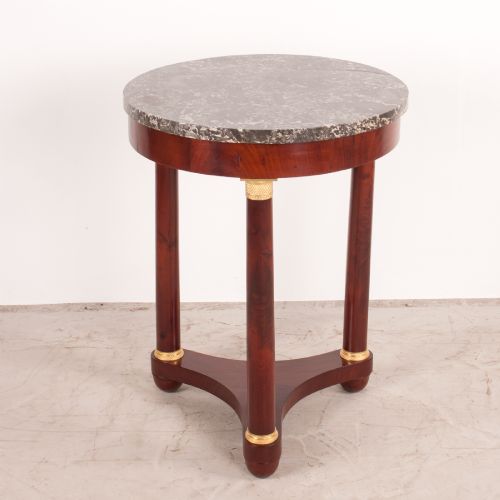
A french empire wine table typically takes the form of a guéridon, side table, or pedestal centre table originating from continental workshops or later Victorian interpretations. When you search for this phrase, you encounter circular occasional pieces designed with distinct classical lines and central support columns.
The selections span the nineteenth century alongside later revivals from the early nineteen-twenties, appearing in forms from modest side tables to grander centrepieces. Mahogany, burr elm, and walnut form the primary wooden bodies, frequently paired with stone tops.
Most examples adhere to the French Empire and Neoclassical vocabularies, showing influences from French Restoration and chateau aesthetics. These tables function effectively as small display surfaces or bedside pieces while anchoring a room with formal symmetry.
Materials and Construction
Cabinetmakers utilised dense timbers such as mahogany and burr walnut for the main structural elements, often selecting figured veneers to create striking patterns on the circular tops. Secondary woods support these veneers within stable frames designed around a central pedestal.
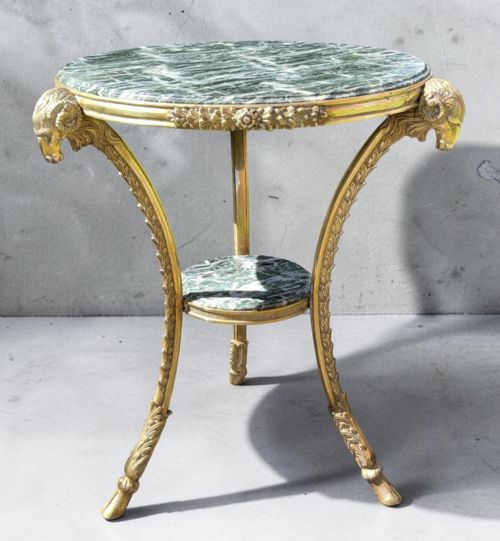
Cast brass, ormolu, and gilt bronze provide the metallic mounts that define the aesthetic, accentuating the structural junctions with classical motifs like rams' heads and swans. Marble serves as the primary stone for the inset or solid tops, offering a cool, durable working surface.
Cast brass rams' heads peer outward from beneath circular wooden tops, guarding your morning coffee with unwavering classical resolve.
Evaluating Quality and Detail
The refinement of the cast metal mounts separates standard production from finer work, as crisp chasing in the ormolu and brass distinguishes superior decorative hardware. Better examples feature finely detailed motifs such as naturalistic animal heads rather than simplified cast elements.
The selection and matching of wood veneers dictate the visual weight of the top, with carefully chosen burr elm or mahogany displaying superior grain movement. Construction integrity in the central pedestal and leg junction ensures stability across heavy marble slabs.
The French Empire Wine Table Glossary
- Guéridon
- A small French table supported by a single central column or a tripod base. This form serves as the primary structural archetype for the pieces found in this category.
- Ormolu
- Gilt bronze created by applying a mercury and gold amalgam to cast bronze. This decorative technique imparts a rich, lasting metallic lustre to mounts and decorative details.
- Neoclassical
- A style inspired by the classical art and architecture of ancient Greece and Rome. It emphasises symmetry, proportion, and restrained ornamentation in furniture design.
- Burr Elm
- Wood harvested from the growth excrescences on elm trees, featuring twisted, swirling grain patterns. Cabinetmakers prize this timber for decorative veneering on table tops.
French Empire Wine Table: Frequently Asked Questions
How were these tables originally used?
These pieces served as convenient movable surfaces in formal salons for holding drinks, small lamps, or decorative objects. Their compact circular format allowed them to sit beside seating or in the centre of smaller rooms.
Over time their role shifted towards decorative display while retaining the sturdy pedestal construction required for supporting heavy marble slabs.
Are these tables sturdy enough for daily use?
The heavy central pillar and weighted base provide substantial stability for everyday placement in a hallway or drawing room. Most examples are designed to bear moderate weights on their stone or wooden surfaces.
Care should be taken when moving them due to the combined weight of the timber frame and inset marble tops.
How do I care for the marble top?
Marble requires gentle cleaning with warm water and a soft cloth to avoid scratching the polished surface or dulling the natural stone. Acidic liquids like wine or citrus juice can etch the polish if left standing.
Applying a specialist stone wax periodically helps protect the finish from moisture rings and everyday wear.
How do I distinguish nineteenth century pieces from later revivals?
Early nineteenth century examples often employ solid construction methods and hand-chiselled bronze mounts reflecting direct period techniques. Later revivals from the twentieth century can display standardised machine casting in the brass elements and different secondary woods.
Examining the underside joinery and the patination of the timber helps determine the chronological placement of each piece.