



French Cylinder Desk
A french cylinder desk offers a curved rolling shutter that conceals fitted writing drawers, combining elegant cabinetry with practical security.

French Cylinder Desk
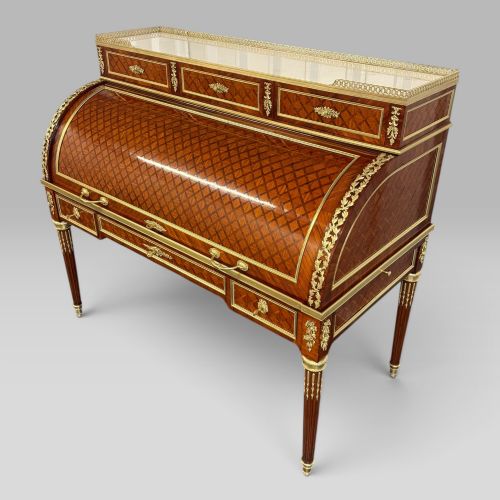
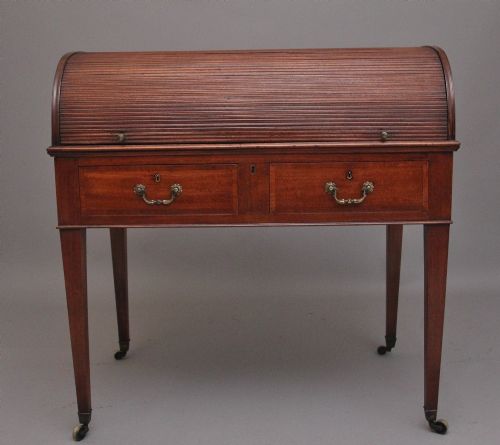
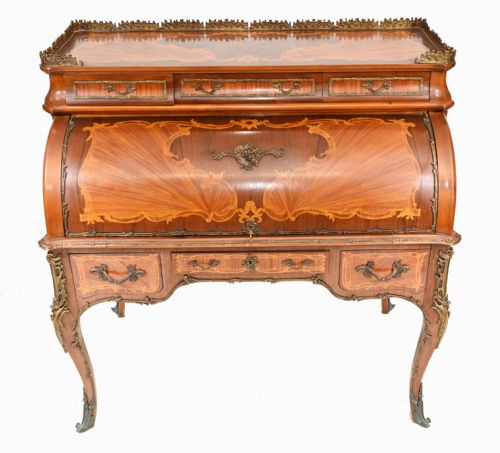
A french cylinder desk is a sophisticated writing cabinet defined by its quarter-circle wooden shutter that rolls back to reveal an interior fitted with small drawers and pigeonholes, often featuring a pull-out leather-lined writing slide.
The versions most commonly met on this page span the nineteenth century, drawing heavily on earlier court aesthetics through revivals of Louis XVI, Louis XV, and Empire styles.
Makers utilised various formats, ranging from diminutive ladies' writing pieces and bonheur de jour arrangements up to large architectural pedestals executed in richly figured timbers.
How they were made
Cabinetmakers constructed the rolling cylinder from narrow vertical slats glued to a flexible canvas or leather backing, allowing the curved shutter to glide smoothly within hidden tracks.
Carcases relied on solid timbers like mahogany, walnut, and fruitwood, decorated with intricate marquetry or geometric parquetry veneers in kingwood, rosewood, and mulberry.
Metal mounts in brass and ormolu protected vulnerable corners and framed panel borders, complemented by marble tops on selected architectural examples.
French Cylinder Desk Retail Price Guide 2026
Typical asking prices for french cylinder desk among the pieces listed under this phrase on Sellingantiques today, from the lower quarter to the upper quarter. They describe what is for sale here now, not the wider market.
Several miniature desks appear here alongside full-sized library pieces, proving that even eighteenth-century bureaucrats needed dollhouse administrative options.
What varies in quality
Quality rests primarily on the precision of the joinery governing the cylinder mechanism, where top-tier examples operate silently and evenly without binding in the tracks.
The artistic execution of the surface decoration separates standard production from exceptional works, visible in the careful matching of wood grains and the depth of hand-chased ormolu mounts.
Internal secondary timbers and the complexity of the interior fittings reveal the maker's dedication, with finer pieces incorporating secret compartments and smoothly dovetailed drawer linings.
Francoise Linke
The French Cylinder Desk Glossary
- Cylinder desk
- A writing table featuring a quarter-cylindrical rolling shutter that covers the writing surface and interior compartments. This mechanical roll top distinguishes the form from flat writing tables.
- Ormolu
- Gilded bronze mounts applied to furniture for decorative enrichment and edge protection. This technique involves coating bronze with a gold amalgam and heating it.
- Parquetry
- Geometric wood veneer patterns arranged in repetitive motifs such as cubes or chequers. Craftsmen utilised contrasting timber tones to create optical depth.
- Bonheur de jour
- A small light lady's writing desk with an enclosed superstructure on top. This graceful form gained popularity during the eighteenth century.
French Cylinder Desk: Frequently Asked Questions
How do you open a cylinder desk?
The rolling shutter connects directly to the pull-out writing slide located immediately below it. Pulling the writing surface forward automatically retracts the cylinder into the desk body.
Pushing the writing slide back returns the cylinder to the closed position, covering the interior compartments and any papers left resting inside.
Were these desks used by men or women?
French cylinder desks served both genders depending on their scale and proportion. Larger pedestal models furnished gentlemen's studies and libraries for estate management.
Smaller formats, often designated as ladies' desks or bureaus de dame, suited lighter correspondence in private drawing rooms and boudoirs.
How do I care for the veneer?
Maintain stable room humidity and keep the wood away from direct sunlight and heat sources to prevent veneer lifting and timber shrinkage. Periodic application of appropriate wax preserves the polished finish.
Avoid excessive moisture during cleaning, using only a soft dry cloth to remove dust from the intricate marquetry and ormolu mounts.