




French Church Painting
These pieces gather the quiet spirit of European devotion, offering buyers an authentic French church painting that brings historical depth and sacred calm into a modern interior.
French Church Painting
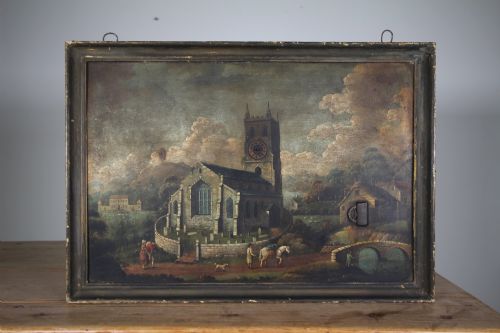
A french church painting captures sacred architecture, village scenes, and monastic interiors through the eyes of artists working from the nineteenth century into the mid-twentieth century. Buyers encounter works executed in watercolour on paper and oil on canvas, reflecting styles that range from post-impressionist interpretations to traditional academic renderings of ecclesiastical subjects.
Beyond direct depictions of religious houses, related items such as church interiors with capuchin friars or townscapes featuring structures like Saint Jacques Church in Dieppe anchor the broader category. These works connect the observer directly to the stone aisles, altars, and weathered plaster of historic French parishes.
How they were made
Painters recorded these ecclesiastical subjects utilising oil paint applied to canvas or watercolour washes laid onto paper supports. The application of pigment captures both the heavy stonework of Gothic architecture and the softer light filtering through narrow windows.
Frames and associated supports often incorporate carved wood, gold leaf, and iron work, reflecting the traditional craftsmanship of the periods spanning the nineteenth and twentieth centuries.
Listings feature works executed in oil and watercolour across the nineteenth and twentieth centuries, spanning post-impressionist and traditional ecclesiastical styles.
What varies in quality
The strength of composition and the handling of light separate standard topographical records from works by accomplished artists who convey the atmospheric solemnity of a French interior. Brushwork that successfully articulates the monumental scale of stone arches and the subtle drapery of clerical garments elevates a canvas above a mere architectural illustration.
The preservation of the original pigment and the stability of the canvas or paper support dictate the long-term integrity of the piece. Works that retain their original unlined state and harmonious palette offer a truer encounter with the maker's initial intent.
Maurice Asselin·Jeffrey Pratt·Henri Therme·Adam Knight
The French Church Painting Glossary
- Watercolour painting
- A work executed with water-soluble pigments on paper. This medium allows for translucent washes that capture the shifting daylight inside a sacred space.
- Oil painting
- A composition created using pigments bound in a drying oil medium, typically applied to canvas or panel. This technique provides rich depth and texture suitable for complex architectural interiors.
- Post-Impressionism
- An artistic movement following impressionism that focuses on symbolic content and formal structure rather than purely optical recording. Artists in this tradition used bold colours and distinct brushwork to interpret French scenes.
- Ecclesiastical
- Relating to the Christian Church or its clergy. In this context, it describes items and artworks originating from or depicting religious buildings and worship.
- Gothic Revival
- An architectural and decorative style that draws inspiration from medieval Gothic design. Pieces from this movement often feature pointed arches and ornate stonework details.
French Church Painting: Frequently Asked Questions
What subjects appear in these paintings?
The artworks primarily depict French townscapes, sacred church interiors, and village scenes featuring historic parishes and monastic figures.
These depictions often include specific architectural landmarks like the church of Saint Jacques in Dieppe alongside generalized views of Paris suburbs and lavender fields near places of worship.
Which periods do these artworks represent?
The pieces span from the nineteenth century through the mid-twentieth century, including works created in the decades around nineteen twenty and nineteen thirty.
This timeframe encompasses varied artistic movements from traditional academic school paintings to post-impressionist interpretations.
What materials support these artworks?
Painters utilised oil on canvas and watercolour on paper to create these depictions of French ecclesiastical life.
Surviving pieces are frequently housed in complementary frames constructed from carved wood and highlighted with gold leaf.
How do I care for these paintings?
Protect works on paper and canvas from direct sunlight and excessive humidity to preserve the stability of the pigments and supports.
Maintain stable indoor environmental conditions to prevent the degradation of older organic materials like wood frames and paper fibres.