


Grey Stone Oil Painting
A grey stone oil painting captures the quiet permanence of masonry, architecture and rugged landscapes through pigment.
Grey Stone Oil Painting
A grey stone oil painting captures architectural masonry, rugged landscapes and classical ruins rendered in muted mineral tones. These works span multiple centuries, ranging from eighteenth-century topographical views featuring stone masons to nineteenth-century portraits and landscapes. The pieces appear in various forms, including works on canvas, wood panel and board, framed within period painted wood.
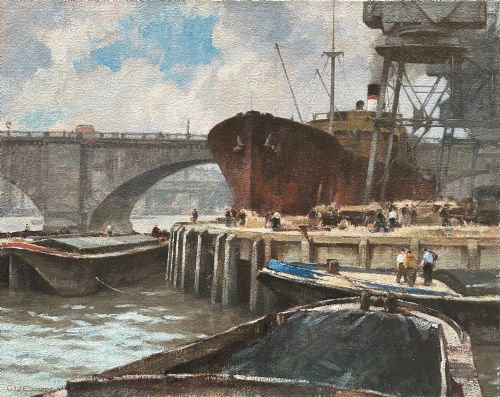
Buyers encounter diverse artistic movements within this category, such as Georgian and Neoclassical compositions alongside British Impressionism and twentieth-century regional realism. Artists render stone structures through subtle tonal shifts in oil paint, creating depth and texture that reflect the material reality of their subjects. Many pieces document specific historical locations, from London bridges and Parisian suburbs to Yorkshire dales.
Materials and construction
These works rely on traditional oil paint applied to prepared surfaces including canvas, wood panel and board. Artists build up the heavy texture of stone through layered brushwork and deliberate pigment manipulation. The resulting surfaces capture both the smoothness of dressed masonry and the rough grain of natural rock formations.
Surviving examples retain their original framing context, frequently housed within painted wood frames that complement the monochromatic palette of the artwork. The combination of oil medium and rigid supports ensures the longevity of these mineral-focused compositions across centuries.
The listings span from the eighteenth century to the mid-twentieth century, featuring British and French artistic traditions.
Factors of distinction
Quality rests in the artist's ability to render the weight and texture of stone through pigment alone. Superior examples demonstrate confident brushwork that distinguishes between weathered exterior rock, smooth architectural blocks and the play of light across mineral surfaces. The handling of atmospheric depth around solid structures separates accomplished regional and salon works from simpler decorative pieces.
Provenance and documentation also influence a work's standing, particularly when artists, specific historical locations or exhibition histories are clearly recorded. Works that capture precise architectural details, such as stonemasonry tools or church facades, alongside human figures show a higher level of compositional ambition.
Cyril Walduck Edwards·Florence Adelina Hess·John Frederic Greenwood·Ernest Higgins Rigg·Herbert Royle·Charles Robert Leslie·William Marlow
The Grey Stone Oil Painting Glossary
- Canvas
- A woven fabric stretched across a wooden frame to serve as a support for oil paint. It provides a slightly flexible surface that holds heavy impasto layers well.
- Wood Panel
- A rigid wooden support used by artists instead of fabric canvas. Panels offer a completely stable base that prevents the cracking often found on older flexible supports.
- Board
- A compressed flat material utilised as a rigid painting surface for oil works. It provides a smooth or textured ground favoured by twentieth-century landscape painters.
- Oil Paint
- A slow-drying paint made by mixing pigments with drying oils such as linseed. This medium allows artists to blend tones seamlessly and build thick, textured passages.
- Trompe L'oeil
- An artistic technique that creates optical illusions of three-dimensional space and objects. In stone subjects, this involves painting architectural elements so realistically they appear tangible.
Grey Stone Oil Painting: Frequently Asked Questions
What subjects appear in these paintings?
These works primarily depict architectural subjects, historical townscapes, churches and rugged rural landscapes dominated by stone structures. Artists frequently include masonry details, bridges and classical ruins to anchor their compositions in specific geographic contexts.
Human figures occasionally appear alongside the stonework, providing scale and narrative context to the architectural views. The palette remains anchored in natural mineral greys, earth tones and muted atmospheric shades.
How should I display a panel painting?
Panel paintings require stable indoor environments away from direct heat sources and dramatic humidity fluctuations. These conditions prevent the wood support from warping or developing structural stress over time.
Secure hanging on interior walls ensures the artwork remains properly supported within its frame. Adequate spacing from damp exterior walls protects both the wood panel and the historic oil layers.
How do I identify the period of a work?
Period identification relies on examining the support materials, framing style and artistic technique visible in the composition. Eighteenth-century and Georgian pieces often feature specific topographical documentation, while nineteenth-century works display broader brushwork associated with realism and early impressionism.
Signatures, inscriptions on the reverse and recorded exhibition histories provide further confirmation of a piece's date. Comparing stylistic elements to documented works by regional artists helps narrow down the decade of creation.
What is the difference between canvas and board?
Canvas provides a woven textile surface stretched over a wooden frame, offering slight give under the brush. This support was widely utilised for large-scale salon paintings and formal portraits throughout the nineteenth century.
Board presents a completely rigid flat surface that requires no tension adjustments and suits smaller outdoor or plein-air studies. Twentieth-century painters frequently adopted board for its portability and durable painting ground.