




French Chateau Entry Table
These french chateau entry table pieces bring grand proportion and carved detail to a hallway, setting a tone of historic elegance.
French Chateau Entry Table
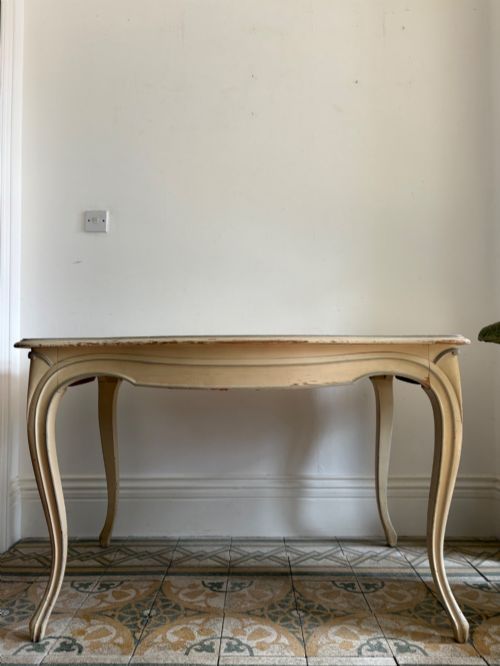
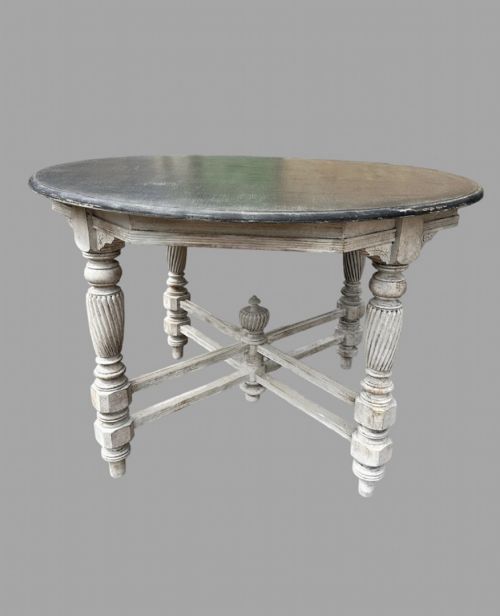
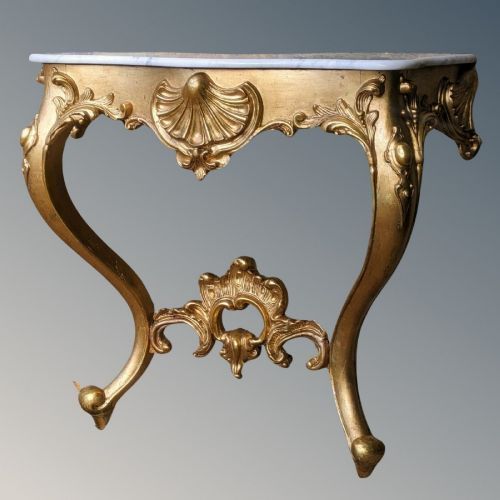
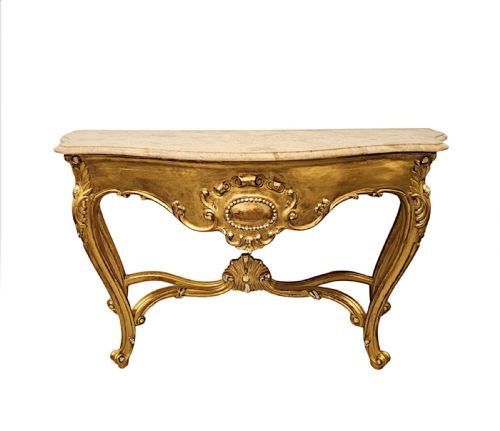
A french chateau entry table typically takes the form of a console table or a centre table designed to anchor a hallway or reception room. These pieces appear in styles ranging from French Rococo and Louis XVI to Baroque and Neoclassical, often featuring serpentine or bow fronts.
The selections on this page span several centuries, including 18th century examples alongside 19th century and early 20th century pieces. Console tables dominate the listings, frequently accompanied by matched mirrors or standing as wall console tables.
Originating in grand domestic settings, these tables provide a striking architectural presence in a modern interior. The forms balance robust timber frames with ornate decorative surfaces suited for a prominent entryway.
Materials and Construction
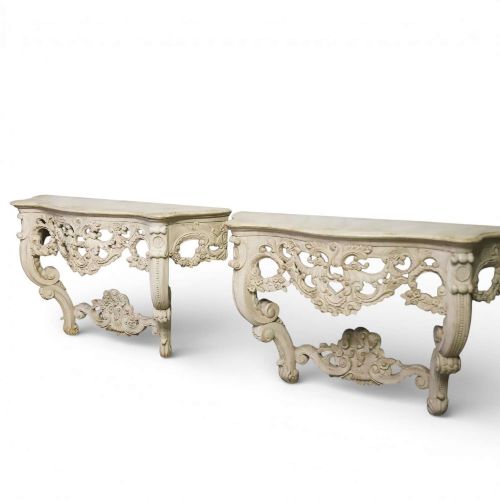
The construction relies heavily on carved wood finished with paint, gesso, or gold leaf to achieve the classic gilded and painted surfaces seen across the periods. Walnut and other hardwoods form the structural basis for hand-carved details and cabriole legs.
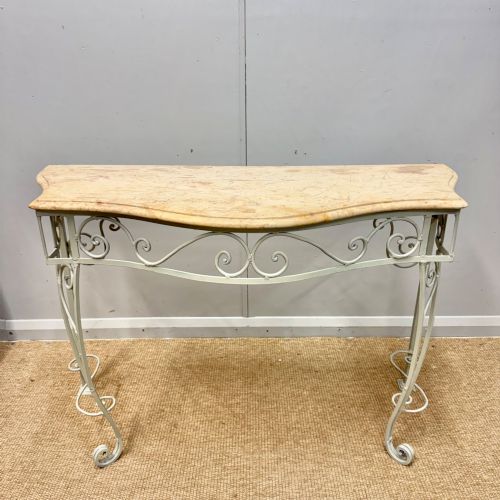
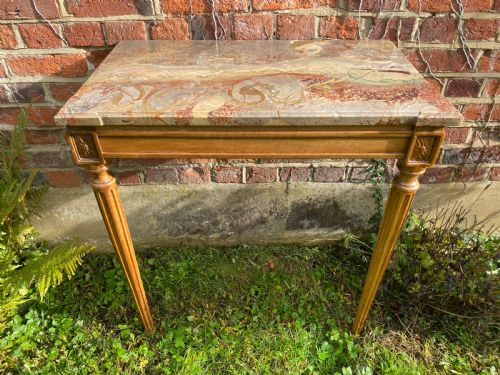
Many examples incorporate inset marble tops that provide a cool, durable surface contrasting with the warmth of carved giltwood or painted timber frames. Wrought iron also appears as a structural material in specific regional variants.
Surface decoration involves traditional hand-applied finishes, from antique white paint to intricate gilding over gesso. Carving is executed by hand, creating deep relief on aprons and legs.
Listings span from the 18th century through the 1930s, featuring marble, giltwood, and painted finishes on console and centre tables.
Assessing Quality and Craftsmanship
Quality reveals itself in the crispness of the hand-carved detail on the wooden frames and the weight and figuring of the marble tops. Superior pieces display harmonious proportions between the carved apron and the slender cabriole legs.
The integrity of the original surface finish, whether giltwood, paint, or gold leaf, distinguishes finer examples from later restorations. Original patination on the timber and metalwork indicates sustained care over the centuries.
The French Chateau Entry Table Glossary
- Console table
- A table designed to be fixed against a wall, often supported by two front legs and secured by brackets at the back. These pieces typically furnish hallways and entryways.
- Centre table
- A freestanding table intended to be viewed from all sides, placed in the middle of a room rather than against a wall. They share similar decorative vocabularies with console tables.
- Cabriole leg
- A furniture leg that curves out and then in, resembling the leg of an animal. This form appears frequently on Rococo and 18th-century furniture.
- Giltwood
- Wood that has been coated with gold leaf or gold paint. This technique creates a luminous surface characteristic of Baroque and Neoclassical styles.
- Serpentine
- A furniture front or edge that curves outward in the centre and inward at the sides. This shape adds dynamic movement to case pieces and tables.
French Chateau Entry Table: Frequently Asked Questions
Where should I place a console table?
These tables find their natural home in a hallway or entryway against a blank wall, often paired with a matching wall mirror to balance the vertical space.
In larger reception rooms, they serve as side tables for lamps and decorative objects, anchoring the perimeter of the room.
How do I care for a marble top?
Marble requires gentle cleaning with a damp cloth and mild soap to protect the polished surface from acidic spills and staining.
Using coasters and mats helps preserve the stone while maintaining its natural finish over decades of daily use.
What is the difference between console and centre tables?
Console tables are engineered to stand against a wall, frequently requiring wall fixings for stability due to their narrow footprints.
Centre tables are built to stand freely in the middle of a room with finished detailing on all four sides.
How do I identify a Neoclassical piece?
Neoclassical design introduces straight lines, symmetry, and classical architectural motifs inspired by ancient Greece and Rome.
This aesthetic contrasts with the earlier curving asymmetry of the Rococo style.