
French Bureau Plat Desk
A french bureau plat desk is a freestanding writing table designed to sit proudly in the middle of a room rather than against a wall.
French Bureau Plat Desk
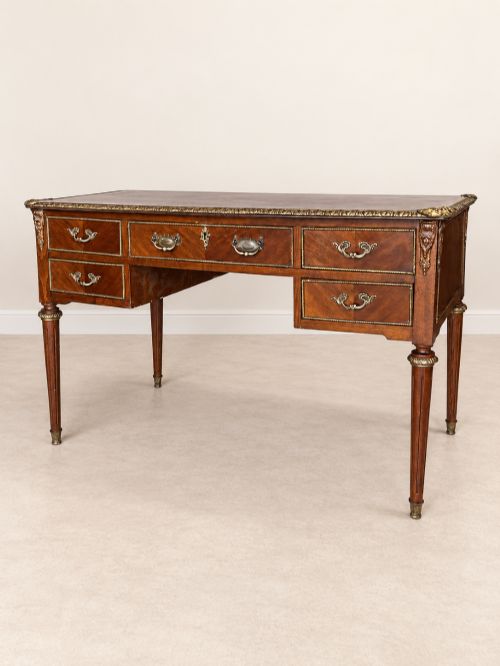
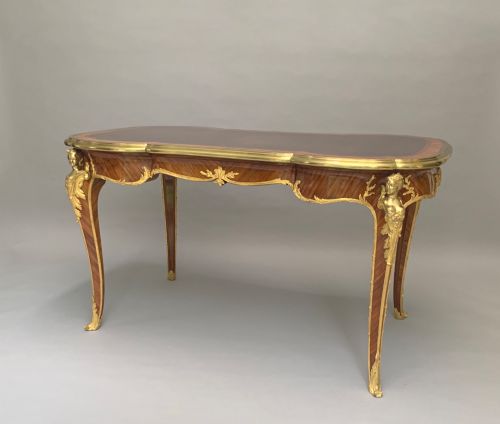
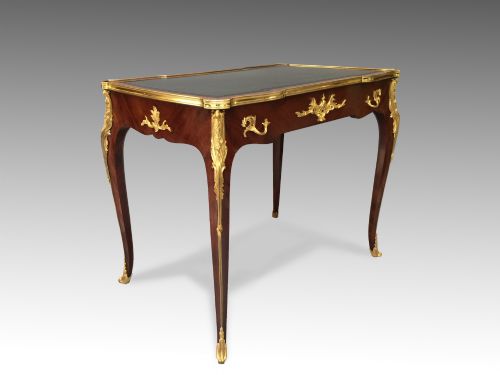
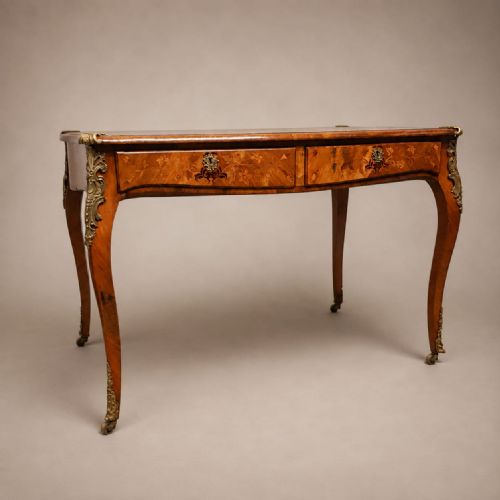
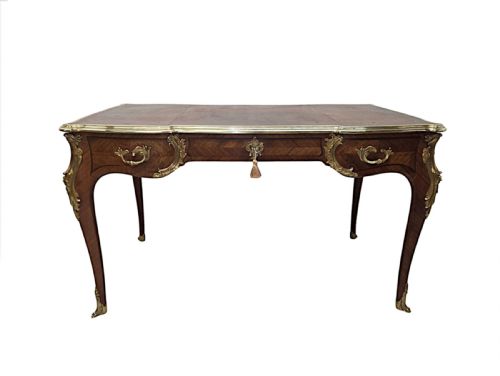
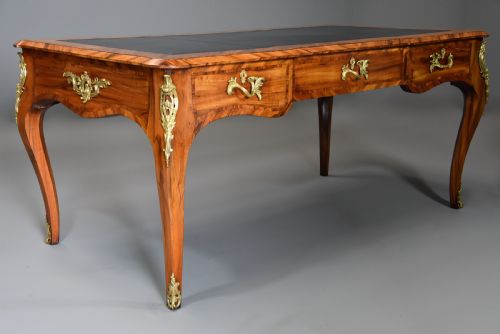
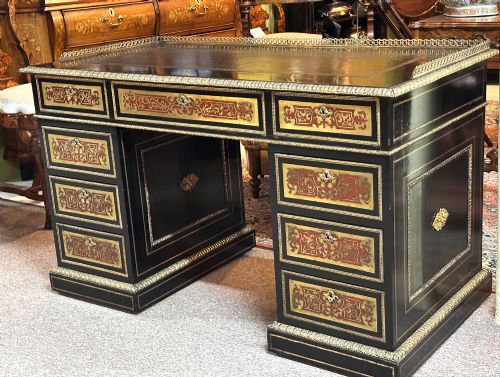
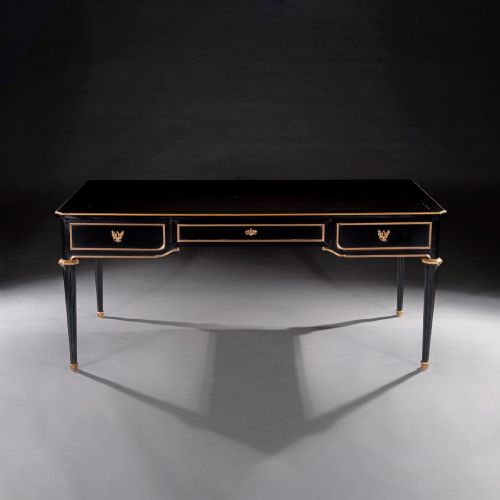
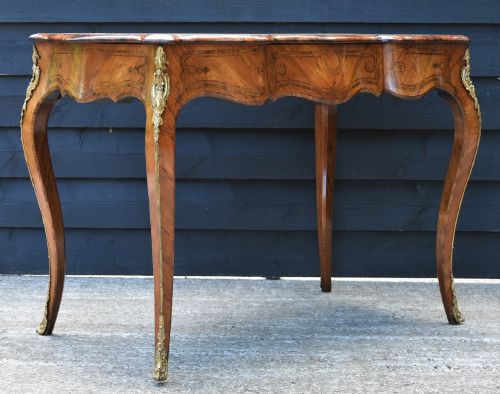
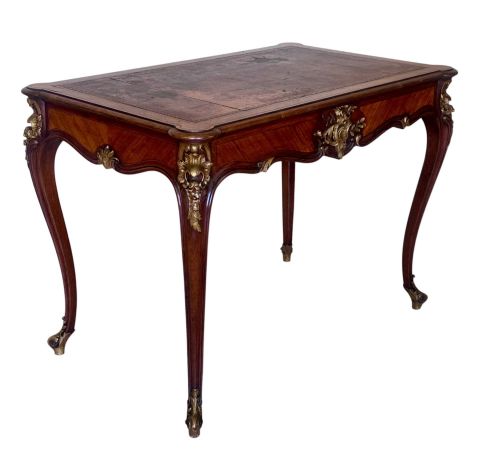
A french bureau plat desk provides a broad writing surface inset with leather, supported on slender cabriole or tapered legs. These pieces emerge predominantly from the nineteenth century, spanning Victorian interpretations and later nineteenth-century revivals.
Makers draw heavily upon Louis XV and Louis XVI vocabularies, producing serpentine outlines and restrained neoclassical proportions alike. The form functions as a writing desk or centre table, finished on all sides for independent placement within a chamber.
Materials and Construction
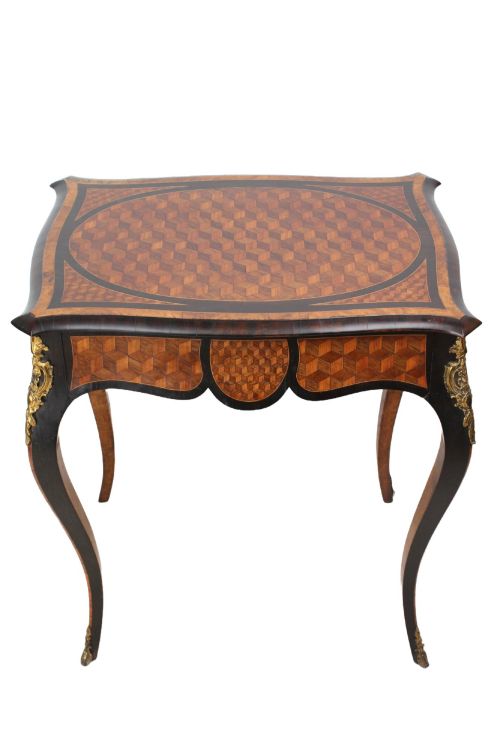
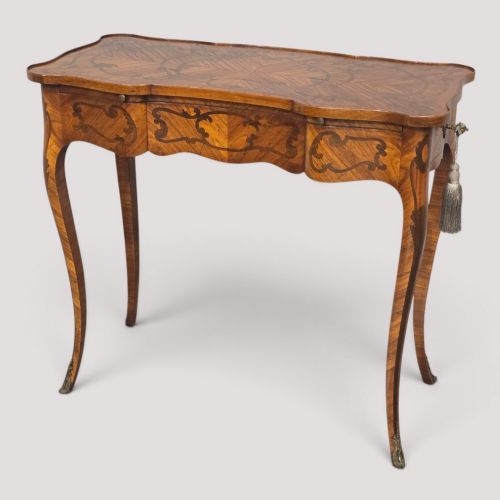
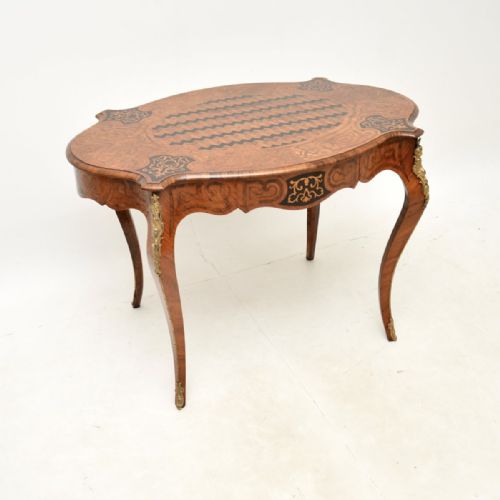
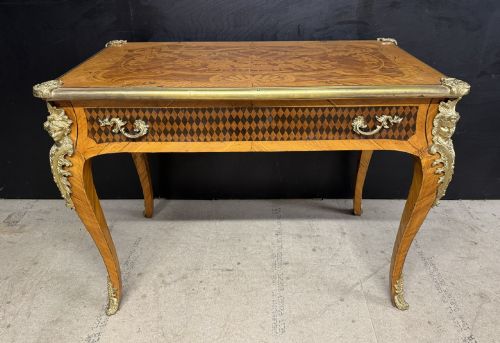
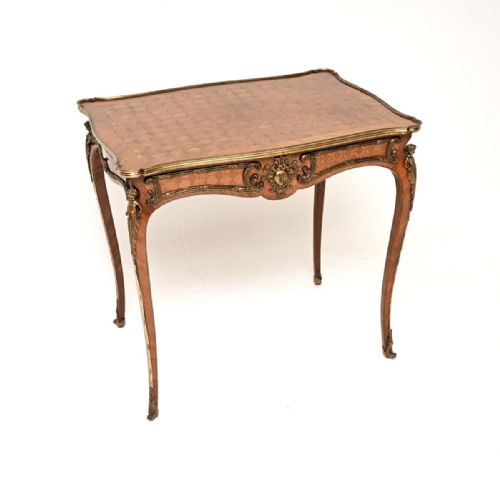
Carinthian and European hardwoods form the primary carcases, overlaid with quarter-cut veneers of kingwood, walnut, mahogany, and rosewood. Intricate marquetry and geometric parquetry patterns decorate the top and frieze drawers with contrasting timber tones.
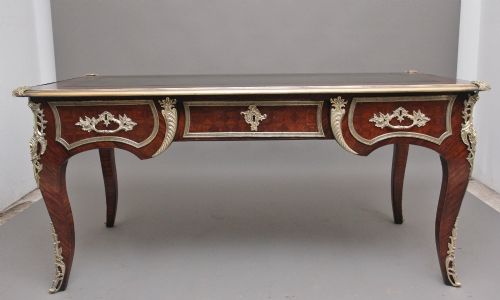
Gilt bronze and ormolu mounts frame the drawers and corners, while chased brass details accent the sabots and borders. Tooled leather panels provide the writing surface, secured with blind tooling around the perimeter.
Listings feature pieces from the Victorian era and the nineteenth century, alongside later revivals up to nineteen-forty.
Standard of Execution
The distinction between ordinary production and masterwork lies in the crispness of the gilt bronze mounts and the depth of the timber figuring. Finer examples display meticulous hand-chased ormolu and tightly fitted parquetry that follows the serpentine curves without distortion.
Structural integrity of the freestanding carcase and the smoothness of drawer movement reflect the workshop standards. Maker attribution, such as pieces bearing the mark of François Linke or Edwards and Roberts, elevates the standing of the work.
Francois Linke·Edwards and Roberts·CH Jeanselme and Co·Durand·JAS Shoolbred
The French Bureau Plat Desk Glossary
- Bureau plat
- A flat-topped freestanding writing table equipped with one or more rows of frieze drawers beneath the surface. This form gained popularity during the eighteenth century and inspired numerous nineteenth-century revivals.
- Ormolu
- Gilded bronze applied to furniture as decorative mounts, handles, and sabots. The process involves coating metal in a mercury and gold amalgam before heating.
- Marquetry
- Decorative veneer work forming pictorial or floral patterns using various coloured woods. Craftsmen cut contrasting timbers together to ensure tight joints.
- Parquetry
- Geometric wood inlay arranged in repetitive patterns such as cubes or chequered grids. This technique highlights the natural grain variations of kingwood and mahogany.
- Sabot
- A cast metal mount fitted to the foot of a table leg for protection and ornamentation. These mounts typically match the design of the shoulder mounts and handles.
French Bureau Plat Desk: Frequently Asked Questions
What is a bureau plat?
A bureau plat is a freestanding writing desk with a flat leather-inset top and drawers built into the frieze. It is finished on all sides so it can float in the middle of a room.
Originating in France, these tables were utilised for correspondence and administrative work rather than storage, lacking the superstructure of a bureau bookcase.
How do I spot a reproduction?
Nineteenth-century pieces often reproduce earlier Louis styles using period timbers, machine-cut veneers, and hand-chased ormolu mounts. Examination of the drawer linings and secondary woods helps determine the exact age.
Makers such as François Linke signed their work, while retailer stamps like Edwards and Roberts indicate high workshop standards from the period.
Can I use it as a desk?
These tables function well as modern desks, provided the height aligns with comfortable seating. The leather top offers a suitable surface for writing.
Care must be taken with historic leather surfaces, which benefit from blotting pads and gentle maintenance rather than heavy daily friction.
What woods were used?
Cabinetmakers employed exotic and domestic hardwoods including kingwood, rosewood, walnut, mahogany, and satine. These timbers appear both as solid framing and as fine veneers.
Parquetry and marquetry patterns combine these woods to create contrasting geometric designs across the top and sides.
What is ormolu?
Ormolu refers to gilt bronze mounts cast and chased by hand to adorn the corners, legs, and aprons of the desk. The metal adds structural emphasis and decorative contrast to the timber.
In finer pieces, the bronze is mercury gilded and meticulously detailed to catch the light across the curves of the carcase.