
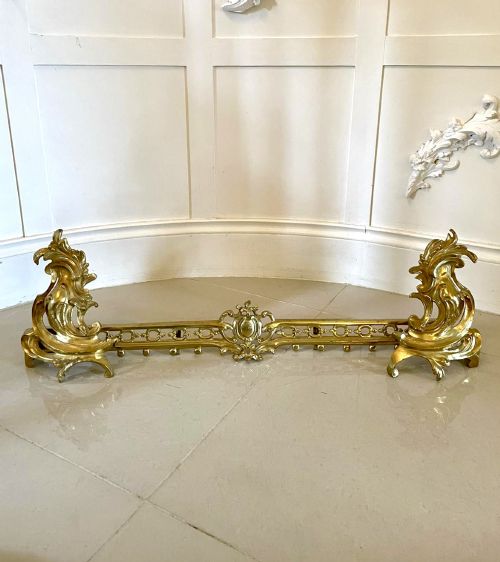
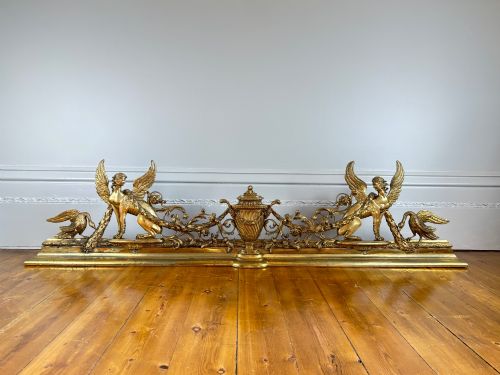

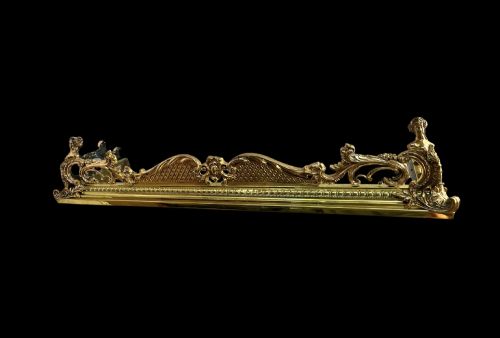


French Brass Fireplace Fender
A French brass fireplace fender frames the hearth with metalwork, bringing formal French design to a working fireplace.
French Brass Fireplace Fender
A French brass fireplace fender is a hearth surround designed to contain embers and protect the room, appearing across nineteenth-century and early twentieth-century dates. You will most frequently meet adjustable examples or pairs of chenets paired with guards, spanning periods from the Victorian era up to the nineteen-twenties.
The styles recorded on this page draw heavily on French design traditions, including Louis XV, Rococo Revival, and Neoclassical Revival forms. Makers and workshops constructed these hearth accessories in gilt bronze, ormolu, cast brass, and polished steel, sometimes combining brass with cast iron.
Buyers seeking a French brass fireplace fender will find pieces ranging from grand extending frames to ornate fire guards and chenets. These items function both as practical hearth barriers and as decorative centerpieces for period fireplaces.
How they were made
Craftsmen utilised cast brass, gilt bronze, and ormolu, applying rich gilding to create reflective surfaces around the hearth. Metalworking techniques included detailed casting and chasing, which allowed workshops to produce elaborate scrollwork and figural motifs.
Many examples incorporate adjustable mechanisms, allowing the metal frame to extend to fit varying fireplace widths. Combinations of brass and cast iron provided the necessary weight and durability for daily use in nineteenth-century interiors.
Listings feature periods from 1850 to 1920, with materials including gilt bronze, ormolu, polished steel, and cast iron.
What varies in quality
Quality in a French brass fireplace fender rests on the crispness of the casting and the depth of the metalwork. Finer examples display sharp, hand-chased details in the ormolu or gilt bronze, whereas simpler versions rely on standard cast brass without subsequent finishing.
The integrity of the extending mechanism and the weight of the materials also distinguish standard production from exceptional pieces. Solid construction in bronze or heavy brass ensures stability across the hearth floor.
E F Caldwell New York
The French Brass Fireplace Fender Glossary
- Ormolu
- Gilded bronze produced by applying a mercury and gold amalgam to a bronze base and heating it. This technique creates a durable, luminous surface finish.
- Chenet
- An alternative term for an andiron, placed at the front of the hearth to support logs or act as a decorative stop. Pairs of chenets often form part of a wider fender arrangement.
- Rococo
- A decorative style characterised by asymmetrical curves, C-scrolls, and naturalistic plant motifs. It heavily influences nineteenth-century French hearth accessories.
- Neoclassical
- A revival style drawing on classical Greek and Roman architecture and ornament. It brings symmetry, urns, and straight lines to fireplace design.
French Brass Fireplace Fender: Frequently Asked Questions
How do I measure for a fender?
Measure the width of your fireplace opening and the hearth stone to ensure the frame sits properly on the floor.
Many period pieces feature adjustable widths, allowing you to fine-tune the fit between the fireplace jambs.
Are all these fenders adjustable?
Not every piece is adjustable, though many nineteenth-century examples incorporate sliding sections to alter the overall length.
Fixed-width fenders and pairs of chenets require precise measurement against your hearth dimensions.
What is the difference between brass and ormolu?
Brass is an alloy of copper and zinc, used widely for cast and sheet metal fireplace accessories.
Ormolu specifically denotes gilded bronze, where a layer of gold is applied to a bronze substrate for a deeper lustre.
Can I use these with a working fire?
These metal frames were originally built to contain embers and protect the room from rolling logs.
Solid construction in brass, bronze, and cast iron makes them suitable for active hearths, provided you check the dimensions first.