




French Brass Clock Set
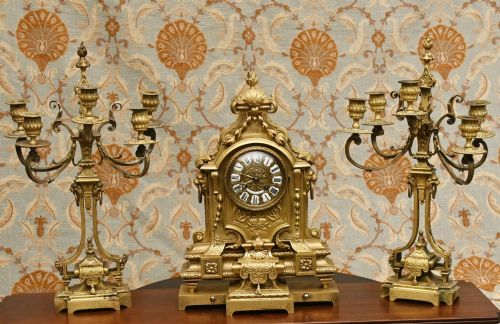
These French brass clock set arrangements combine a striking timepiece with matching side pieces, bringing ornamental symmetry and mechanical precision to a mantelpiece.
French Brass Clock Set
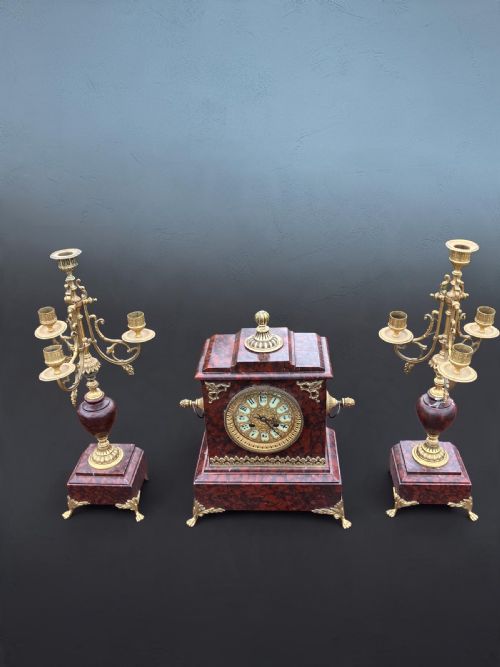
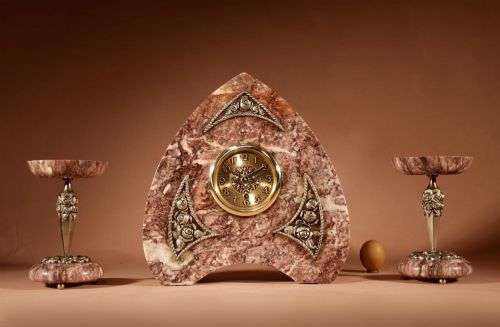
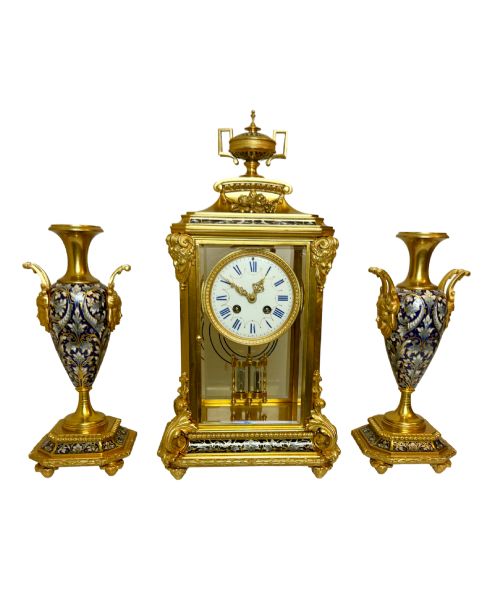
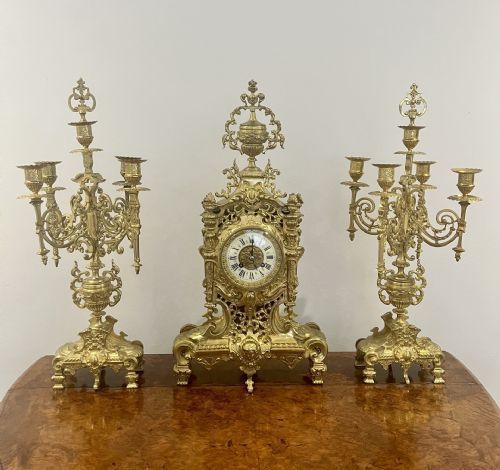
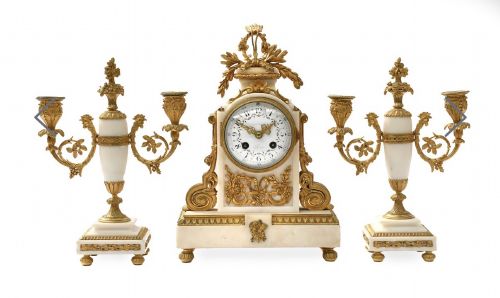
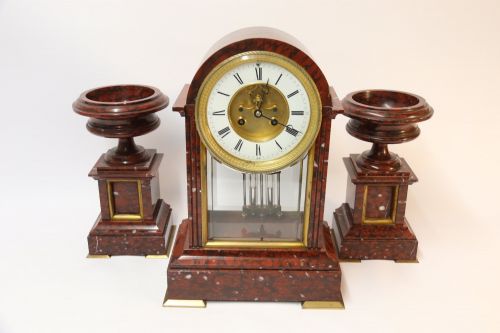
A french brass clock set typically comprises a central mantel timepiece accompanied by matching side ornaments such as candelabras, urns or vases. The listings here span the nineteenth century into the early twentieth century, capturing periods from the Second Empire and Victorian eras through to Art Deco designs.
The most common configurations include three-piece sets featuring a clock flanked by matching decorative objects, often executed in architectural marble, onyx or cast metal. These groupings reflect a traditional desire for balanced interior decoration across formal rooms and studies.
Materials and construction methods
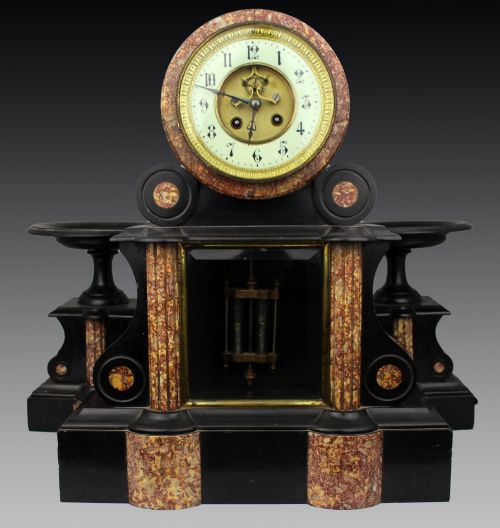
Maker workshops utilised heavy cast brass, bronze and ormolu alongside polished natural stones such as rouge marble, green onyx and black marble. Metalwork was frequently gilded or chased by hand to create intricate surface relief and decorative mounts.
Dials incorporated detailed white enamel with painted numerals, protected behind bevelled glass panes. Movement engineering relied on eight-day striking mechanisms produced by established Parisian clockmakers.
French Brass Clock Set Retail Price Guide 2026
Typical asking prices for french brass clock set among the pieces listed under this phrase on Sellingantiques today, from the lower quarter to the upper quarter. They describe what is for sale here now, not the wider market.
Several sets include tiny bronze Cupids hovering near the clock face, apparently trying to stop the hands from turning.
Distinguishing finer examples
Quality rests in the crispness of the cast metal ornamentation and the weight of the stone bodies. Master founders produced sharper relief in ormolu mounts and champleve enamel work than standard commercial workshops.
The sophistication of the internal movement and the integration of the matching garniture pieces dictate the standing of a set. Complete three-piece assemblies that retain their original matched candelabras or side pieces demonstrate greater harmony of design.
Japy Frères·Samuel Marti·A.D Mougin·Vincenti of Paris·Deniere Paris
The French Brass Clock Set Glossary
- Clock garniture
- A set consisting of a central clock and matching ornamental side pieces designed to be displayed together. These matched sets create a unified visual theme on a mantel or sideboard.
- Ormolu
- Finely ground high-carat gold applied to a bronze base using a mercury amalgamation technique. This historic process yields a rich, durable golden surface.
- Champleve enamel
- A technique where troughs or cells are hollowed into the metal surface and filled with vitreous enamel before firing. It creates colourful geometric or floral patterns across the brass body.
- Escapement
- The internal mechanism that controls the release of power in a clock movement, regulating the rotation of the gears. Different escapement types govern the precision of the strike.
- Portico clock
- A mantel clock featuring a architectural case supported by four or more columns. This neoclassical form gained popularity during the nineteenth century.
French Brass Clock Set: Frequently Asked Questions
How do I maintain an eight-day movement?
Wind the clock carefully using the correct key every week without over-tightening the mainspring. Ensure the case sits perfectly level on a stable surface to keep the pendulum beating evenly.
Professional servicing every few years keeps the internal brass gears clean and properly lubricated. Avoid placing the clock in direct sunlight or damp areas to protect the enamel dial and metal finish.
What is a clock garniture?
A clock garniture is a matched set of decorative objects designed to sit together on a mantelpiece. The central timepiece is flanked by identical side pieces such as candelabras or ornamental urns.
This arrangement originated in grand European interiors to provide symmetrical decoration. Each piece in the set shares the same materials, casting style and decorative motifs.
How do I identify Louis XVI style pieces?
Louis XVI style pieces feature neoclassical elements such as straight architectural lines, symmetrical proportions, and classical motifs like urns and swags. The metal mounts often display acanthus leaves and ribbon bows.
Materials typically include fine marbles paired with gilded bronze or brass rather than the curving asymmetry seen in earlier rococo designs.
Are these clocks suitable for daily use?
These clocks were built for everyday timekeeping and feature robust mechanical movements designed to run for decades. Regular winding keeps the mechanical components functioning properly.
While they serve as reliable timepieces, their age requires gentle handling and protection from vibrations. Many owners choose to set the time carefully by moving the minute hand rather than forcing the mechanism.