


French Allegorical Mantel Figures
French allegorical mantel figures bring narrative mythology and classical personification into domestic rooms through fine metalwork and marble.
French Allegorical Mantel Figures
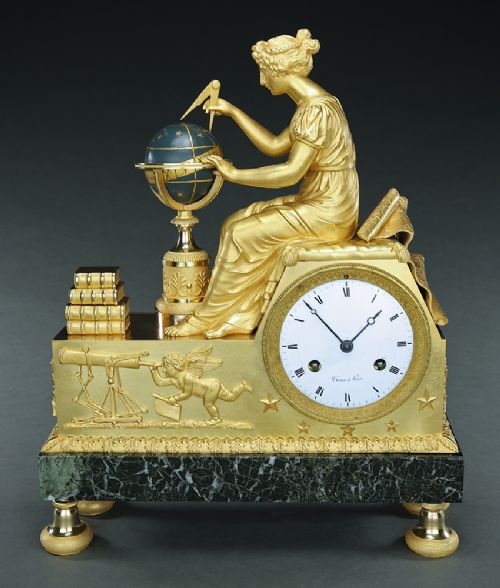
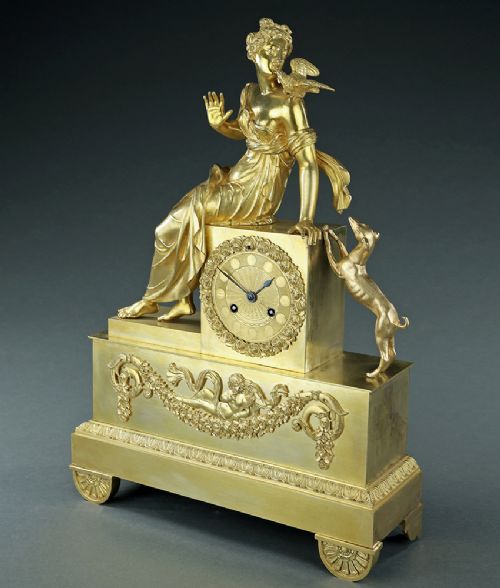
When you search for French allegorical mantel figures, you are looking at sculptural works and clock garnitures that embody abstract concepts like love, fidelity, astronomy, and literature. These pieces take the form of mantel clocks, figurines, statues, and sculptural pairs produced during the nineteenth century, including Georgian and Victorian periods.
The objects frequently depict named personifications such as harvest dancers, Modestie, Gaiete, putti, and chastity. You will most commonly encounter mantel clocks featuring seated or standing figures alongside clock faces, as well as matched pairs of bronze and cast metal statues.
The design vocabulary draws heavily from French Empire, Louis XVI, Neoclassical, French Restoration, and Art Nouveau styles. These stylistic influences dictate the architectural bases, floral mounts, and classical drapery surrounding the central figures.
Materials and construction methods
The makers of these pieces relied primarily on cast metal, bronze, spelter, and gilt bronze or ormolu to render the human form and intricate decorative mounts. Ormolu provides a brilliant golden surface layer through the application of finely ground gold to a bronze base.
Materials recorded across the inventory include gilt bronze, ormolu, marble, brass, bronze, spelter, and cast metal.
Assessing quality in execution
The distinction between standard production and exceptional work lies in the crispness of the bronze chasing and the depth of the ormolu gilding. Superior examples exhibit fine hand-finished detail in the hair, drapery, and facial expressions of the figures.
The choice of base materials also signals quality, with solid rouge marble bases and heavy bronze castings standing apart from lighter spelter and cast metal alternatives. Signed works associated with known founders or makers carry distinct advantages in precision and historical record.
Reiche·Remond·Deniere Et Fils
The French Allegorical Mantel Figures Glossary
- Ormolu
- A method of applying finely ground gold-mercury amalgam to a bronze object, followed by firing to leave a rich golden coating. This technique creates the characteristic bright finish seen on many classical clock mounts.
- Spelter
- A zinc-based alloy frequently used as a less expensive substitute for bronze in nineteenth-century figure casting. It is softer than bronze and often painted or bronzed to imitate finer metal.
- Garniture
- A set of matching decorative objects, typically comprising a central mantel clock flanked by matching candelabra or side urns. These sets create a balanced arrangement on a fireplace mantel.
- Putto
- A representation of a chubby male child, often winged, derived from classical art and frequently appearing in pairs on nineteenth-century bronzes. They symbolise various playful or allegorical themes.
- Neoclassical
- A style inspired by the art and architecture of ancient Greece and Rome, characterised by symmetry, classical proportions, and restrained ornamentation. It heavily influences French Empire and Louis XVI decorative arts.
French Allegorical Mantel Figures: Frequently Asked Questions
What do these figures represent?
These figures personify abstract ideas, virtues, and intellectual pursuits such as fidelity, literature, astronomy, and modesty through classical human form.
They draw on mythological and allegorical traditions to communicate moral or cultural values within a domestic interior.
How do I identify the period?
Period identification relies on observing the stylistic markers, such as the strict symmetry of French Empire and Louis XVI designs versus the flowing organic lines of Art Nouveau.
Material choices, dial construction, and the specific casting quality also help narrow down whether a piece originates from the early nineteenth century or the later Victorian era.
Were these clocks used on mantels?
Yes, the primary function of these figural clock assemblies was to stand on the mantelpiece above a fireplace as both timekeepers and focal points for the room.
Their substantial marble bases and symmetrical garniture pairings were specifically proportioned for display on a fireplace shelf.
What is a clock garniture?
A clock garniture is a matched set consisting of a central mantel clock accompanied by side ornaments designed in the exact same style.
These complementary pieces create a unified decorative scheme across a mantel or sideboard.