

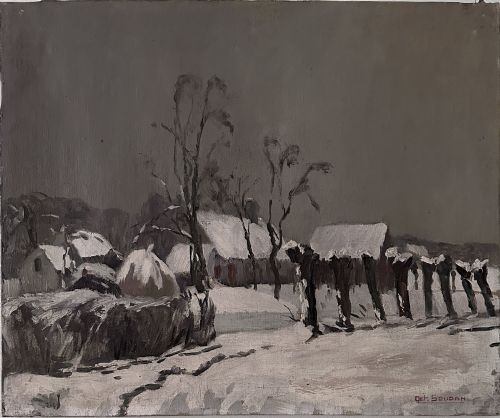
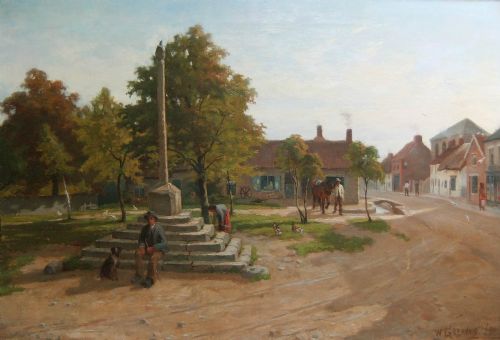


Framed Village Picture
A framed village picture brings home quiet country streets and coastal harbours captured by 19th-century and 20th-century artists.
Framed Village Picture
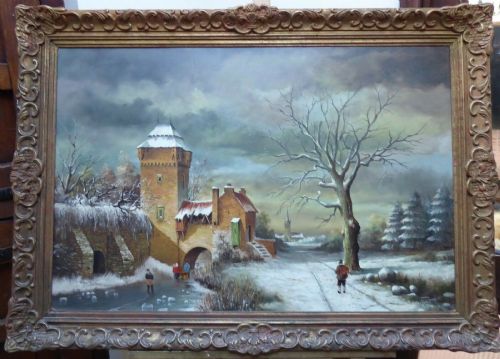
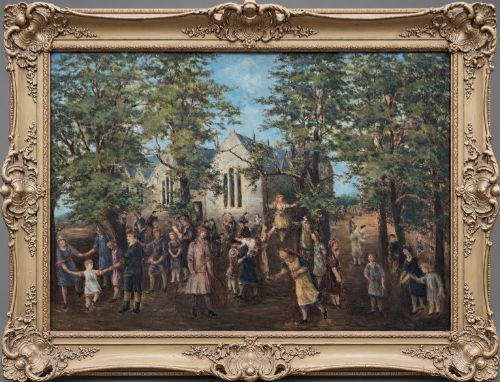
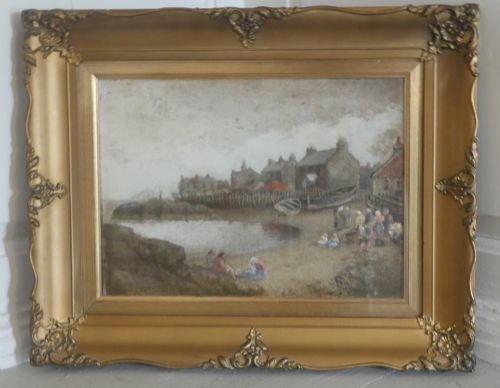
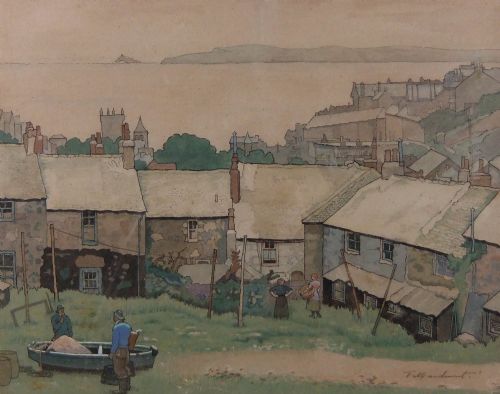
A framed village picture records rural settlements, coastal harbours and country lanes through the eyes of Victorian and 20th-century painters. These works document English and Scottish localities, from Yorkshire villages to Cornish harbours, rendered in authentic period styles.
The versions most often met on this page include watercolours on paper and oil paintings on canvas, housed within their original wooden frames. They span 19th-century realism through to mid-20th-century impressionistic interpretations of rural life.
Materials and construction
These pieces rely on traditional artist materials such as oil paint applied to canvas or watercolour pigment brushed onto paper. Support structures utilise wooden stretchers and heavy paper bases designed to preserve the integrity of the paint layers.
Protection is afforded by glass panes fitted into timber frames, which secure the artwork while exposing the varied brushwork and pigment density. Pastels and coloured etchings also appear, each framed to safeguard delicate surfaces from atmospheric moisture.
Framed Village Picture Retail Price Guide 2026
Typical asking prices for framed village picture among the pieces listed under this phrase on Sellingantiques today, from the lower quarter to the upper quarter. They describe what is for sale here now, not the wider market.
Listings feature works from the 19th century through to the 1960s, utilising oil, watercolour, and pastel on paper and canvas.
Assessing quality
Quality rests in the fidelity of the brushwork and the artist's command of light, perspective and atmosphere within the specific landscape. Stronger examples display confident handling of pigment that brings architectural stonework and natural terrain to life.
The integrity of the framing and the preservation of the paper or canvas surface also dictate the standing of a piece. Original mountings and stable pigment layers distinguish the finer works from more routine decorative productions.
Edward Mills·Thomas Maidment·William Greaves·Arthur Tucker·James Watson·John Edward Bale·Frank Wood·John McDougal·David Woodlock·Walter Henry Sweet·John J. Hamer·David Heward·Joseph Hughes Clayton·Stephanie Cooper·John Holland Snr
The Framed Village Picture Glossary
- Watercolour pigment
- Finely ground colour suspended in a water-soluble binder, applied to paper to create translucent washes of tone.
- Oil on canvas
- Pigment mixed with drying oil applied to a stretched woven fabric support, allowing rich texture and deep colour saturation.
- Etching
- A printmaking method where lines are bitten into a metal plate with acid before being inked and pressed onto paper.
- Pastel drawing
- A work executed with coloured chalk sticks, offering soft powdery textures that require glass protection.
Framed Village Picture: Frequently Asked Questions
What periods do these pictures span?
The works stretch from the mid-19th century through the Victorian and Edwardian eras into the mid-20th century.
Most examples originate from the Victorian period up to the 1950s and 1960s.
How should I hang a watercolour?
Watercolours require placement away from direct sunlight to prevent the pigments from fading over time.
Keep them in stable room conditions to protect the paper and framing materials.
Are these works signed by the artists?
Many pieces bear artist signatures or attributions recorded directly on the canvas, paper or frame.
Some works remain unattributed while still displaying strong regional characteristics and period technique.
What subjects appear in these scenes?
Common subjects include Yorkshire and Cornish village streets, Scottish firths, country inns, and coastal harbours.
Artists focused on recording recognizable British topography and rural daily life.