
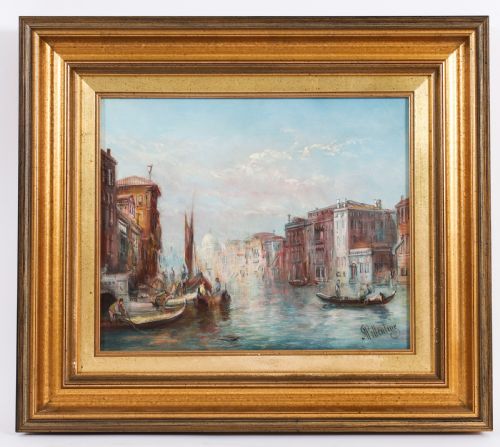
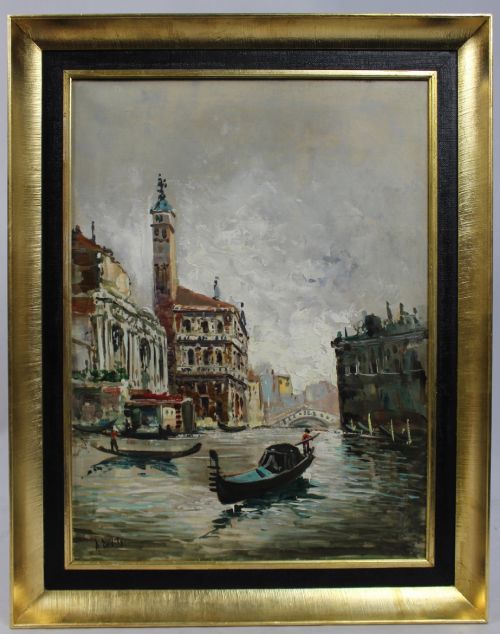
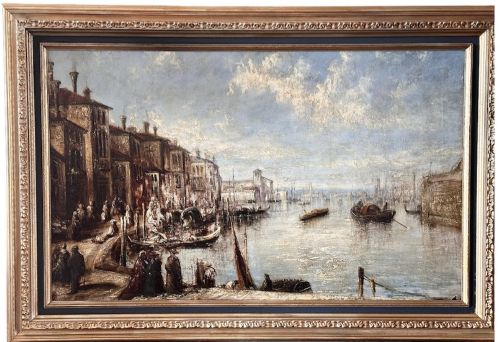
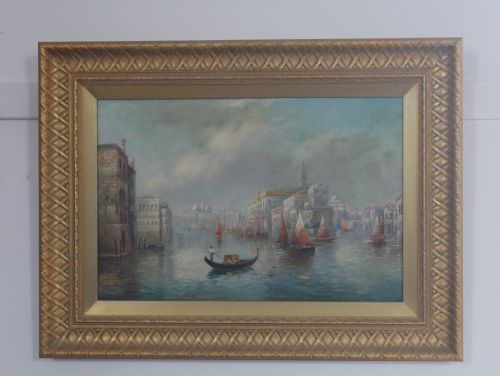


Framed Venice Canal Artwork
Framed venice canal artwork captures the light and architecture of the lagoon through historic oil paintings and watercolours.
Framed Venice Canal Artwork
When searching for framed venice canal artwork, a buyer examines depictions of the Grand Canal, the Doge's Palace, and local waterways executed by British and European artists. These pieces range from Victorian romantic views to mid-century impressionist cityscapes.
The selection centres on framed paintings and watercolours dating from the nineteenth century through the mid-twentieth century. Works span subjects such as the Bridge of Sighs, Santa Maria della Salute, and ordinary gondolas navigating historic waterways.
Most examples belong to the nineteenth century, featuring detailed townscapes and maritime scenes by named painters. Buyers encounter both substantial oil on canvas works and delicate watercolour studies.
How They Were Made
Artists recorded the Venetian lagoon using oil paint on canvas or board, alongside watercolour and gouache on paper. These pigments capture the distinct light reflecting off the water and ancient palazzos.
Surviving pieces retain their period framing in wood and gilded wood, often matching the aesthetic of the Victorian or early twentieth-century era in which they were created.
Venice inspired artists to brave the canals with watercolours and canvases, capturing everything from grand processions to quiet gondola rides.
What Varies in Quality
The distinction between tiers rests upon the precision of the perspective, the handling of light on the water, and the skill demonstrated in rendering complex architectural facades such as the Dogana.
Attribution to a recorded nineteenth or twentieth-century artist elevates a piece significantly. The integrity of the original canvas, paper support, and period giltwood framing also contributes to the standing of an individual work.
Alfred Pollentine·Antonio DeVity·Francis Moltino·Claude Jousset·William Raymond Dommersen
The Framed Venice Canal Artwork Glossary
- Oil on Canvas
- Pigment mixed with drying oil applied to a stretched cloth support. This technique allows for rich colour depth and textured brushwork.
- Watercolour
- A medium consisting of water-soluble pigments applied to paper. It offers luminous, transparent washes ideal for capturing atmospheric sky and water effects.
- Giltwood
- Wood carved and coated with gold leaf or gold paint. It forms the decorative border of traditional picture frames.
- Impressionism
- An art movement focusing on transient effects of light and ordinary subject matter. Mid-century examples apply these principles to Italian townscapes.
- Gouache
- An opaque water-based paint often used alongside watercolour to add solid highlights. It provides dense areas of colour in works depicting nocturnal or brightly lit scenes.
Framed Venice Canal Artwork: Frequently Asked Questions
What subjects appear in framed venice canal artwork?
The works depict iconic Venetian landmarks including the Grand Canal, Santa Maria della Salute, and the Doge's Palace. Artists also recorded quieter waterways, gondolas, and historic palazzos.
Views often feature bustling canal traffic or tranquil lagoon settings captured under various atmospheric conditions, from daylight to moonlight.
How do I date these paintings?
Dating relies on stylistic markers, artist attribution, and framing materials. Nineteenth-century pieces typically exhibit romantic or detailed Victorian conventions, while later works lean towards mid-century impressionism.
Examining the canvas preparation, paper type, and framing style provides further confirmation of the period.
Are these works originals?
The selection comprises original hand-painted works in oil, watercolour, pastel, and gouache. Each piece represents an artist's direct observation or studio interpretation of Venice.
Signatures, artist records, and exhibition histories help verify the individual provenance of these historic townscapes.
How should I display them at home?
These framed artworks suit traditional and contemporary interiors alike, often serving as a focal point in a living room or study. Adequate wall space allows the gilded wood frames and detailed compositions to stand out.
Placement away from direct sunlight preserves the pigments of both the watercolours on paper and the oils on canvas.