
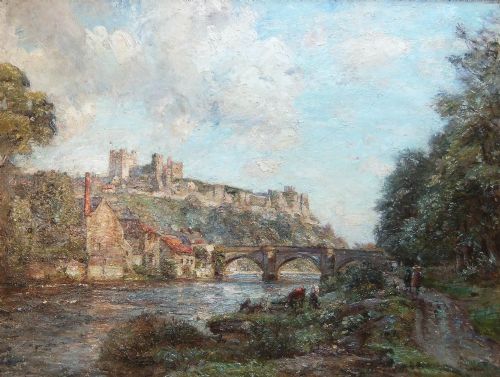

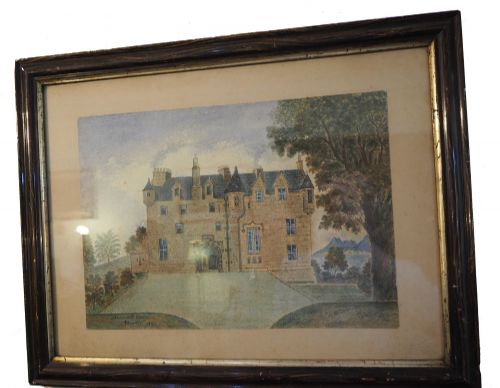
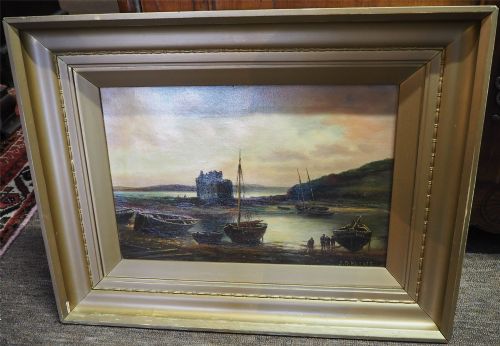
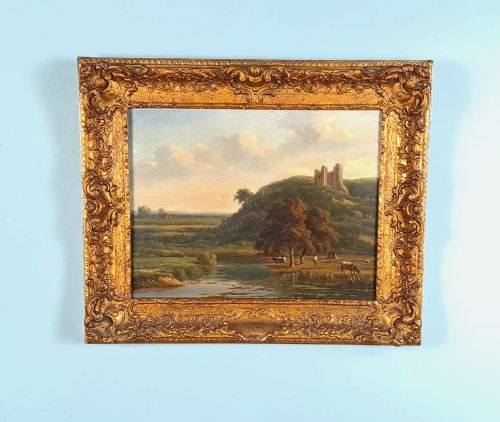


Framed Castle Painting
A framed castle painting brings historic masonry and sweeping landscapes onto the wall, captured through oils and watercolours by generations of artists.
Framed Castle Painting
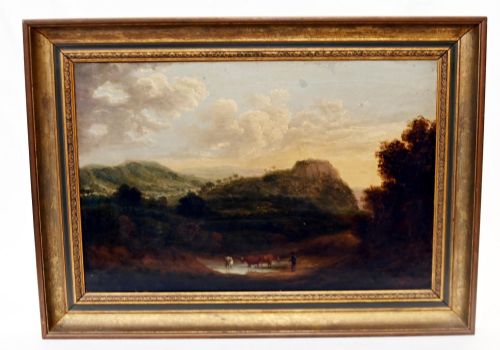
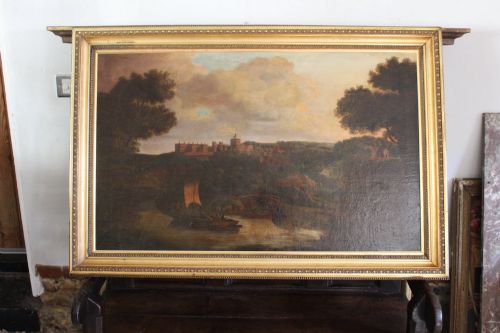
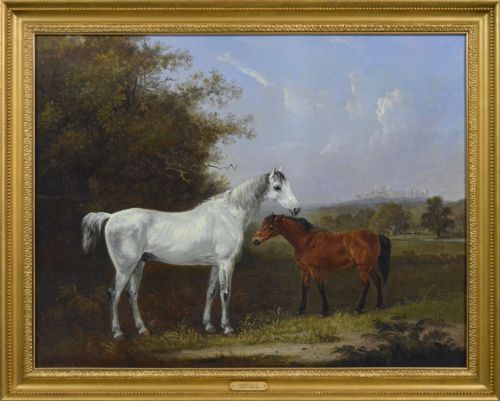
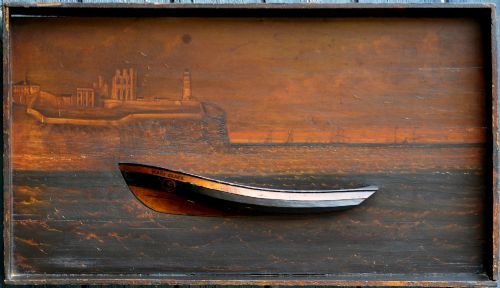
A framed castle painting depicts medieval fortifications, royal residences, and ancient ruins set within British and European landscapes. These works span from the late eighteenth century through the twentieth century, appearing predominantly as oils on canvas or delicate watercolours under glass.
Buyers seeking a framed castle painting will encounter Victorian watercolours alongside large nineteenth-century oil paintings and early twentieth-century depictions. Named fortresses such as Windsor, Bamburgh, and Bolton Castle frequently anchor the composition, grounding romantic scenery in identifiable geography.
The surviving selection ranges from intimate cabinet watercolours to massive giltwood-framed country house oils. While many works emerge from the Victorian era, examples extend into Edwardian and later twentieth-century interpretations of these enduring stone subjects.
Materials and Techniques
Artists built these scenes using oil paint on canvas and board, or watercolour pigment on paper, employing traditional media suited to both studio and plein-air observation. Canvases received layers of pigment to build atmospheric depth in skies and stony facades, whilst watercolours relied on washes to capture light across coastal and river views.
Frames play an integral role in the construction of these pieces, utilising carved wood and gilt surrounds to complement the artistic period. Leaded glass windows with hand-painted castle scenes also appear, demonstrating alternative decorative applications of the subject matter.
Artists occasionally painted Scottish castles during sudden rainstorms, ensuring the masonry looked authentically damp.
Assessing Quality
Quality in a framed castle painting rests upon the artist's command of perspective, light, and structural proportion when rendering complex masonry. Stronger examples display confident brushwork or precise washes that define stone texture and atmosphere without relying on formulaic repetition.
The relationship between the artwork and its period frame alters the overall integrity of the piece. Original giltwood or moulded frames that complement the date of the canvas elevate the presentation, whilst inferior or later mountings diminish the historic context.
Herbert Royle·T C Hofland·Thomas Cooper Moore·James Orrock·David Cox Jnr·William Mellor·George Gregory·George Morland·Frank Wood·Samuel Sidley·Fred Lawson·Willie Stephenson
The Framed Castle Painting Glossary
- Watercolour pigment
- A medium composed of colourants suspended in a water-soluble binder, applied to paper to create translucent washes and fine illustrative detail.
- Giltwood
- Timber carved and coated with a thin layer of gold leaf, commonly utilised for ornate nineteenth-century picture frames.
- Oil on canvas
- A painting technique utilising pigments bound in drying oils applied to a stretched woven fabric support, allowing rich colour saturation and texture.
- Board
- A rigid flat substrate used instead of canvas for painting, frequently utilised by artists working outdoors during the nineteenth century.
- Provenance
- The documented history of ownership surrounding an artwork, which helps establish authenticity and origin over time.
Framed Castle Painting: Frequently Asked Questions
What periods do these paintings date from?
The available selection primarily encompasses nineteenth-century and Victorian works, alongside Georgian origins and early twentieth-century pieces.
Artists continued interpreting historic fortresses well into the twentieth century, providing a broad chronological range for collectors.
How were these artworks displayed historically?
These paintings were traditionally hung in country houses, drawing rooms, and studies within substantial decorative frames.
Large oil works served as focal points above mantelpieces, whilst smaller watercolours suited more intimate domestic spaces.
Are the castles in the paintings real places?
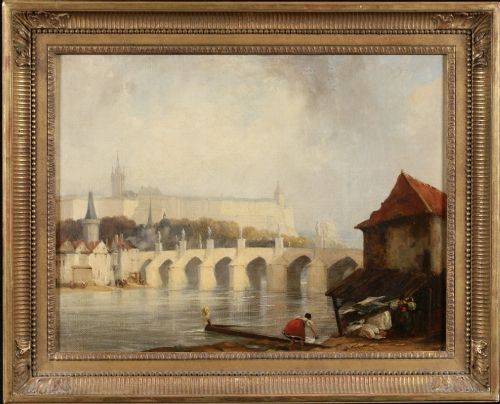
Many works depict actual British and European landmarks, including Windsor, Edinburgh, Conwy, and foreign sites like Prague Castle.
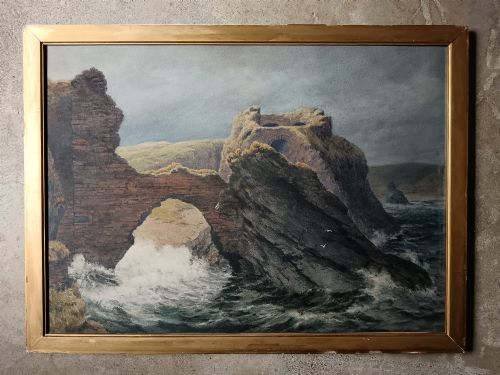
Some compositions focus on ruined strongholds that inspired romantic interpretations by landscape painters of the period.
How do I care for a framed antique painting?
Keep the artwork away from direct sunlight and fluctuating humidity to protect both the canvas pigments and the wooden frame.
Dust the gilt surfaces gently with a soft dry brush and avoid using chemical cleaners on the antique materials.