


Four Tier Corner Stand
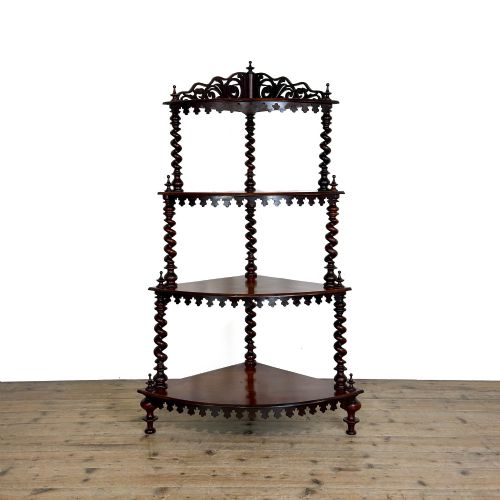
A four tier corner stand brings upright display into neglected rooms, making use of awkward angles with stacked shelves.
Four Tier Corner Stand
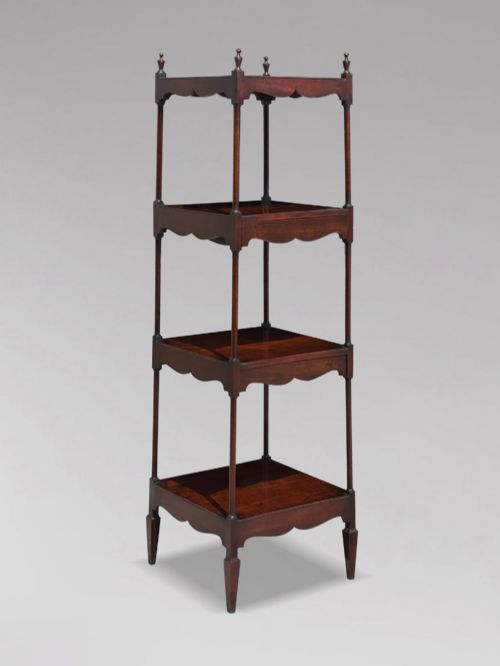
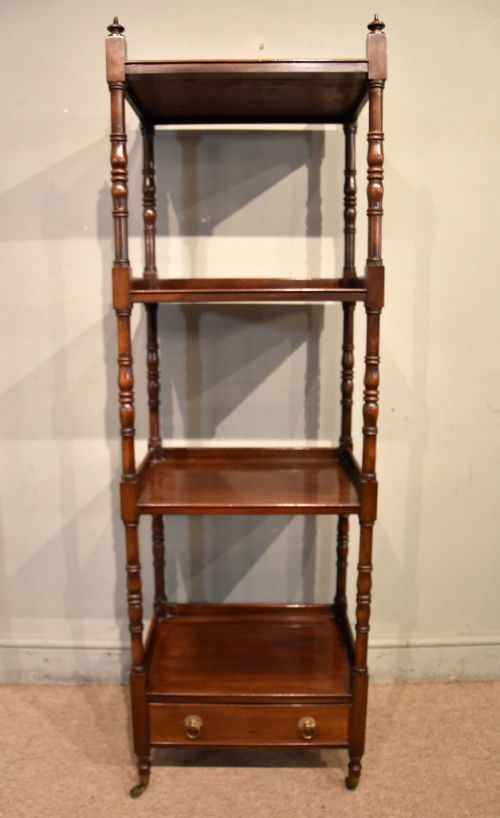
A four tier corner stand, also catalogued as a whatnot or etagere, provides stepped shelving designed specifically to fit the intersection of two walls. These pieces emerge across the Georgian, Regency, and Victorian periods, serving as functional display furniture for parlours and drawing rooms.
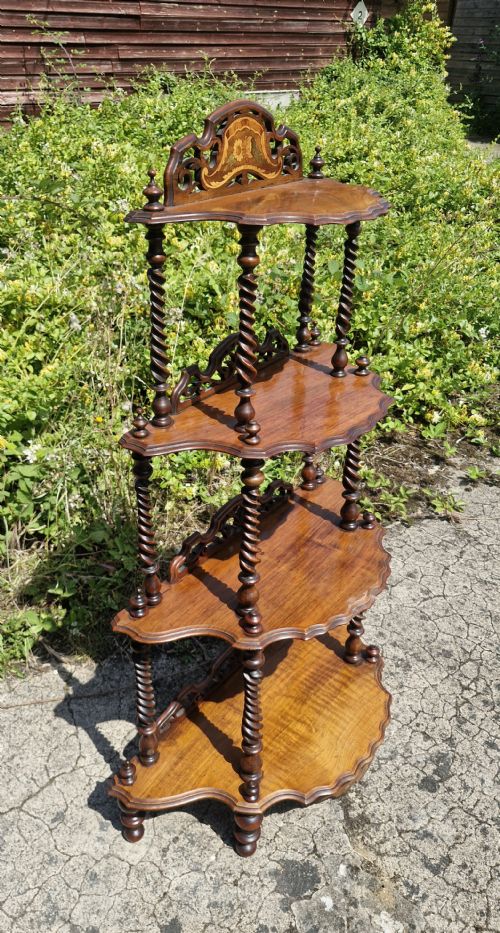
The version most commonly met on this page is the Victorian four tier corner stand in mahogany or burr walnut. These examples utilise graduated shelves supported by turned or column uprights, often finished with marquetry inlay or wood inlay detail.
Makers adapted the form to suit domestic display needs, resulting in freestanding corner units alongside specific A-frame or tapering shelf configurations. The four tiers allow collectors to exhibit small ceramics, books, or decorative objects without dominating the floor space.
Materials and construction
Cabinetmakers built these tier stands predominantly using dense timbers such as mahogany, walnut, and rosewood. Sections of burr walnut and decorative marquetry inlay appear on finer Victorian examples to create visual contrast on the upper surfaces.
Structural stability relies on solid upright supports and carefully jointed shelf platforms, sometimes incorporating brass fittings or subtle wood inlay. The wood is finished to highlight natural grain patterns, ranging from dark polished mahogany to warm figured walnut.
Some Victorian corner stands feature tiny turned finials perched on top like miniature architectural caps.
Assessing quality and execution
Quality rests in the choice of timber and the precision of the shelf joints rather than sheer ornamentation. Superior pieces employ figured burr walnut or dense mahogany with crisp turning on the supports, whereas simpler iterations rely on plain domestic timber.
The integration of detailed marquetry inlay and well-executed corner alignment separates standard utility shelving from high-status drawing room furniture. The joinery where the tiers meet the uprights determines the structural integrity and overall refinement of the stand.
Gillows
The Four Tier Corner Stand Glossary
- Whatnot
- A piece of furniture consisting of a set of open shelves for displaying small objects. This form gained popularity during the Georgian and Victorian eras.
- Etagere
- A set of tiered open shelves used for display. The term often applies interchangeably with whatnots in nineteenth-century records.
- Marquetry inlay
- Decorative patterns formed by inserting thin pieces of wood into a solid wood ground. It frequently appears on Victorian walnut surfaces.
- Burr walnut
- Wood taken from a walnut tree growth, showing intricate and swirling grain patterns. Cabinetmakers used burr veneers on prominent surfaces for decorative effect.
Four Tier Corner Stand: Frequently Asked Questions
What were four tier corner stands used for?
These stands served as display furniture in nineteenth-century sitting rooms. Owners placed ornaments, small clocks, and ceramics upon the graduated shelves.
The corner placement allowed households to utilise dead space while keeping prized collections visible to visitors.
How do I date a corner whatnot?
Dating relies on timber choice, construction methods, and stylistic cues present in the woodwork. Georgian and Regency pieces typically show cleaner lines and simpler mahogany construction.
Victorian examples frequently introduce burr walnut veneers, decorative inlay, and more elaborate turning on the upright supports.
Are these stands stable enough for heavy books?
Most tier stands were designed for lighter decorative objects rather than heavy library volumes. The graduated shelf depths mean the top tiers are narrow and best suited to small ornaments.
Placing heavy items on the upper shelves can compromise the balance of the piece, so weight should remain grounded on the lowest tier.
How do I fit a corner stand into a modern room?
A corner unit tucks directly into empty wall junctions, taking up minimal floor area while adding vertical display capacity. They suit dead corners in living spaces or hallways.
Pairing the dark tones of mahogany or walnut with simple surrounding decor lets the stacked wood grain stand out.