

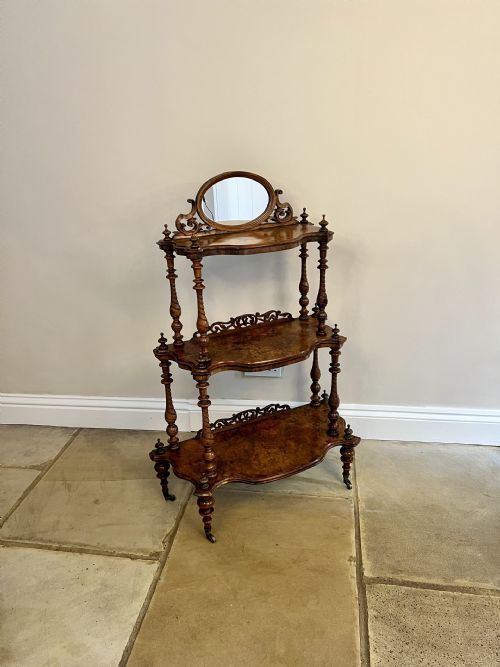
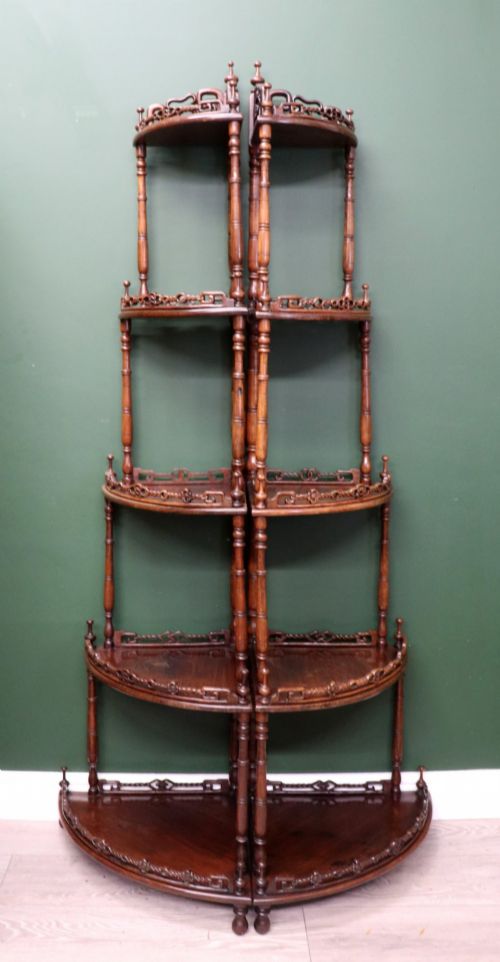
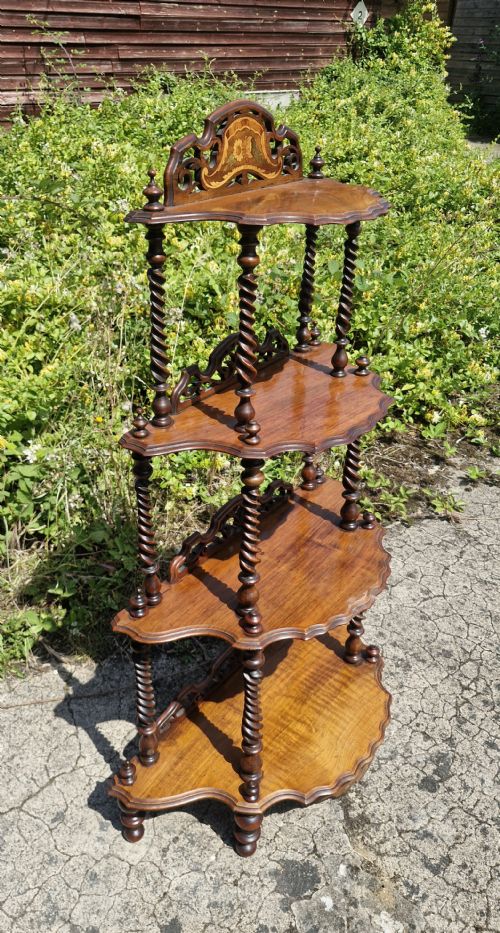
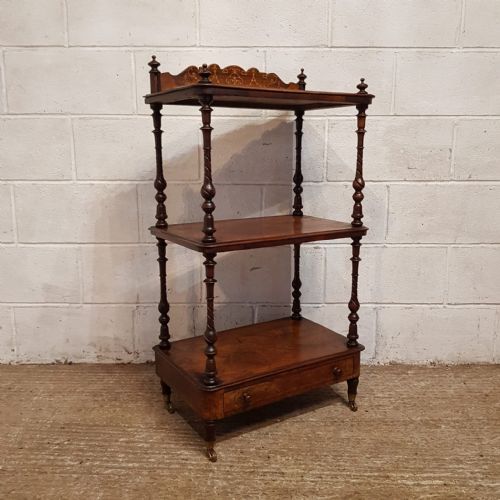


Carved Walnut Corner Whatnot
A carved walnut corner whatnot fits awkward angles with tiered display space, bringing rich Victorian timber into neglected corners.
Carved Walnut Corner Whatnot
A carved walnut corner whatnot is a tiered shelving unit designed to fit into the corner of a room, saving floor space while offering multiple levels for display. The examples on this page are predominantly Victorian pieces originating from the mid to late nineteenth century, spanning decades such as the eighteen fifties, sixties, seventies and eighties.
Most entries are corner whatnots or freestanding corner display stands utilising the ninety degree angle of a room. Formats range from four tier shelving units to five tier towers, sometimes featuring marquetry inlay, mirrored glass, or lower cabinet doors in mahogany and walnut.
How they were made
Makers utilised solid walnut and burr walnut veneers, often combining them with secondary woods like mahogany. Surfaces frequently display marquetry inlay and brass details, while structural uprights incorporate carved elements and turned supports.
Construction methods rely on tiered wooden platforms secured by turned columns or carved pillars. More elaborate examples integrate ceramic components, mirror glass panels, or small cabinet sections beneath the open shelves.
Materials across the selection combine walnut, burr walnut, mahogany, brass, ceramic, mirror glass, and marquetry inlay.
What varies in quality
The choice of timber creates a distinct visual hierarchy, moving from plain walnut to highly figured burr walnut veneers. Marquetry inlay work and the intricacy of carved decoration also separate standard items from exhibition grade pieces.
Structural complexity influences distinction, with simpler open shelving units sitting apart from pieces incorporating glass, brass fittings, or enclosed lower cupboards. The number of tiers and the precision of the turned supports further distinguish individual pieces.
The Carved Walnut Corner Whatnot Glossary
- Whatnot
- An open multi-tiered piece of furniture designed for displaying ornaments and small objects. It originated in the eighteenth century and remained popular throughout the Victorian era.
- Burr walnut
- A prized timber cut from the abnormal growth or burl of a walnut tree, yielding swirling, highly figured grain patterns. Cabinetmakers used it as a veneer on high status Victorian furniture.
- Marquetry inlay
- The art of applying pieces of veneer into a fitted surface to form decorative patterns or pictures. Victorian pieces often use contrasting woods for floral or geometric motifs.
- Demi-lune
- A half moon shape applied to tables or console units. These pieces sit flat against a wall while retaining a curved front edge.
- Etagere
- A French term for a piece of furniture consisting of a set of open shelves for displaying ornaments. The terms whatnot and etagere often overlap in nineteenth century records.
Carved Walnut Corner Whatnot: Frequently Asked Questions
Where should I place a corner whatnot?
These units fit directly into ninety degree room angles, turning unused corners into display space for ceramics, books and ornaments.
Because they occupy vertical wall junctions rather than central floor space, they suit both compact rooms and larger period drawing rooms.
How do I identify a Victorian corner whatnot?
Look for nineteenth century timber choices such as walnut and burr walnut, combined with turned uprights, marquetry inlay and tiered open shelving.
Most examples date between the eighteen fifties and the eighteen eighties, reflecting the period's fondness for decorative display furniture.
Can these shelves hold heavy items?
Open tiered shelving units are designed primarily for decorative ornaments, small clocks, and light porcelain collections rather than heavy books.
The turned supports and tiered platforms provide stable support for standard display pieces but are not built for heavy loads.