
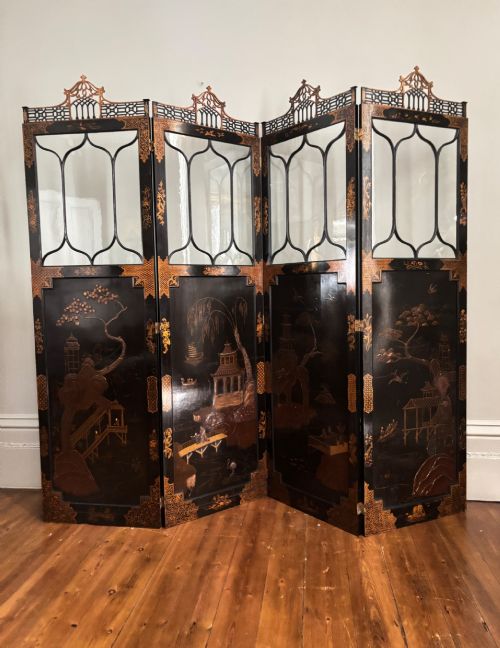
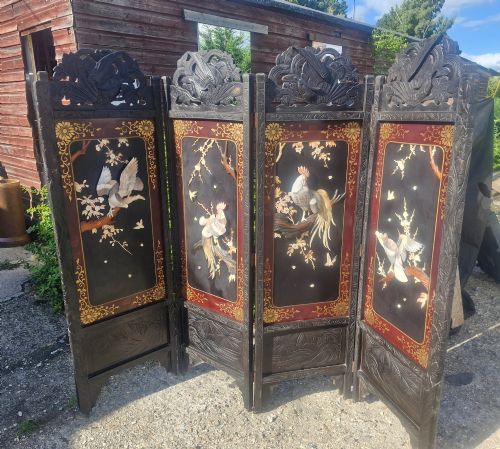
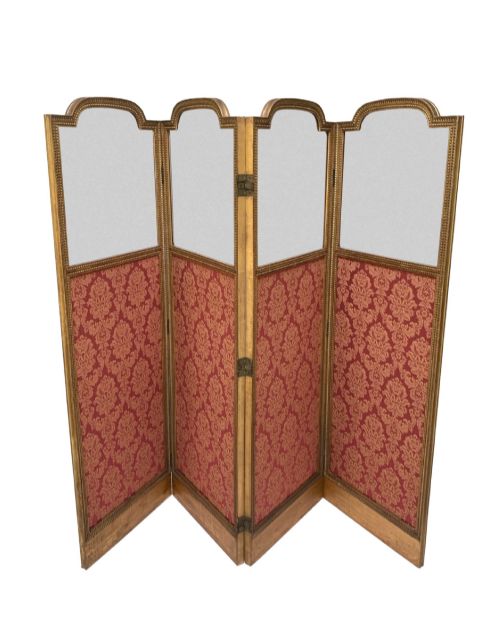
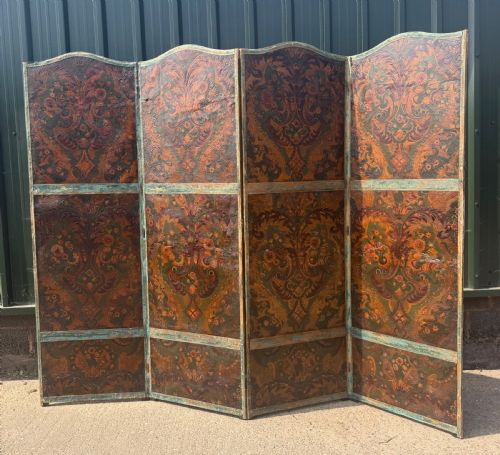


Four Fold Room Screen
A four fold room screen splits a large space and catches the eye, built to turn a draughty corner into a private study.
Four Fold Room Screen
A four fold room screen provides a flexible way to divide an interior space, functioning as a dressing partition or a decorative focal point. When you search for a four fold room screen, you encounter pieces originating from the eighteenth, nineteenth, and early twentieth centuries.
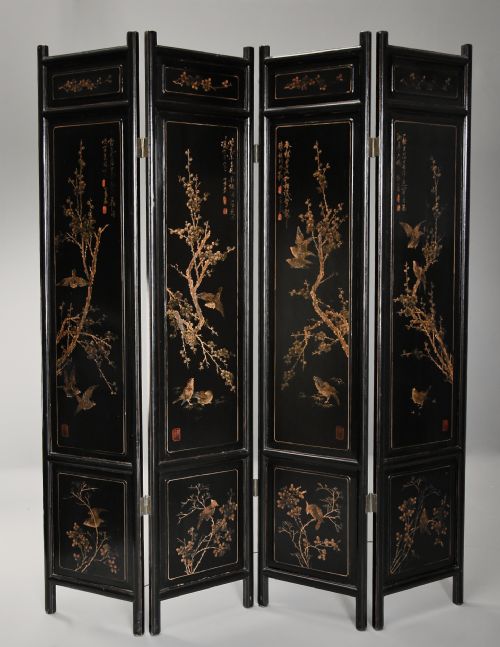
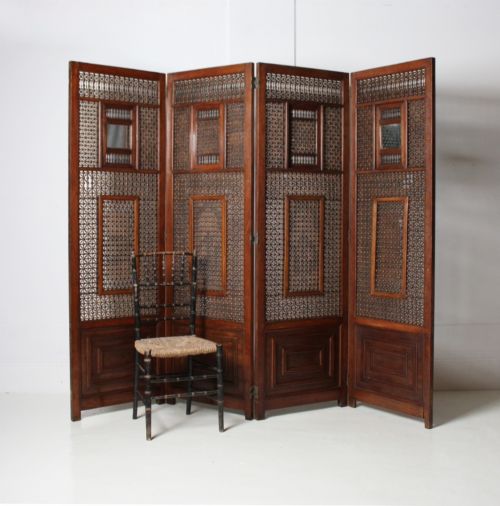
The material vocabulary spans carved hardwood, ebonised oak, lacquered panels, and heavy leather. Common decorative idioms include Chinoiserie, French Chateau, Chinese Chippendale, and Arts and Crafts, reflecting varied domestic tastes across British, French, Chinese, and Japanese traditions.
How they were made
Constructed around a rigid timber framework of mahogany, walnut, or oak, these screens utilise hinged panels to allow smooth articulation. Joinery methods range from traditional pegged mortise and tenon joints to sturdy brass connecting hinges.
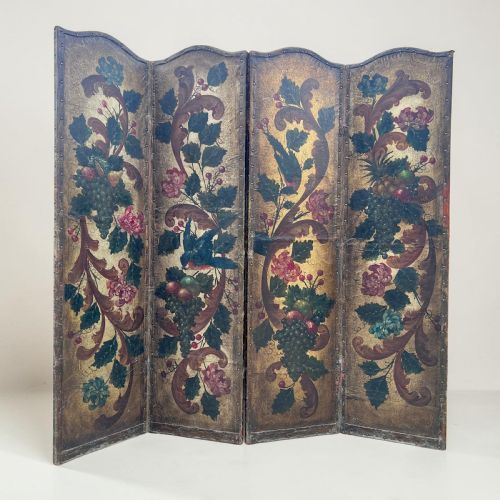
Surfaces receive decorative treatments such as hand-painted polychrome pigments, carved bone, hardstone mounts, and embossed gilt leather. Textile panels incorporate needlepoint, silk cotton, and jacquard fabrics stretched securely across internal wooden frames.
Victorian scrap work screens doubled as parlour games, where guests spent hours hunting for hidden lithographs pasted beneath layers of varnish.
What varies in quality
The distinction between standard examples and the finest pieces lies in the depth and precision of surface embellishment. Hand-carving on hardwood frames or deep relief work on lacquer and bone show an artisan's careful hand compared to simpler painted finishes.
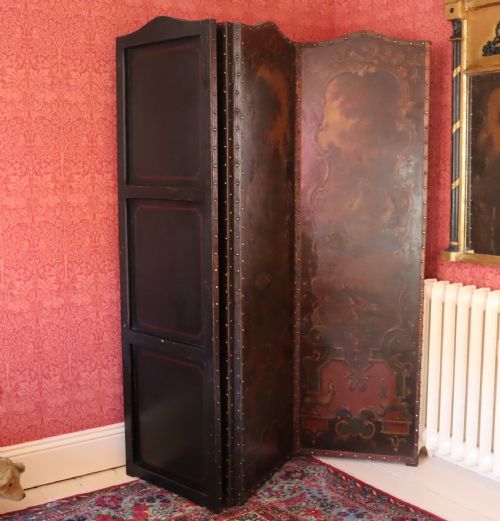
Structural integrity relies on the quality of the timber and the original hinges, where heavier leather and canvas require robust support to prevent sagging. The subtlety of polychrome pigments and gilt tooling elevates an ordinary room divider into a masterwork.
Paul Sormani·William Morris
The Four Fold Room Screen Glossary
- Chinoiserie
- European interpretations of Chinese and East Asian artistic traditions, often applied in lacquer and gilt decoration. This style gained immense popularity during the eighteenth and nineteenth centuries.
- Cordoban leather
- Heavy Spanish leather embossed, painted, and gilt with rich patterns. Artisans used this durable material for sumptuous wall hangings and privacy screens.
- Mashrabiya
- An architectural element of turned wood lattices forming intricate geometric screens. It filters light and provides ventilation while maintaining privacy in domestic interiors.
- Scrap work
- A Victorian craft technique where colourful paper scraps and lithographs were pasted onto panels. These layers were then varnished to create a dense, narrative collage.
- Needlepoint
- A form of counted thread embroidery stitched onto a stiff canvas mesh. It provides a durable, tactile surface frequently utilised on nineteenth-century upholstery panels.
Four Fold Room Screen: Frequently Asked Questions
How do you stabilise a tall screen?
A tall four fold room screen stands securely when the panels are arranged in a gentle zig-zag or accordion configuration rather than pulled completely flat.
Positioning the folds at alternating angles distributes the weight evenly and prevents the panels from tipping under their own height.
Were these used outdoors?
These pieces were designed strictly for interior domestic use to manage draughts and create private dressing areas within larger chambers.
Exposure to moisture and temperature fluctuations outdoors damages delicate lacquered surfaces, leather, and fabric upholstery.
How do I care for leather panels?
Painted and embossed leather panels require a stable indoor environment away from direct sunlight and excessive heat sources.
Dusting them gently with a dry, soft cloth preserves the gilt tooling and prevents the painted surface from cracking.
What defines a dressing screen?
A dressing screen typically incorporates mirrors, fabric, or leather to provide privacy in a bedroom while changing clothes.
Many examples feature lightweight construction so they could be easily moved around the room as needed.