

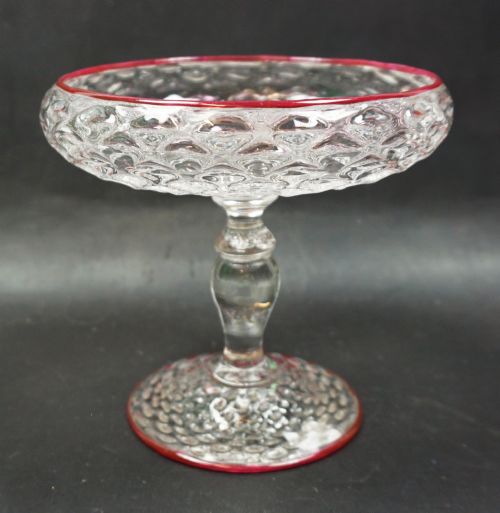

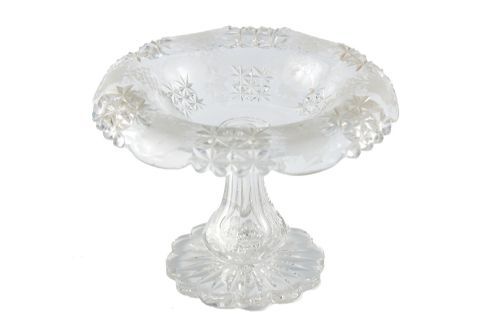


Footed Crystal Compote
These footed crystal compote pieces elevate fruit and sweetmeats upon your table with substantial weight and refractive brilliance.
Footed Crystal Compote
A footed crystal compote sits raised upon a pedestal or stem, serving as a decorative bowl or fruit dish for the dining table. These table centrepieces and tazzas appear in forms spanning the Georgian, Victorian, and Edwardian eras, alongside later twentieth-century examples.
The pieces on this page include heavy pedestal bowls and moulded tazzas originating from English and Bohemian workshops. You will encounter traditional Irish crystal alongside clear glass fruit bowls and coloured overlay vessels.
Forms range from deep hobnail patterned bowls to shallow etched plates on elevated feet. Each serves to display fruit or confections while catching the light of a dining room.
How They Were Made
Glassmakers created these vessels using lead crystal or clear glass, shaping them through hand blowing and mould pressing. Artisans then applied wheel-cutting techniques to carve deep geometric facets and decorative patterns into the surface.
Some pieces incorporate cased glass methods, fusing layers of coloured and clear crystal together before cutting through the outer layer. Etched ornamentation and applied details such as red cane decoration complete the manufacture of specific tazzas.
Footed Crystal Compote Retail Price Guide 2026
Typical asking prices for footed crystal compote among the pieces listed under this phrase on Sellingantiques today, from the lower quarter to the upper quarter. They describe what is for sale here now, not the wider market.
Victorian dining tables required tall glass architecture to impress guests, meaning your dessert often sat higher than the conversation.
What Varies in Quality
The clarity and weight of the lead crystal establish the foundational quality of each compote, alongside the depth and crispness of the wheel-cut facets. Sharp, well-defined cutting reflects light with greater brilliance than soft or shallow incisions.
Proportion and balance between the bowl and the supporting foot dictate the elegance of the piece. Superior examples display harmonious form and careful finishing to the pontil mark on the underside of the base.
The Footed Crystal Compote Glossary
- Compote
- A raised bowl on a stem or foot used for serving fruit or sweetmeats. This form sits centrally on dining tables.
- Tazza
- A shallow saucer or bowl mounted on a pedestal foot. Such vessels often display elaborate cut or etched decoration.
- Hobnail
- A faceted glass pattern resembling the broad-headed nails used on heavy boots. This texture creates strong light refraction.
- Cased Glass
- Glass made from two or more distinct layers of different colours. Cutting away the outer layer reveals the contrasting glass beneath.
- Pedestal Bowl
- A container elevated upon a distinct foot or stem. This construction lifts the contents above the surface of the table.
Footed Crystal Compote: Frequently Asked Questions
What is a footed crystal compote used for?
These vessels were traditionally placed in the middle of the dining table to serve fruit, nuts, or sweetmeats during formal meals.
Today they function as standalone decorative centrepieces or open display bowls for living spaces.
How do I date an antique compote?
Dating relies on observing the manufacturing technique, weight of the lead crystal, and style of the cut glass patterns. Victorian and Georgian pieces often exhibit hand-blown characteristics and distinct facet-cutting.
Comparing the form and decorative motifs to documented periods helps narrow down the era of production.
Are these compotes made of lead crystal?
Many of the listed pieces utilise lead crystal or heavy cut glass to achieve their substantial weight and refractive clarity. Other examples consist of clear glass or cased glass.
Each material contributes distinct optical qualities and heft to the finished pedestal bowl.