
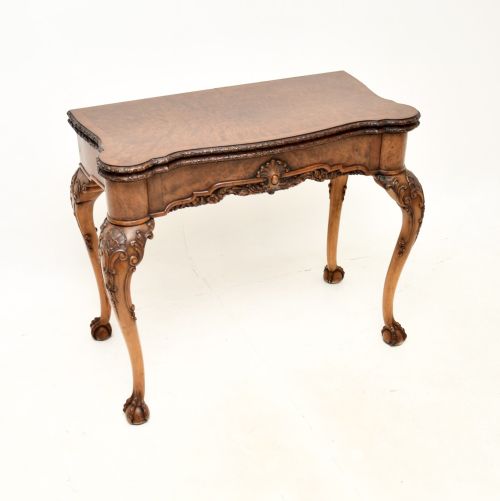
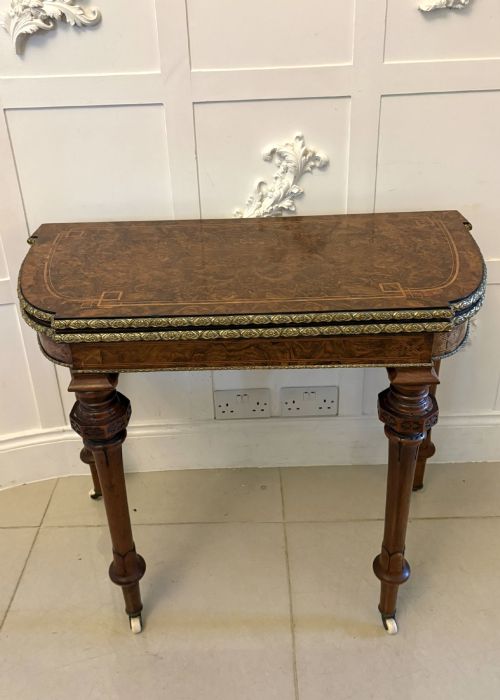
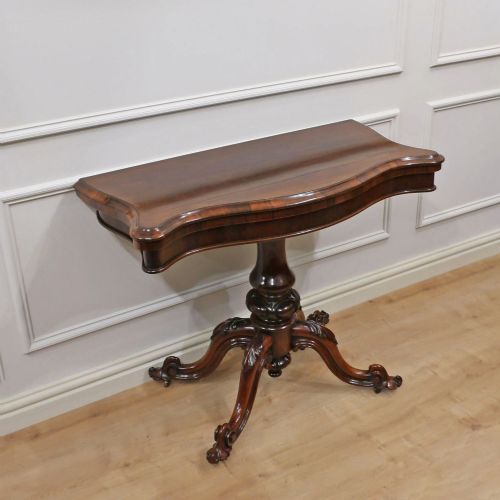
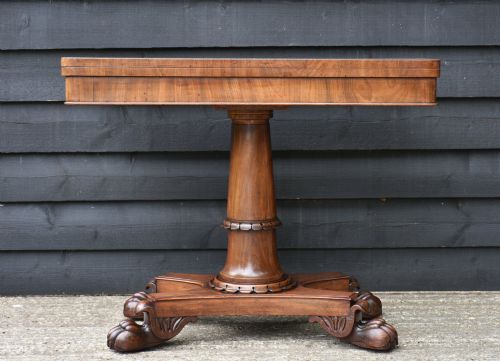
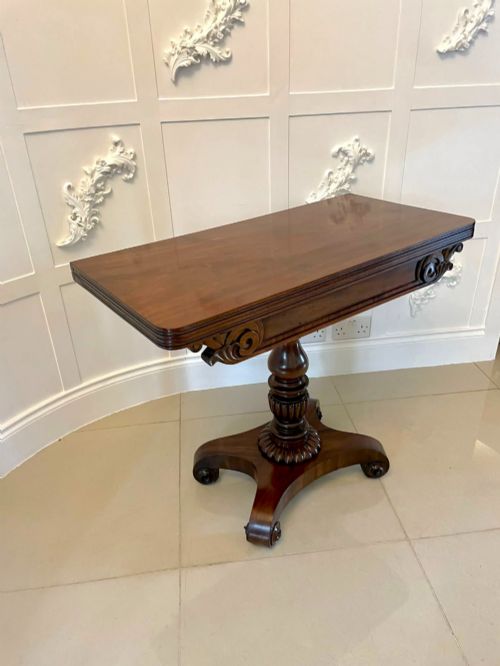
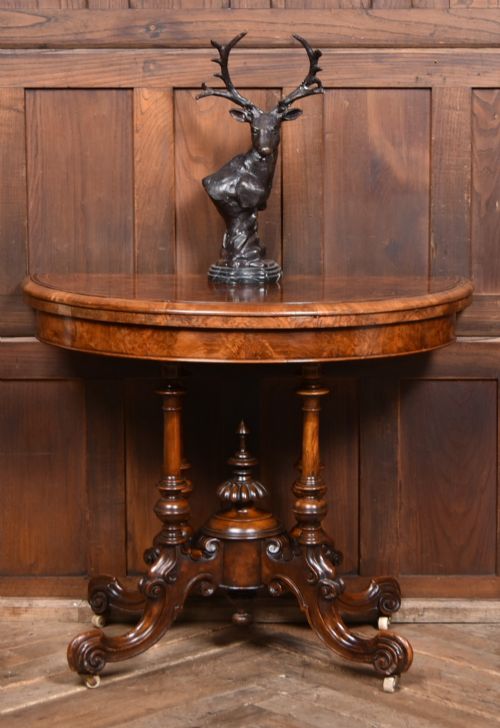
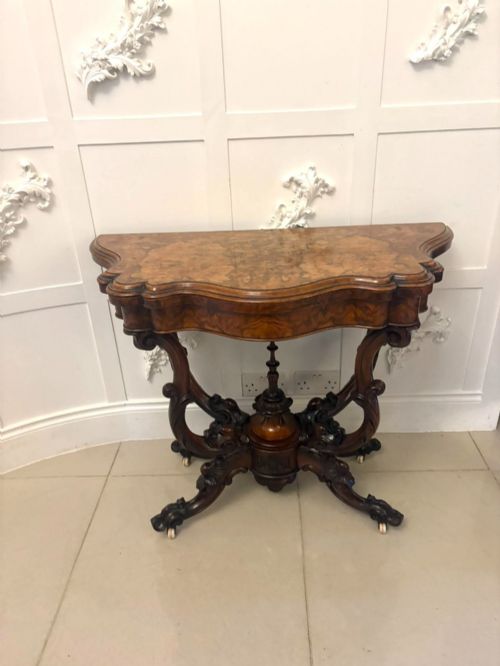
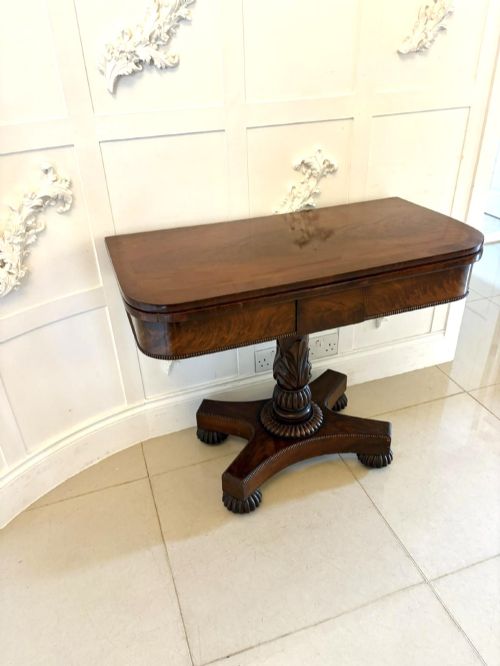


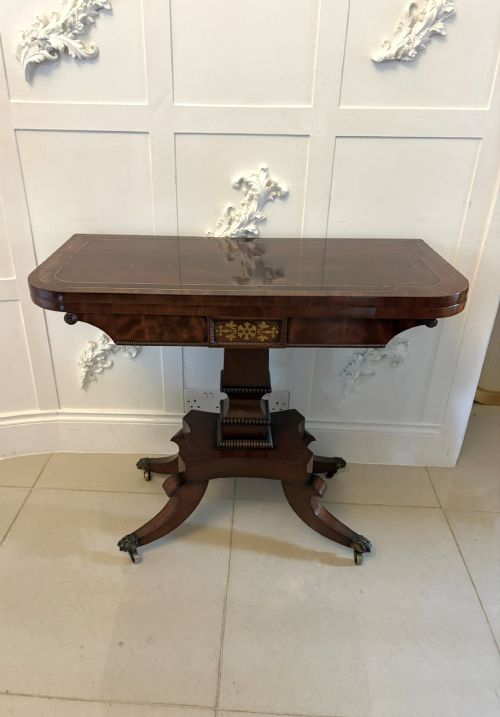
Fold Over Gaming Table
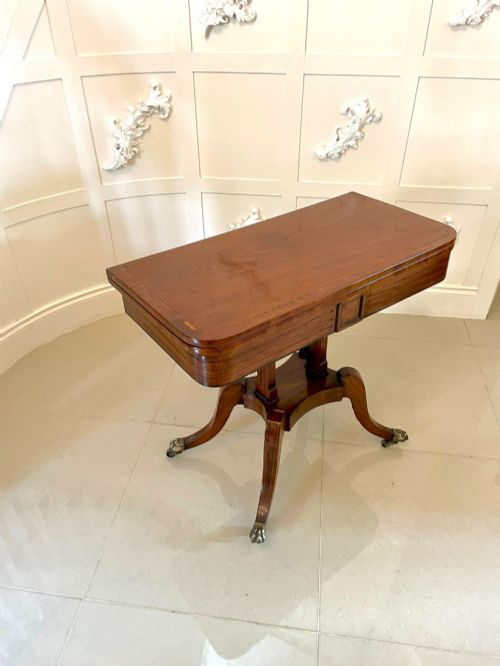
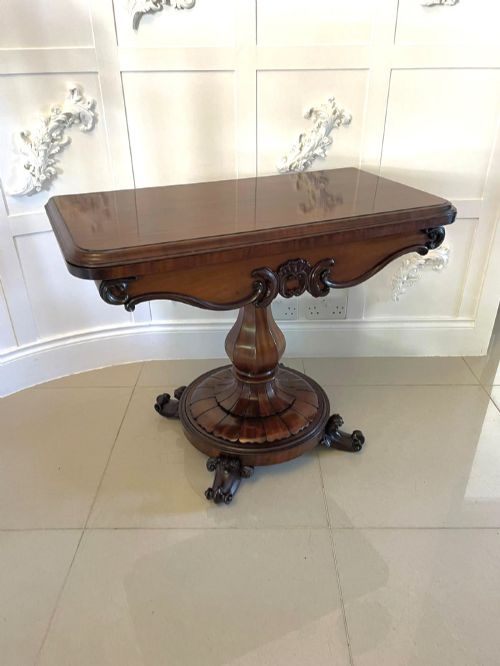
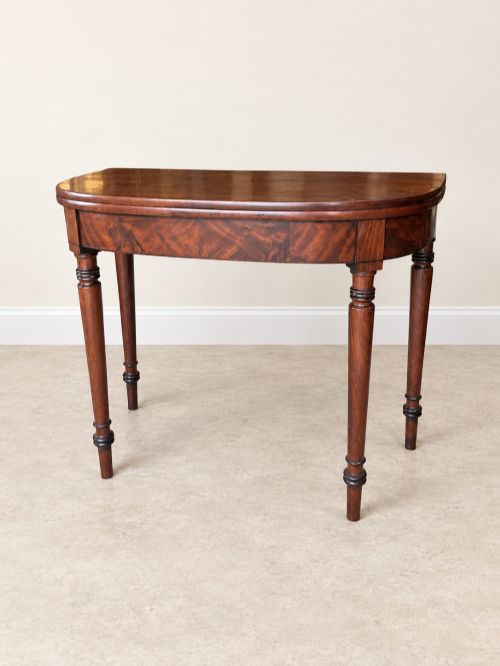
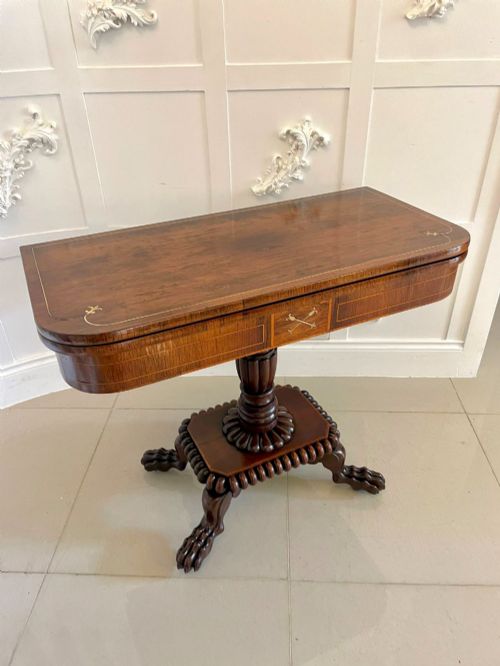
A fold over gaming table brings dual-purpose ingenuity to a room, offering a generous surface that opens to reveal a baize-lined interior for play.
Fold Over Gaming Table
A fold over gaming table serves as a versatile piece of furniture designed to adapt from a compact side or console unit into a spacious surface for cards and entertainment. The forms appearing on this page span the Georgian, Regency, and Victorian eras, alongside Edwardian examples and specific regional items such as Irish walnut variants.
Buyers will encounter multiple configurations sharing this dual identity, most frequently card tables, games tables, and tea tables. These pieces operate on hinges, pivots, or concertina mechanisms that allow the upper leaf to double in area when opened.
Materials and Construction
Cabinet makers utilised dense native and exotic timbers, relying heavily upon mahogany, walnut, and rosewood, often enhanced by burr walnut, burr yew, flame mahogany veneer, satinwood, and kingwood crossbanding. These rich veneers create striking visual depth across the top surface when the leaves are closed.
Decorative embellishments frequently incorporate brass inlay, ormolu mounts, and carved elements such as a carved basket base. The structural integrity relies on precision joinery to support the folding top leaf without placing undue strain on the hinges or pivoting frame.
Listings span the eighteenth, nineteenth, and early twentieth centuries, featuring Georgian, Regency, Victorian, and Edwardian eras.
Distinctions in Quality
The standard of a fold over gaming table rests upon the choice of timber figure, the precision of the crossbanding, and the crispness of any carved detailing. Finer examples display continuous grain patterns across the folded top and employ superior timbers like coromandel or meticulously matched flame mahogany.
Execution of the mechanism further separates standard production from exceptional examples, as high-grade concertina frames and smooth pivoting actions demonstrate superior craftsmanship. The integration of decorative brass inlay or gilt ormolu mounts reveals the ambition of the original workshop.
George Bullock
The Fold Over Gaming Table Glossary
- Concertina action
- A table frame that expands outward on an accordion-like hinge system when the top unfolds, providing four balanced legs for support. This design allows the weight of the open leaf to distribute evenly.
- Crossbanding
- A border of veneer laid around the perimeter of a table top with the grain running at right angles to the central panel. This technique frames the primary timber and highlights the edge.
- Demi-lune
- A half-moon shape with a curved front and a straight back edge designed to sit flat against a wall. These tables save floor space while closed.
- Serpentine
- A gently undulating line formed by alternating convex and concave curves across the front edge of a table. This contour demands skilled carpentry to execute cleanly.
Fold Over Gaming Table: Frequently Asked Questions
What is a fold over gaming table?
A fold over gaming table is a dual-purpose item featuring a hinged top leaf that opens to double the surface area, traditionally concealing a baize-lined playing field beneath.
Closed, the piece functions as a side, console, or tea table against a wall, making it exceptionally adaptable for domestic interiors.
How do you open the top?
The top leaf typically swings open on hinges, pivoting 180 degrees to rest upon a rotatable underframe, a swinging rear leg, or an expanding concertina frame.
Care must be taken to support the weight evenly during this movement to protect the original hinges and pivot joints.
Were these used only for games?
Despite their primary design for card games, many examples double as tea tables or general side surfaces for daily domestic use.
The versatility allowed households to maximise space in reception rooms without cluttering the floor area.
How do I identify a Regency period table?
Regency pieces often display classical architectural influences, featuring rosewood or mahogany timbers frequently accented with brass inlay.
They tend to date from the early nineteenth century and frequently utilise bold geometric lines or pedestal bases.
Can I place these against a wall?
Yes, demi-lune and rectangular variants sit flat against a wall when closed, functioning as console or side tables.
Opening the table requires pulling it away from the wall to allow the leaf and supporting frame to swing clear.