



Fluted Leg Hallway Console
A fluted leg hallway console brings architectural line and a narrow footprint to an entrance space, offering a surface that sits flush against a wall.
Fluted Leg Hallway Console
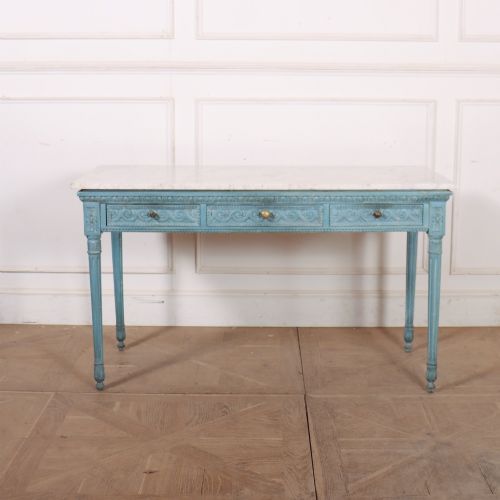
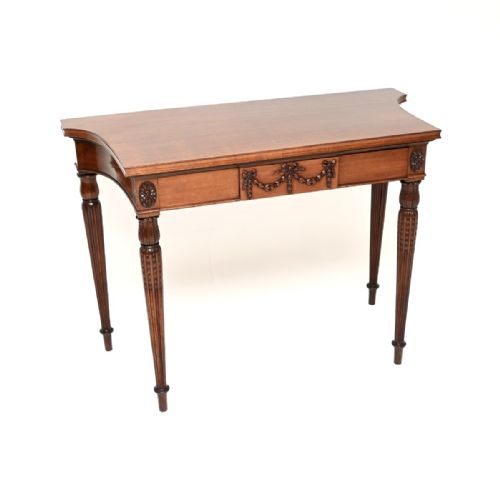
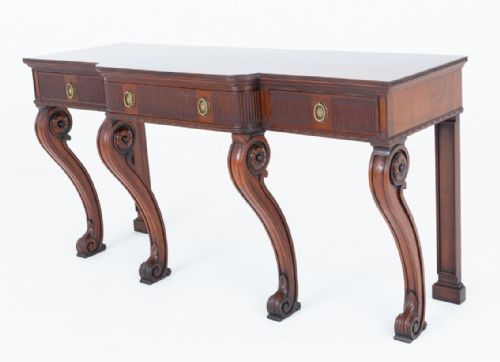
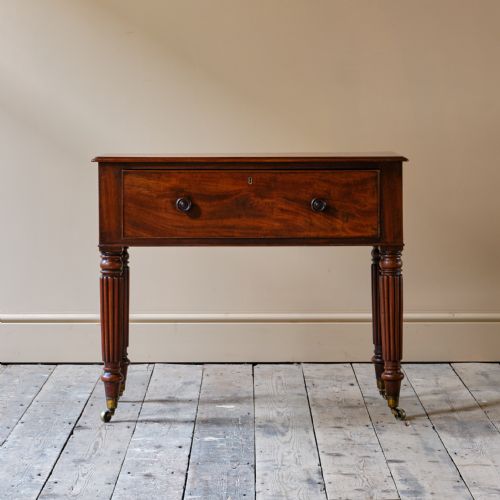
A fluted leg hallway console is designed primarily as a narrow surface for an entrance or passage, appearing in formats such as console tables, side tables, servers, and serving tables. These pieces span the eighteenth century through to the early twentieth century, drawing on Georgian, Regency, Italian Neoclassical, and Edwardian aesthetic vocabularies. The forms range from strict rectangular shapes to curved demi-lune profiles and serpentine fronts.
The version most commonly met on this page is constructed from mahogany, often referencing Georgian style or Regency revival tastes with slender, vertical grooves carved directly into the timber legs. Other iterations introduce painted wood surfaces, giltwood accents, or contrasting marble tops in shades like rouge. These tables serve the practical need for a shallow display or drop-off surface in compact rooms without overwhelming the spatial flow.
Materials and construction methods
Timber selection centres heavily on mahogany, valued for its stability and rich grain, alongside oak and general structural timber for foundational framing. Surface enrichment relies on painted finishes and applied giltwood or ormolu details that catch the light in a hallway setting. Decorative inlays provide geometric and linear contrast to the primary wood planes.
Carving defines the signature fluted leg, where vertical channels are meticulously scooped out of the wood stock by hand or machine to create a classical column effect. Stone tops, particularly rouge marble, are shaped to fit precisely within or upon the wooden frame, requiring careful masonry work to align with serpentine or breakfront contours.
The furniture spans multiple periods from the eighteenth century through the nineteenth century and into the early twentieth century.
Distinctions in quality and execution
The standard of a fluted leg hallway console rests on the crispness of the carving along the legs and the integration of decorative elements like brass mounts or ormolu. Superior pieces exhibit precise proportions where the narrow depth balances harmoniously with the height and length, avoiding any sense of top-heaviness. Timber choice also dictates worth, with figured mahogany showing deeper chatoyancy than plain stock.
Joinery execution separates robust examples from those compromised by loose joints or clumsy repairs over the decades. The fit of marble inserts and the neatness of inlay work indicate the original maker's skill level and subsequent care. Finer examples retain their original surface finishes and patination rather than suffering from heavy modern stripping.
Gillows·Holland & Sons
The Fluted Leg Hallway Console Glossary
- Console table
- A wall-mounted or freestanding table designed with a shallow depth specifically for narrow spaces like hallways. It traditionally stands against a flat wall rather than floating in the middle of a room.
- Fluted leg
- A vertical support column decorated with parallel shallow grooves carved into the surface. This classical detail derives from ancient architectural columns.
- Demi-lune
- A half-moon shape used for table tops and frames that sits completely flat against a wall. It provides a softer profile than a sharp rectangular corner in confined areas.
- Ormolu
- Gilded bronze mounted onto furniture as decorative enrichment. It creates metallic highlights against wood and marble surfaces.
- Serpentine
- A gently undulating curved line forming the front edge of a table top or frame. It alternates between convex and concave sweeps to add visual movement.
Fluted Leg Hallway Console: Frequently Asked Questions
What is a fluted leg hallway console used for?
These tables provide a narrow surface in narrow passages for keys, correspondence, or decorative objects without obstructing foot traffic.
They also serve as a focal point beneath a hallway mirror or painting to establish the decorative tone of a home.
How do I place a console in a small hallway?
Measure the clearance between the opposite wall and the intended spot to ensure doors can still open fully past the narrow depth.
Select a design with slender legs and an open base to maintain a sense of light and space around the piece.
How do I distinguish Georgian style from revival pieces?
Original pieces from the eighteenth or early nineteenth century display timber ageing, construction methods, and wear patterns consistent with genuine period use.
Revival pieces from the Victorian and Edwardian eras emulate these earlier proportions using period-appropriate machinery and secondary woods.
Are marble tops original to these tables?
Many console tables, particularly those with Italian Neoclassical or French influence, were manufactured specifically to carry stone inserts like rouge marble.
Checking the rebate and fit of the stone against the wooden frame helps determine if the top belongs to the original construction.