
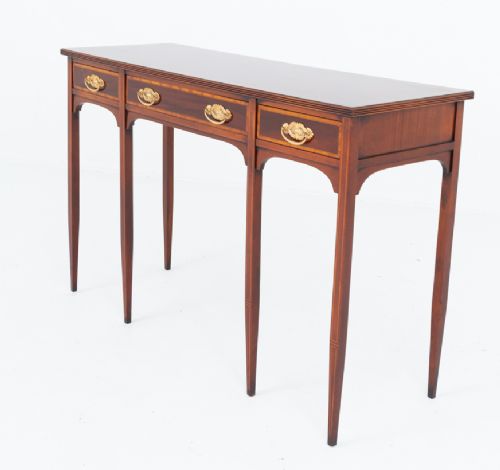


Narrow Mahogany Entry Table
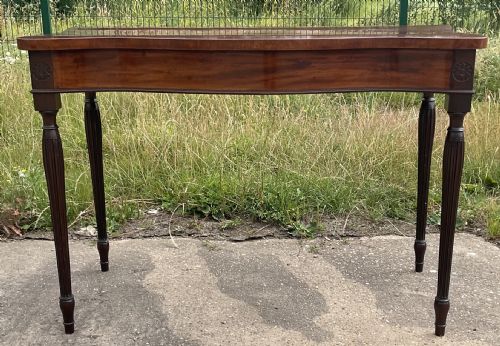
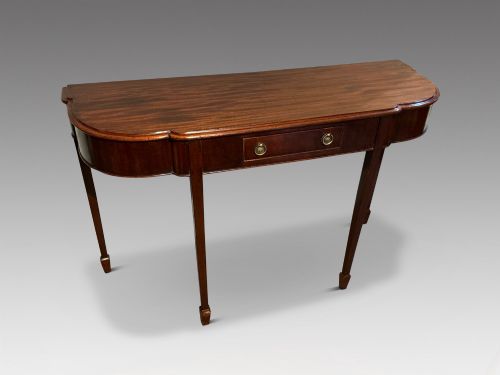
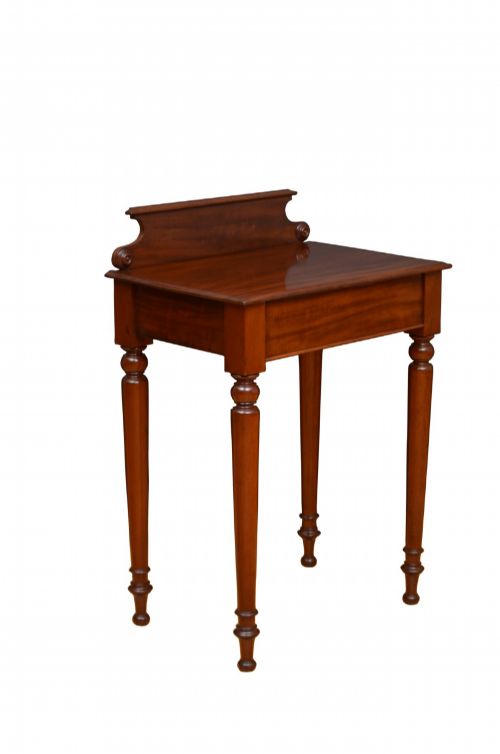
A narrow mahogany entry table brings slender proportions and rich timber grain to a hallway, offering a surface for letters and keys without crowding the floor.
Narrow Mahogany Entry Table
A narrow mahogany entry table appears primarily as a console table, pier table, or small sideboard designed to stand against a hallway or landing wall. These pieces emerge across the nineteenth and early twentieth centuries, spanning the Victorian and William IV eras alongside later Georgian revival pieces.
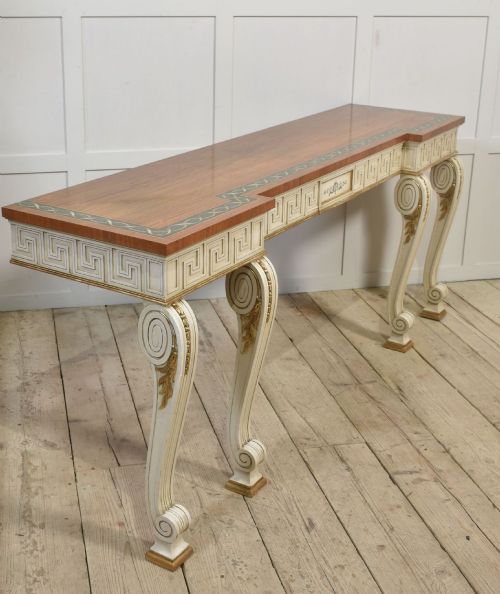
The form typically showcases shallow depths suited to tight spaces, sometimes featuring a single drawer or standing as a free-standing console. Makers adopted styles ranging from strict neoclassical lines and Sheraton revival details to campaign brass fittings and serpentine or breakfront outlines.
Surviving examples on this page mix timber construction with occasional marble tops and painted or inlaid wood accents. Buyers seeking a narrow mahogany entry table encounter these console and sideboard formats most frequently across the listed periods.
Materials and construction
Makers built these pieces primarily using solid mahogany and mahogany veneers selected for deep grain patterns and warm reddish-brown tones. Workshops applied traditional joinery methods to shape serpentine and breakfront carcasses while integrating functional drawers.
Campaign tables carry built-in travel readiness, meaning your hallway furniture is technically prepared to pack up for a military expedition at a moment's notice.
Assessing quality and finish
Quality rests upon the selection of the mahogany timber and the crispness of any inlaid decoration or carved details. Finer pieces demonstrate careful attention to proportion, particularly where serpentine or breakfront outlines demand precise carpentry.
The integrity of the structural joints and the smooth operation of drawers separate standard workshop output from superior cabinet work. Original brass fittings and intact marble tops further distinguish the upper tier of surviving examples.
Druce and Co
The Narrow Mahogany Entry Table Glossary
- Console table
- A table designed to stand against a wall, frequently supported by brackets or front legs rather than standing independently on four full legs.
- Serpentine front
- A furniture front curving outward at the centre and inward at the ends, creating a gentle undulating shape.
- Breakfront
- A large piece of furniture whose central section projects forward beyond the flanking sections.
- Campaign furniture
- Portable pieces designed for military officers, typically featuring recessed brass handles and corner brackets for protection during transport.
Narrow Mahogany Entry Table: Frequently Asked Questions
Where should I place a narrow entry table?
These tables fit best in hallways, corridors, or narrow landings where floor space is limited. Their shallow depth allows them to sit flush against a wall without obstructing passageways.
Position one beneath a mirror or coat rack to create a functional drop zone for keys, post, and daily essentials.
How do I identify a Victorian piece?
Victorian furniture spans the nineteenth century and often displays heavier proportions or rich, dark mahogany grain. Look for construction hallmarks and specific period styling within the timber work.
Comparing the legs and apron details against dated nineteenth-century examples helps confirm the era of manufacture.
What is a pier table?
A pier table is a traditional console designed specifically to stand against the wall space between two windows. These tables often featured mirrors above them in period interiors.
On this page, pier tables share the same slender depth and decorative presence as standard console tables.
Can these tables hold heavy items?
Most entry tables are designed for decorative objects, lamps, and small accessories rather than heavy loads. The slender legs and shallow frames prioritize elegance and space-saving proportions.
Marble top variants offer slightly sturdier surfaces, though care should still be taken with very heavy or bulky loads.