


Floral Watercolour Still Life
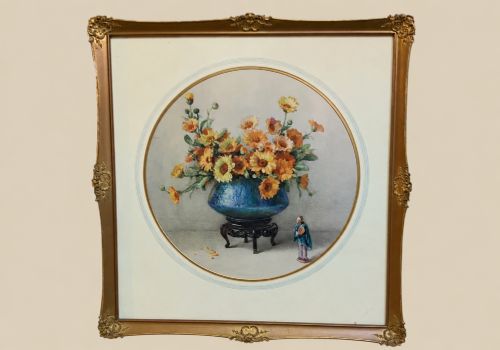
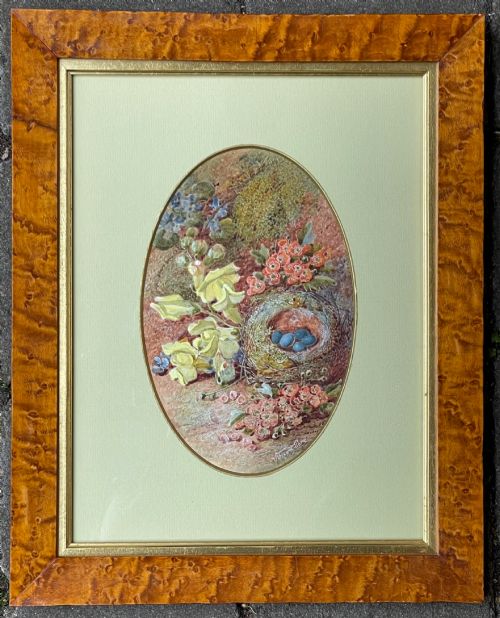
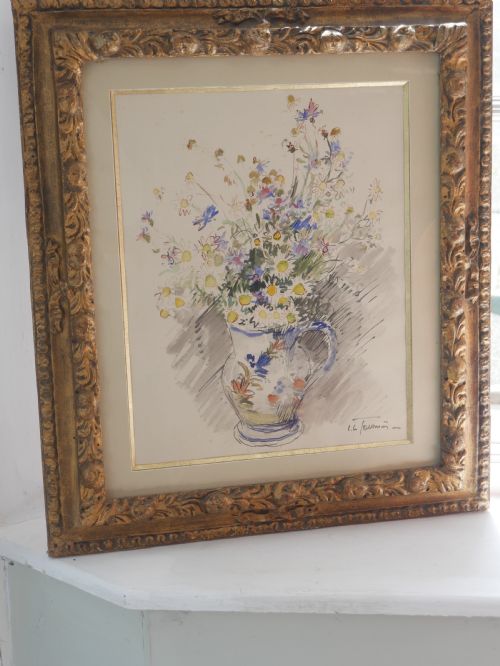
These floral watercolour still life works capture botanical subjects on paper, offering delicate studies of blooms that bring interior spaces to life.
Floral Watercolour Still Life
A floral watercolour still life presents painted arrangements of flowers, often contained in jugs, vases, or baskets, executed across the nineteenth and twentieth centuries. Buyers examine pieces ranging from Victorian botanical studies and naturalism to Edwardian works and mid-century British compositions.
The selections span from strict nineteenth-century representations featuring mossy banks and nests to wartime 1940s watercolours and later 1950s interpretations. Works appear in formats including framed paintings, original wall art, and detailed botanical watercolours on paper.
Execution and Detail
Quality rests upon the artist's handling of transparency and pigment saturation, where skilled brushwork achieves botanical precision in petal structures and foliage. Stronger examples demonstrate careful tonal control in rendering light across glass vessels, fruit, and ceramic jugs.
Compositional balance distinguishes accomplished paintings from simpler decorative exercises, particularly in how the artist integrates the floral subject with surrounding objects like Chinese porcelain or baskets.
Materials recorded across these listings include paper, watercolour pigment, gouache, ink, wood, glass, and gold leaf.
Vincent Clare·James Tower·Henrietta Creswell·William Edward Fox·Lester Sutcliffe·William Hough·Eloise Harriet Stannard·Edith Barrow·Rowland Henry Hill·Grace Hastie·Margaret Laing·Phyllis I Hibbert·Marian Chase·Jabez Bligh·Alice Macallan Swan·Marion Broom·Annie Mary Youngman·Edith Alice Andrews·John Sherrin·Amy Reeve-Fowkes·Helen Cordelia Angell·Wiliam Stephen Coleman·Owen Bowen·Eva Francis·Wendela Boreel
The Floral Watercolour Still Life Glossary
- Watercolour
- A painting method in which the pigments are suspended in a water-soluble vehicle, applied to paper to create translucent washes of colour. This medium defines the dominant appearance of these botanical and floral works.
- Gouache
- An opaque watercolour medium containing pigment mixed with a binding agent and white filler, utilised to achieve solid areas of colour and highlights. It appears alongside traditional transparent watercolours in specific period works.
- Botanical study
- A rigorous depiction of plant forms focusing on scientific accuracy of petals, stems, and leaves rather than purely decorative arrangement. These works document specific species like camellias, primroses, and azaleas.
- Still life
- An artistic composition depicting inanimate subject matter, typically commonplace objects such as vases, jugs, and gathered fruit alongside cut flowers. The genre allows artists to explore light, shadow, and arrangement.
Floral Watercolour Still Life: Frequently Asked Questions
How should I hang a watercolour painting?
Keep watercolours away from direct sunlight to prevent the pigments from fading over time. Position them on interior walls where room temperature and humidity remain stable.
Ensure the frame is sealed properly behind glass to protect the paper from dust and atmospheric moisture.
What subjects appear in these still lifes?
The compositions predominantly feature cut flowers, including roses, wallflowers, anemones, and gladioli. Artists frequently arrange these blooms inside ceramic jugs, glass vases, or woven baskets.
Secondary elements such as fruit, birds' nests, books, and Chinese objects occasionally accompany the botanical subjects.
How do I date an antique watercolour?
Examine the framing methods, paper type, and artist signatures recorded in the documentation. Victorian works often display distinct naturalistic detail, whereas mid-century pieces show freer brushwork.
Period markers in the titles, such as wartime dates or specific stylistic movements, provide further chronological context.
Are gouache and watercolour the same?
Watercolour relies on transparent washes that allow the white of the paper to illuminate the pigment. Gouache includes added white filler, creating an opaque finish that blocks out the paper underneath.
Artists often combine both mediums within a single floral composition to balance luminous petals with solid backgrounds.