
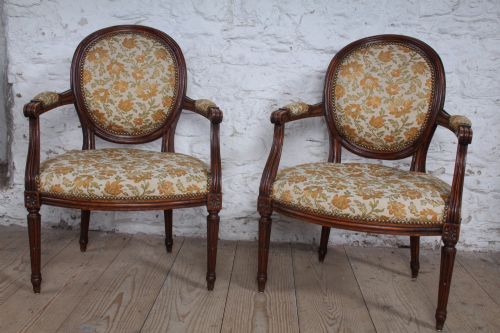
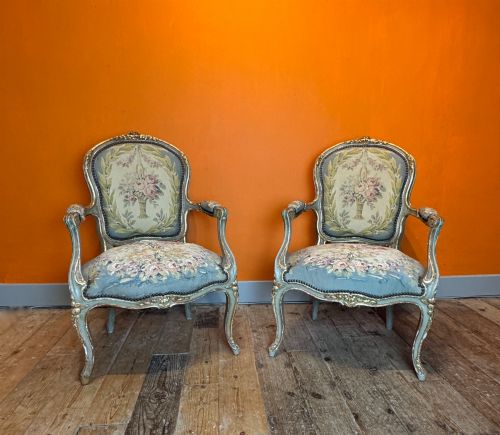
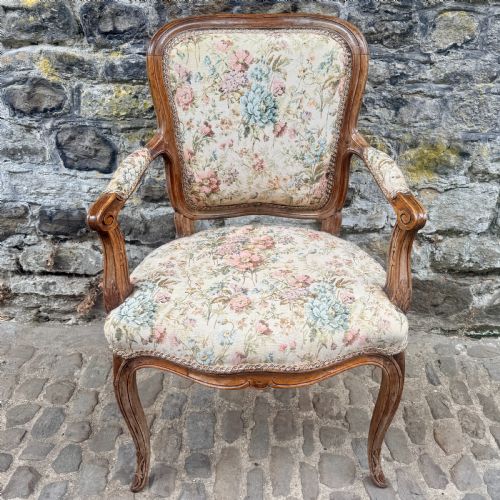
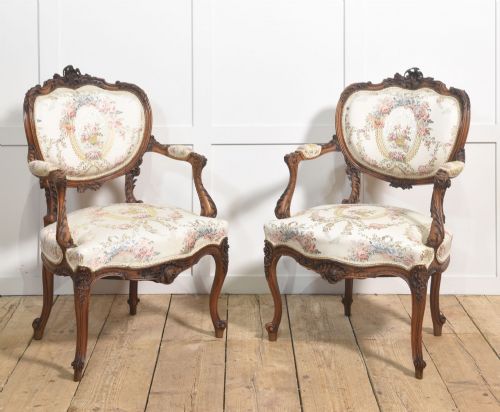


Floral Upholstered Fauteuil
A floral upholstered fauteuil brings open-armed seating and patterned textiles together, offering period charm for a sitting room.
Floral Upholstered Fauteuil
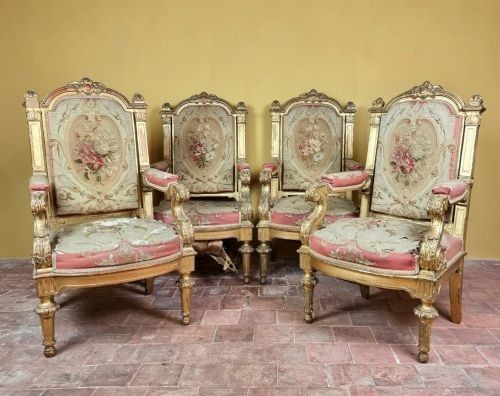
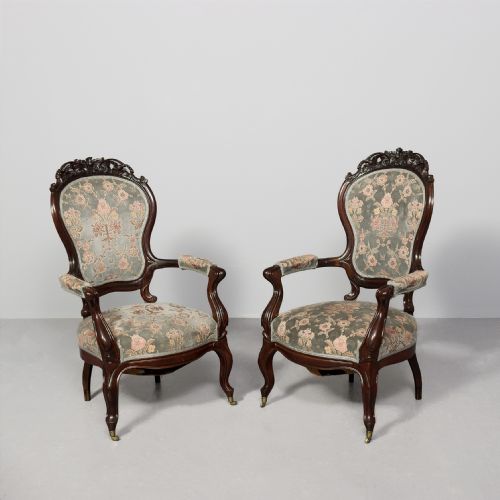
A floral upholstered fauteuil is an open-armed armchair rooted in French design traditions, spanning the eighteenth century through to the early twentieth century. Buyers seeking this search phrase encounter pieces attributed to French Provincial, Louis XV, and Louis XVI revival styles, alongside Victorian interpretations.
The inventory on this page consists predominantly of nineteenth-century examples alongside a smaller selection of eighteenth and early twentieth-century pieces. These armchairs typically appear as pairs or single seats, featuring exposed wooden frames paired with textile covers.
Forms range from painted and parcel-gilt frames to walnut, mahogany, and giltwood constructions. The upholstery incorporates tapestry, needlepoint, and patterned fabric panels depicting floral motifs.
How they were made
Frames are constructed from hardwoods including walnut, mahogany, and rosewood, as well as softer timbers that received paint, parcel-gilt, or giltwood finishes. Carved details define the structural members, including cabriole legs and moulded arm supports.
Upholstery relies on traditional textile techniques, utilising tapestry weave and needlepoint panels worked in wool and silk threads. These covers are secured directly to the open wooden frameworks with tacks.
The listings span from the eighteenth century to the early twentieth century, featuring walnut, mahogany, giltwood, and painted finishes.
What varies in quality
The caliber of the woodwork sets examples apart, distinguishing crisp, hand-carved floral motifs and moulded lines on walnut or giltwood frames from simpler, softer turns. Carved rosewood and gilded surfaces indicate higher workshop ambition.
The execution and survival of the needlework or tapestry upholstery dictate the visual impact of the chair. Needlepoint panels with dense stitching and well-preserved polychrome threads elevate the textile component above standard fabric covers.
Holland and Sons
The Floral Upholstered Fauteuil Glossary
- Fauteuil
- An open-armed upholstered armchair with an exposed wooden frame originating in France. These seats typically feature padded armrests and a distinct separation between the upholstered back and seat.
- Giltwood
- Timber coated with a thin layer of gold leaf over a prepared gesso ground. This finish appears frequently on formal revival salon chairs.
- Needlepoint
- Embroidery stitched onto an open-weave canvas foundation, commonly used for the seat and back panels of period armchairs. It provides a durable, textured floral surface.
- Cabriole leg
- A furniture leg that curves outward in a convex arc and tapers inward to a foot, inspired by the shape of an animal's leg. This form appears across eighteenth-century and nineteenth-century revival seating.
- Parcel-gilt
- A decorative treatment where selected portions of a painted or stained wooden surface are gilded. It highlights carved mouldings and structural details on French frames.
Floral Upholstered Fauteuil: Frequently Asked Questions
Where should I place a fauteuil?
These open-armed chairs suit drawing rooms, bedrooms, and reading corners where their decorative carved frames remain visible from all angles. Their relatively lightweight proportions allow them to function as occasional seating rather than heavy lounge chairs.
Pair them with complementary side tables or position them symmetrically as a matched pair.
How do I date an antique armchair?
Dating relies on timber selection, carving styles, and construction methods visible beneath the frame. Eighteenth-century models display different joinery and timber patination compared to nineteenth-century revival pieces.
Revival pieces often adopt earlier Louis styles while utilising nineteenth-century machinery marks and secondary woods.
Are these chairs comfortable for daily use?
Period fauteuils offer upright seating support rather than deep, soft lounging. The open arms and firm squab cushions reflect the formal posture of historic interiors.
Interior padding density varies depending on whether the upholstery is original or historically restored.