


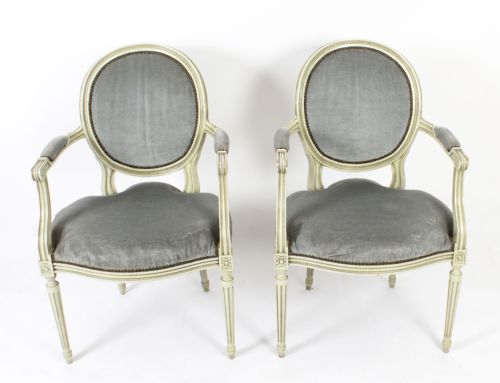

Medallion Back Fauteuil
These medallion back fauteuil armchairs bring classical French elegance into a room through curved wooden frames and upholstered comfort.
Medallion Back Fauteuil
A medallion back fauteuil is an open-armed seating form defined by its distinct circular or oval wooden backrest, originating from classical French design. When searching for a medallion back fauteuil, buyers encounter pieces spanning several centuries, from authentic 18th century examples to later revival interpretations.
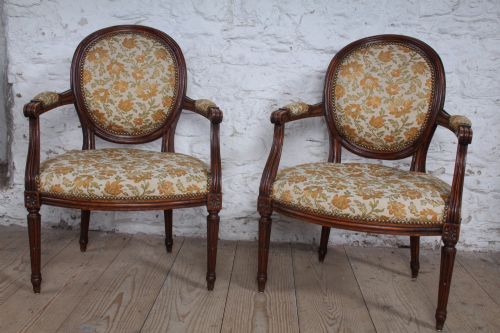
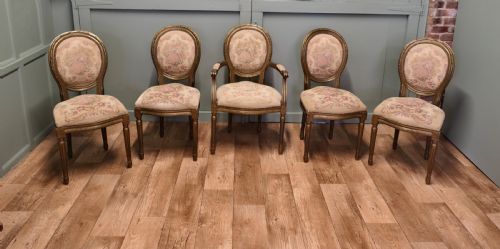
The pieces on this page lean heavily into Louis XVI style and its later revivals, featuring the characteristic straight tapered legs and neoclassical carved details. Salon chairs and armchairs appear frequently in pairs or larger sets, often retaining older fabric or tapestries.
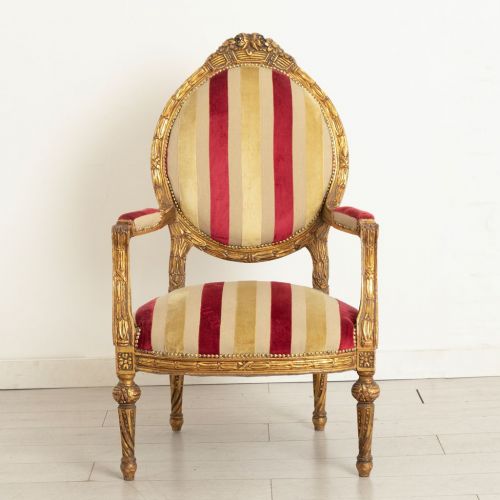
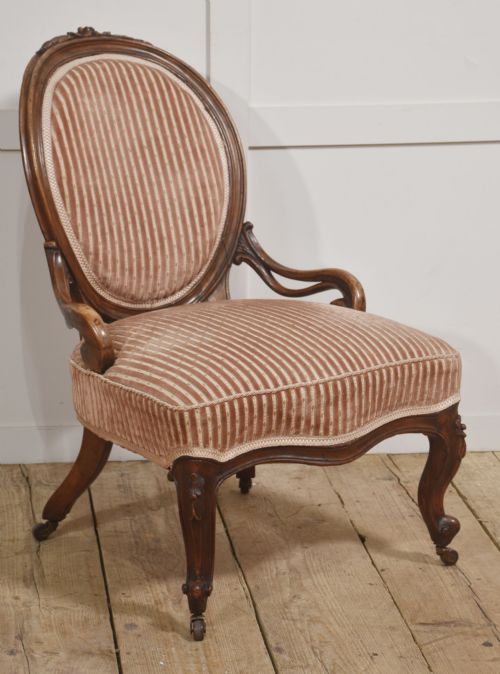
Originating largely from French workshops and British Edwardian interpretations, these chairs serve as both decorative salon seating and functional bedroom chairs. Walnut, painted wood and gilded timber provide the structural foundation for the upholstered seats and backs.
How they were made
Maker's workshops built the structural frames of these armchairs using solid woods such as walnut, alongside timber prepared for painted finishes or gilding. Woodworkers shaped the distinct circular backrests and carved subtle neoclassical motifs directly into the timber.
Upholstery completed the piece, utilising traditional webbing, stuffing and cover materials including silk velvet, patterned fabric and woven tapestry. Brass tacks often secure the textile edges along the wooden frame of the armchair.
One set of chairs clearly enjoyed a previous life in a bedroom before moving into the salon.
What varies in quality
The refinement of the wood carving separates standard revival pieces from finer artisan work, particularly in the crispness of the floral or ribbon motifs on the crest. Giltwood surfaces show quality through the depth and warmth of the gold leaf application over the timber base.
Upholstery choices and the survival of original textiles alter the character and historical integrity of each salon chair. Proportions also vary, with finer examples maintaining a balanced relationship between the open arms and the upholstered oval back.
The Medallion Back Fauteuil Glossary
- Fauteuil
- An open-armed upholstered armchair with exposed wooden sides, originating in France. These seats were designed for formal domestic comfort.
- Giltwood
- Timber coated with a thin layer of gold leaf or gesso and gold paint. This finish creates a bright reflective surface on antique chair frames.
- Louis XVI style
- A neoclassical design vocabulary characterised by straight tapered legs, geometric symmetry and classical motifs. It replaced the curved asymmetry of earlier rococo work.
- Tapestry upholstery
- Heavy hand-woven or machine-woven fabric depicting pictorial scenes or floral patterns. It frequently covers the seat and back of formal period armchairs.
- Salon chair
- A light, decorative armchair intended for entertaining guests in a reception room. These seats are often slightly smaller than a standard library armchair.
Medallion Back Fauteuil: Frequently Asked Questions
Are these armchairs comfortable for daily use?
These chairs provide a firm, upright sit typical of period salon seating rather than deep lounging comfort. The open arms support a relaxed posture suited to reading or conversation.
Upholstery padding varies depending on whether the piece retains older stuffing or has received modern restoration. Most buyers use them as occasional chairs in a bedroom or drawing room.
How do I identify a revival piece from an 18th century original?
Examination of the timber, tool marks and construction joints reveals the age of the wooden frame. Eighteenth century examples show distinct hand-tooling and wood shrinkage consistent with great age.
Revival pieces from the nineteenth and early twentieth centuries often employ machine assistance or standardised joinery while closely imitating the earlier French aesthetic.
Can I mix different pairs of salon chairs together?
Placing contrasting pairs of salon chairs in the same room creates a layered interior common in traditional design. Matching the wood finish or fabric tones helps unify disparate seating forms.
Matching sets of four or six pieces offer a more formal symmetry around a table or along a wall.
How should I care for gilded wood frames?
Gilded timber requires gentle dusting with a soft, dry brush to protect the delicate gold leaf surface. Moisture and abrasive cleaners damage the metallic finish permanently.
Keeping the chairs away from direct sunlight prevents the painted or gilded wood from drying and cracking.