
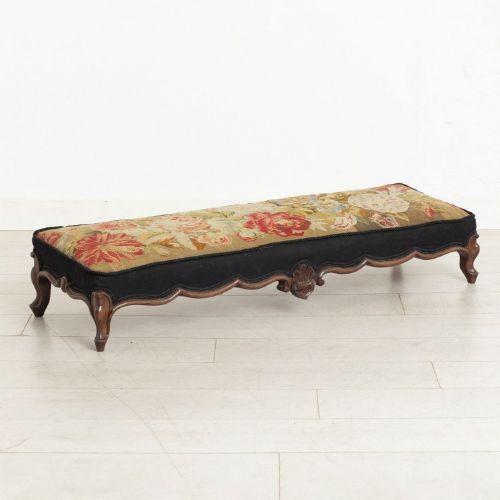


Floral Needlepoint Footstool
A floral needlepoint footstool brings pattern and texture to a fireside or dressing room, grounding a traditional interior with hand-worked textile.
Floral Needlepoint Footstool
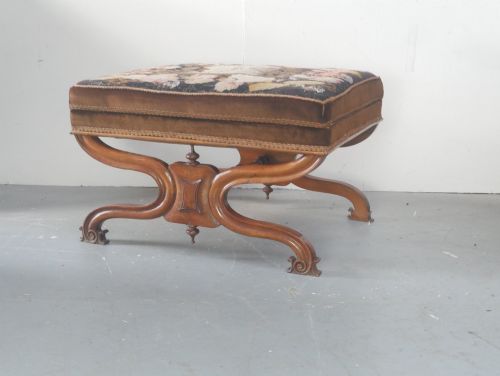
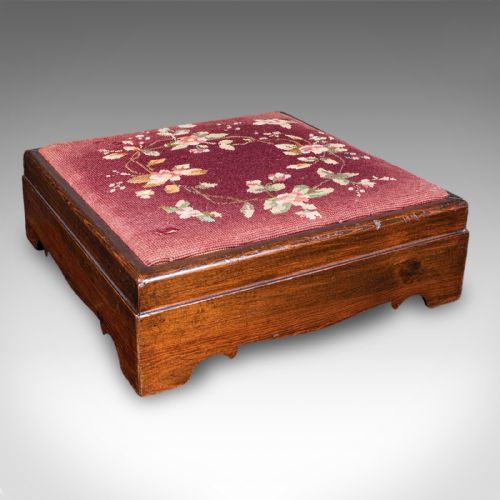
A floral needlepoint footstool is a low seat designed for resting the feet, frequently encountered in Victorian and early twentieth-century variations. These pieces span compact fireside models and low dressing stools, alongside longer ottomans and benches.
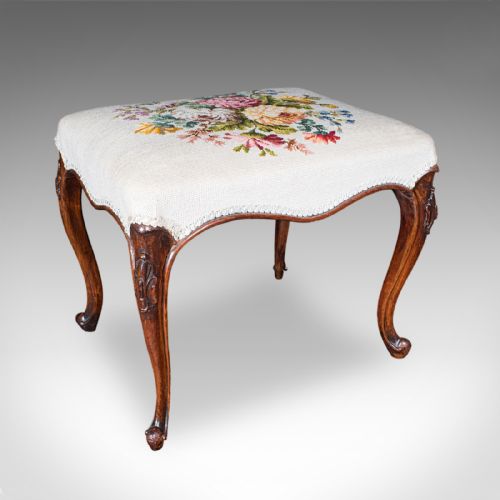
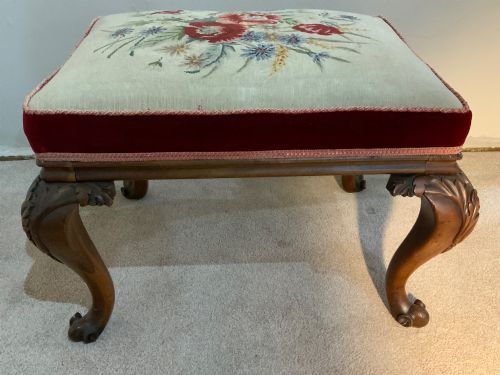
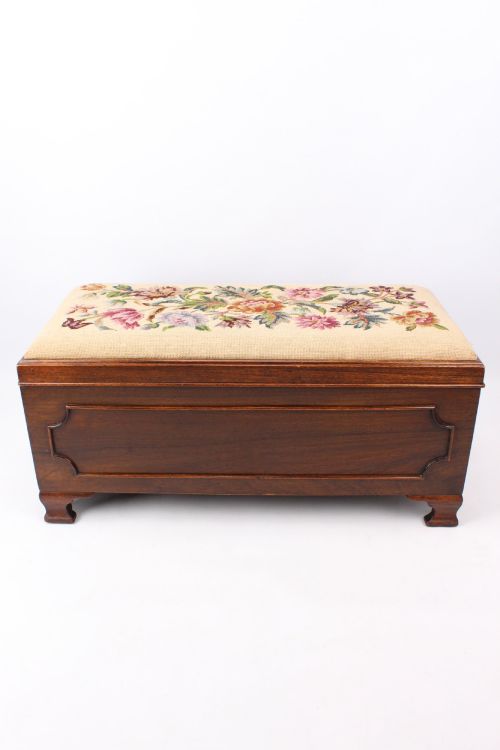
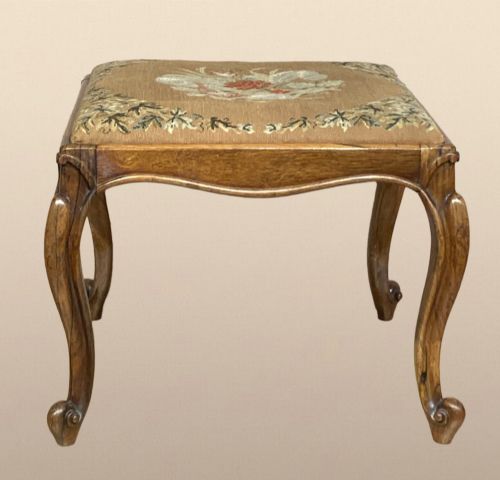
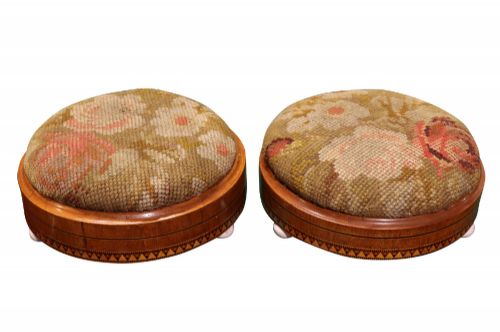
The selections on this page range from mid-nineteenth-century examples in walnut and mahogany to later Edwardian and 1930s interpretations. Frames take various shapes, including circular, oval and long rectangular silhouettes supported by cabriole or turned legs.
Materials and construction
Timbers such as walnut, mahogany, rosewood and pitch pine form the structural frames, often shaped with carved details or turned supports. Joinery relies on traditional methods appropriate to each period.
The upholstered tops feature wool tapestry and needlepoint worked in floral motifs, sometimes paired with velvet or textile trims and brass elements.
Walnut and mahogany dominate the timber frames across these listings, alongside rosewood, pitch pine and birch.
Assessment of quality
Quality rests primarily on the depth and crispness of the timber carving and the complexity of the frame geometry, such as finely shaped cabriole legs or inlaid details. Walnut and rosewood frames generally demonstrate superior cabinetmaking compared to simpler painted or pine structures.
The needlepoint upholstery itself dictates the visual weight of the piece, with dense wool stitching, well-preserved botanical colour palettes and intact original fabric setting the finest examples apart from later replacements.
Whytock and Reid
The Floral Needlepoint Footstool Glossary
- Needlepoint
- A type of counted thread embroidery stitched onto an open weave canvas foundation. It forms the durable floral panels seen on these footstools.
- Cabriole leg
- A furniture leg that curves outward and then tapers inward, finishing in a pad or scroll foot. This form is typical of nineteenth-century walnut stools.
- Tapestry
- A heavy hand-woven or needle-worked textile used for upholstery. It provides a dense, patterned surface suited to daily foot placement.
- Ottoman
- A low upholstered seat or bench without a back or arms. These larger formats accommodate extended needlework panels.
- Pitch pine
- A resinous softwood utilised for framing certain Edwardian footstools. It offers a pale, durable structural base.
Floral Needlepoint Footstool: Frequently Asked Questions
Where were these footstools used?
These pieces were positioned beside firesides, in drawing rooms or in front of dressing tables for comfort and utility.
Their low profiles allowed them to slide easily beneath tables or sit neatly against upholstery in formal rooms.
How do I identify a Victorian footstool?
Victorian examples frequently employ walnut or mahogany timbers, often featuring cabriole legs and floral wool needlepoint tops.
Dates typically hover around the mid-to-late nineteenth century, displaying characteristic dark wood patination and sturdy joinery.
Are the needlepoint tops original?
Many pieces retain their period needlework, though wool tapestries can sometimes show evidence of professional re-upholstery or conservation over time.
Examining the tension of the canvas and the wear on the wool helps determine whether the textile matches the age of the frame.
What is the difference between a footstool and an ottoman?
Footstools are generally smaller, single-person seats or low rests intended primarily for the feet during relaxation.
Ottomons provide a longer, bench-like surface that can function as secondary seating as well as a footrest.