
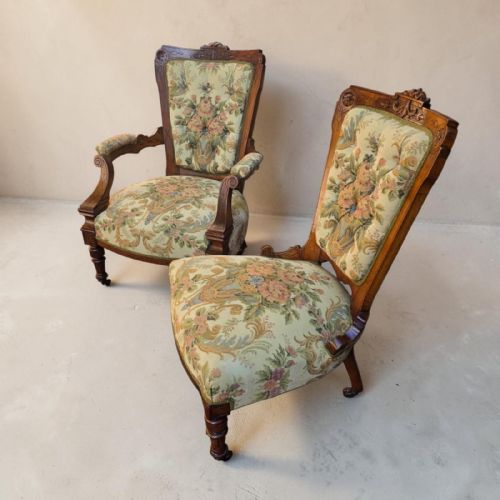
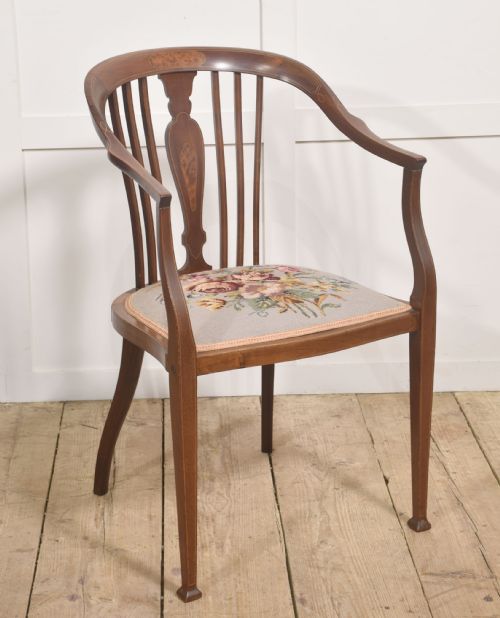


Floral Needlepoint Armchair
A floral needlepoint armchair brings textured wool upholstery and rich timber frames together to ground a room in traditional British and continental seating.
Floral Needlepoint Armchair
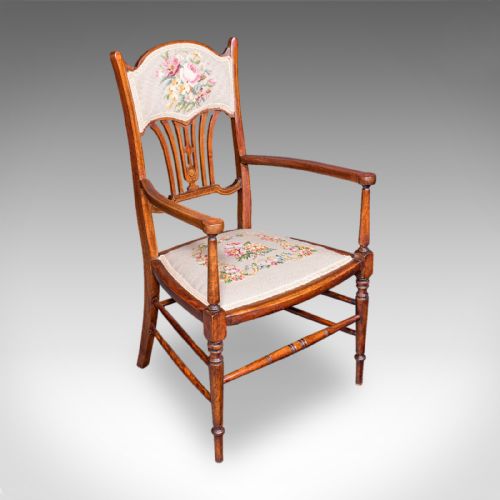
A floral needlepoint armchair combines supportive timber seating frames with hand-worked textile panels depicting botanical motifs. Buyers search for these pieces to introduce warmth, pattern, and historical character into a study, drawing room, or bedroom.
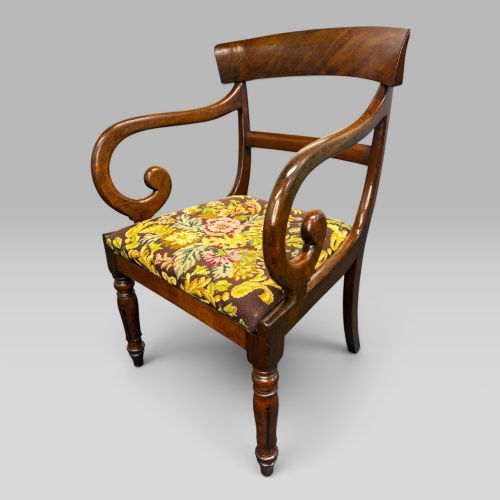
On this page, the pieces you meet most often date from the nineteenth century, spanning Victorian, Regency, and Edwardian periods. Forms range from low nursing chairs and salon armchairs to larger open armchairs and wingbacks, frequently constructed from walnut or mahogany.
Materials and construction methods
Makers built the structural frames of these armchairs using dense hardwoods such as mahogany, walnut, beech, and occasional rosewood or oak. These timbers were turned, carved, or inlaid with satinwood to form sturdy supports that outlast lighter modern furniture.
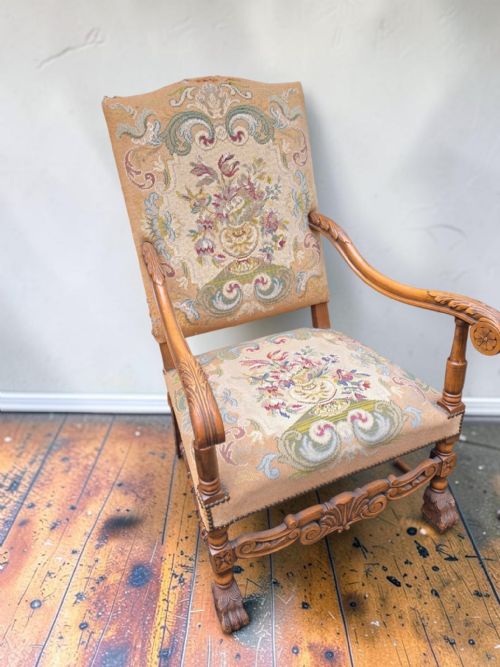
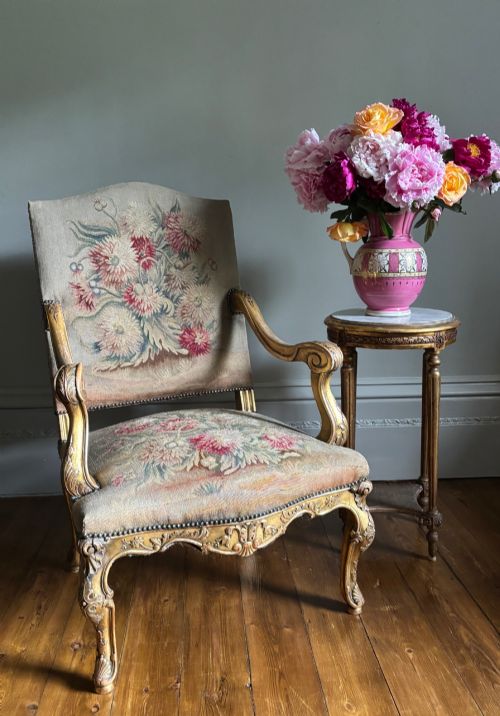
The characteristic upholstery consists of wool tapestry needlework panels secured over traditional stuffing and webbing. Giltwood, brass accents, and painted finishes also appear on specific French and English continental revival models.
Current listings feature nineteenth-century seating constructed from walnut, mahogany, and giltwood, alongside Edwardian and Regency variations.
Distinctions in quality
Quality rests upon the crispness of the timber carving, the integrity of the joinery in the frame, and the tightness of the needlepoint stitch. Superior examples display dense, finely rendered floral patterns rather than loose or faded stitching.
The Floral Needlepoint Armchair Glossary
- Needlepoint
- A type of counted thread embroidery stitched onto an open-weave canvas foundation. It forms the durable floral panels seen on the seats and backs of these chairs.
- Giltwood
- Timber that has been coated with a thin layer of gold leaf or gilt paint. This treatment enhances decorative open armchairs influenced by French design.
- Nursing chair
- A low-seated Victorian chair designed originally to allow a mother to tend to an infant comfortably. They often feature generous upholstery and an absence of heavy armrests.
- Sabre leg
- A concave-curving furniture leg that tapers toward the foot, typical of Regency period seating. This shape imparts a sense of outward momentum to the frame.
- Fauteuil
- An open-framed wooden armchair with upholstered armrests originating in France. They frequently display carved wooden rails and exposed needlepoint panels.
Floral Needlepoint Armchair: Frequently Asked Questions
How do I clean needlepoint upholstery?
Gently vacuum the textile using a low suction setting with a soft brush attachment to remove surface dust. Avoid harsh chemical cleaners or excessive moisture which can damage the wool threads and inner padding.
For stubborn marks, consult a professional textile conservator familiar with antique tapestries rather than attempting wet cleaning at home.
Are these chairs suitable for daily sitting?
Most nineteenth-century armchairs are structurally robust enough for everyday use provided the internal webbing and joints remain sound. Their solid hardwood frames were built to withstand generations of domestic life.
Keep in mind that historical seat heights and depths can feel lower and more compact than modern lounge seating.
How do I identify a Victorian armchair?
Victorian armchairs often feature dark walnut or mahogany frames with substantial proportions, deep buttoning, or carved floral details. The styling frequently borrows from earlier historical revivals such as Rococo or Jacobean tastes.
Look for hand-turned legs, heavier padding, and construction methods typical of nineteenth-century industrial workshop production.
What is a Regency style armchair?
Regency armchairs typically exhibit cleaner classical lines inspired by ancient Roman and Greek furniture. They frequently incorporate sabre legs, reeded woodwork, and dark polished mahogany.
The overall aesthetic is less heavily carved than Victorian equivalents, favouring architectural simplicity and balanced proportions.