




Floral Enamelled Glass
Floral enamelled glass brings together colourful pigment and translucent vessels across decades of domestic display.

Floral Enamelled Glass
Floral enamelled glass encompasses decorative and functional objects adorned with painted pigment, appearing frequently in forms such as vases, decanters, trinket boxes and table lamps. These pieces originate from periods spanning the Victorian era through the early twentieth century, incorporating styles like Art Nouveau, Edwardian and Art Deco alongside nineteenth-century French and Bohemian traditions.
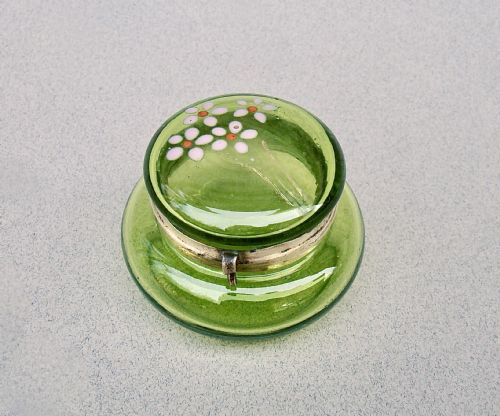
Buyers will most commonly encounter nineteenth-century and early twentieth-century examples, including bulb vases, biscuit jars and glassware painted with floral motifs. The selection ranges from Bristol blue and white opaline glass to green and crystal vessels carrying applied enamel details and gilding.
How they were made
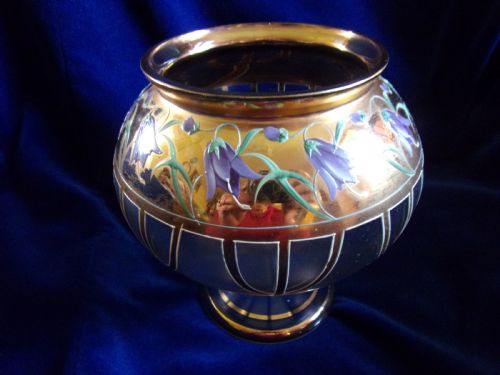
The creation of these objects involves blowing or moulding glass in various colours, such as amethyst, green, white opaline and crystal, before applying opaque or translucent enamel paints by hand. Artisans frequently integrated gold leaf, gilding and metal mounts in brass or wrought iron to complete the vessels.
Techniques range from simple brush-painted floral decoration on Victorian biscuit barrels and decanters to sophisticated cameo glass carving and multi-layered polychromatic enamelling seen in continental studio production.
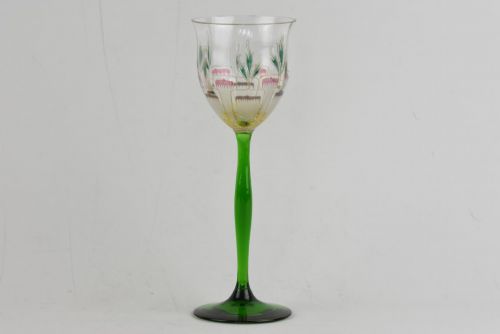
Object forms recorded in the inventory range from functional decanters and cordial glasses to decorative sculpture, table lamps, and trinket boxes.
What varies in quality
Quality rests upon the precision of the enamel work and the complexity of the glass body, distinguishing standard domestic utility items from exceptional studio pieces. Finer examples display meticulous brushwork, vibrant and well-preserved polychromatic enamels, and integrated precious metals or patinated bronze mounts.
The harmony between the glass form and the floral design dictates the overall success of the piece, where superior artistic execution in styles like Art Nouveau elevates the work beyond mass-produced glassware.
Thereisenthal·Theresienthal·S Theeman·Daum·Rene Lalique·Hannah Walton·Karl Palda
The Floral Enamelled Glass Glossary
- Opaline glass
- A semi-translucent opaque glass, often white or pastel-toned, frequently utilised for nineteenth-century vases and dressing table jars. It provides a pale canvas that accentuates brightly coloured enamel floral painting.
- Cameo glass
- A glass vessel formed with multiple layers of different colours, acid-etched or carved away to create a raised design. In floral enamelled pieces, this technique combines relief carving with surface painting.
- Enamel
- A vitreous composition melted onto the surface of glass for decoration. It provides durable colour and opaque or translucent properties when fired.
- Gilding
- The application of gold leaf or gold paint to highlight rims, handles and floral patterns on glass vessels. This finish adds reflective contrast to the coloured body.
- Plique-a-jour
- An enamelling technique where the enamel is applied within a cellular metal framework without a backing, resembling miniature stained glass. It allows light to pass directly through the coloured areas.
Floral Enamelled Glass: Frequently Asked Questions
How do I clean floral enamelled glass?
Clean these delicate glass pieces gently by hand using lukewarm water and a soft cloth, avoiding harsh detergents or soaking that might weaken the historic enamel decoration.
Dry them immediately with a lint-free towel to protect any gilt highlights or metallic mounts attached to the vessel.
Were these items used daily or displayed?
Many objects such as decanters, wine glasses and biscuit jars served practical functions in nineteenth-century dining and domestic hospitality.
Other items like trinket boxes, dresser jars and decorative vases were intended primarily for ornamental display in drawing rooms and boudoirs.
How can I tell Victorian pieces apart from later ones?
Victorian examples often feature heavier opaque glass bodies, substantial floral painting in traditional palettes, and domestic forms like biscuit barrels and opaline bulb vases.
Later pieces from the early twentieth century frequently adopt stylised Art Nouveau or Art Deco contours, incorporating cameo techniques and refined metal bases.
What is opaline glass?
Opaline glass is a delicate, semi-opaque material popular during the nineteenth century, known for its milky appearance in white, blue or pink shades.
Its smooth, pale surface made an ideal background for detailed hand-painted enamel flowers and gilt decoration.