
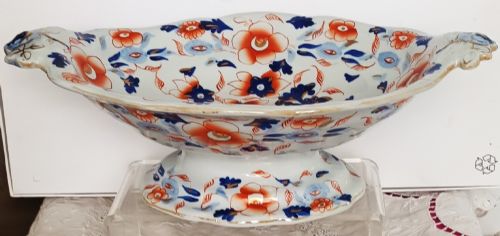


Floral Ceramic Pedestal Bowl
These floral ceramic pedestal bowl examples bring structured height and painted botanical detail to a table, combining utility with decorative presence.

Floral Ceramic Pedestal Bowl
A floral ceramic pedestal bowl elevates fruit, flowers, or confectioneries on a raised foot above the surface of a table. These pieces range from grand Victorian centrepieces and Edwardian comports to earthenware fruit bowls and footed dishes.
The selections on this page span the nineteenth century through the early twentieth century, taking forms such as French Rococo Revival lidded dishes, majolica vases, and glazed Art Nouveau centrepieces.
Makers and factories from England, France, Germany, and Italy produced these footed vessels in porcelain, ironstone, and earthenware, often incorporating applied botanical motifs and hand-painted floral patterns.
Materials and construction
Potters shaped these vessels using porcelain, ironstone, and earthenware, applying glazes to seal the ceramic body before or after firing. Many examples incorporate hand-painted floral decoration, enamel work, and details in gold leaf or gilt.
More ornate compositions feature applied porcelain roses, figurative putti, and pierced or moulded structural elements that demand careful kiln management to prevent distortion during firing.
The selection includes nineteenth-century pieces spanning the Georgian, Regency, and Victorian periods alongside Edwardian and 1930s designs.
Distinctions in quality
Quality rests on the crispness of the modelling, particularly in applied floral elements and figural work, where sharper detail indicates superior craftsmanship. The precision of the hand-painting and the evenly balanced application of glaze further separate standard production from finer studio or factory output.
The complexity of the form also dictates standing, with multi-tiered centrepieces, pierced baskets, and footed comports requiring advanced ceramic engineering compared to simpler open bowls.
Ulisse Cantagalli·Schierholz Plaue·C.G. Schierholz and Sohn·Maling·Mason·Eichwald
The Floral Ceramic Pedestal Bowl Glossary
- Comport
- A shallow footed dish or bowl used for serving fruit or sweetmeats at the table. These pieces stand on a raised pedestal base.
- Centrepiece
- A large ornamental object placed in the middle of a dining table. In ceramic work, this often takes the form of an elaborate pedestal bowl decorated with figures or flowers.
- Ironstone
- A dense, durable type of earthenware patented in the nineteenth century. It provides a sturdy alternative to porcelain while accepting complex printed and painted glazes.
- Majolica
- Tin-glazed earthenware decorated with brightly coloured metal oxide paints over an opaque white glaze. The technique gained popularity across Europe during the nineteenth century.
- Putto
- A representation of a chubby male child, often winged, derived from classical art. These figures frequently appear clambering among applied floral elements on continental centrepieces.
Floral Ceramic Pedestal Bowl: Frequently Asked Questions
What is a floral ceramic pedestal bowl used for?
These elevated vessels serve as decorative table focal points or functional containers for fruit and floral arrangements. Their raised foot lifts the contents above the table surface for better visibility.
Historically, larger examples functioned as dining table centrepieces for formal meals, while smaller comports held desserts or sweetmeats.
How do I care for antique ceramic bowls?
Gentle hand washing in warm water with mild soap preserves the delicate hand-painted decoration, enamel work, and gilt highlights. Avoid abrasive scrubbers that can damage the glaze.
Keep these pieces out of dishwashers and microwaves to protect the ceramic body and prevent crazing in the antique glaze layer.
How can I tell Victorian pieces from Edwardian ones?
Victorian examples often favour heavier ornamentation, such as Rococo Revival curves, dense blue and white patterns, or classical majolica glazing. The forms tend toward rich, ornate decoration.
Edwardian and later pieces frequently show lighter pastel palettes, simpler moulded lines, or flowing Art Nouveau botanical motifs reflecting changing tastes in interior design.
What distinguishes ironstone from porcelain?
Ironstone is a heavy, opaque earthenware developed for durability in domestic and commercial service. It offers strength and a thick body that withstands frequent handling.
Porcelain is vitrified, harder, and more translucent, often reserved for finer decorative centrepieces and delicate tablewares with intricate painted details.