
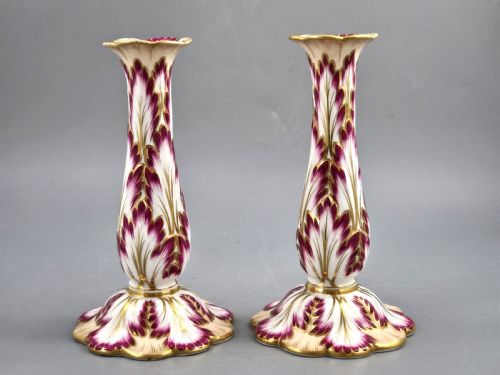
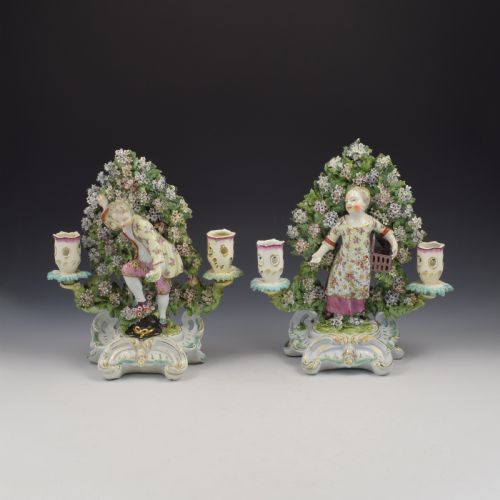


Floral Ceramic Candlesticks Pair
These floral ceramic candlesticks pair pieces of porcelain and earthenware with sculpted foliage, bringing vibrant colour and classical form straight to your table.
Floral Ceramic Candlesticks Pair
When searching for floral ceramic candlesticks pair, collectors find symmetrical sets designed for domestic lighting and display. These items originate across various eras including the Georgian and nineteenth-century periods.
The selections on this page predominantly feature porcelain and hard-paste porcelain construction. Forms range from simple foliage patterns to elaborate figural compositions adorned with bocage.
European factories dominate the origins, with English makers such as Ridgway, Derby, Minton, and Mason's appearing alongside continental German works like Meissen, Sitzendorf, and Dresden.
How they were made
Makers utilised ceramic bodies formed through moulding and hand-shaping, applying enamel colours directly onto the surface before firing. Gold leaf and gilding were frequently added to highlight raised details and scrollwork.
Figural examples incorporate delicate applied elements such as porcelain leaves and flowers known as bocage, requiring immense skill from the modeller to assemble prior to kiln firing.
Children dressed as gardeners and musicians spent centuries holding up heavy wax candles without ever complaining about the weight.
What varies in quality
The refinement of the modelling separates standard production from exceptional work, particularly in the crispness of moulded foliage and facial details on figural pieces. Hand-painted enamel precision and the preservation of applied gilding dictate the overall visual appeal.
Completeness of delicate porcelain flowers and leaves heavily influences the integrity of each pair. Earlier Georgian items often display different handling of glaze and body density compared to later continental output.
Ridgway·Derby·Sitzendorf·Meissen·Minton·Mason's·Dresden
The Floral Ceramic Candlesticks Pair Glossary
- Bocage
- An ornamental background of carved or modelled foliage and flowers encircling figures on early porcelain. This technique was widely utilised by eighteenth-century English and continental factories.
- Hard-paste porcelain
- A durable ceramic composition made from kaolin and petuntse fired at very high temperatures. It produces a dense, bright white body that resists scratching.
- Gilt
- A thin layer of gold applied to the ceramic surface for decorative accent. It adds a metallic sheen that contrasts with the painted enamel colours.
- Rococo Revival
- A nineteenth-century design style mimicking the asymmetrical curves, scrolls, and naturalistic motifs of the mid-eighteenth century. It frequently appears on decorative candlesticks and candelabra.
- Enamel
- A glass-like substance fused to the ceramic body during firing to provide vibrant, permanent colour. Painters applied these pigments by hand before the final glaze baking.
Floral Ceramic Candlesticks Pair: Frequently Asked Questions
How were ceramic candlesticks used historically?
These matched sets provided illumination on dining tables, mantelpieces, and sideboards in wealthy homes. Candles fitted securely into the sockets while the decorative bases reflected ambient light from hearths and chandeliers.
Over time, their primary role shifted from functional lighting to ornamental display as safer illumination methods emerged in later centuries.
How can I distinguish eighteenth-century pieces from later copies?
Examine the weight, glaze texture, and hand-painting technique under magnification. Eighteenth-century hard-paste porcelain often exhibits subtle potting imperfections and softer enamel depth that nineteenth-century revival pieces rarely replicate accurately.
Check for factory marks where applicable, though many early items relied solely on pattern numbers or distinctive potting characteristics rather than stamped logos.
What is bocage and why does it matter?
Bocage refers to the intricate sculptural leaves and flowers surrounding ceramic figures. It creates a lush, naturalistic backdrop that frames the main subject on the candlestick.
Because these porcelain branches are exceptionally fragile, the survival of an undamaged bocage significantly impacts the historical integrity and desirability of any pair.