
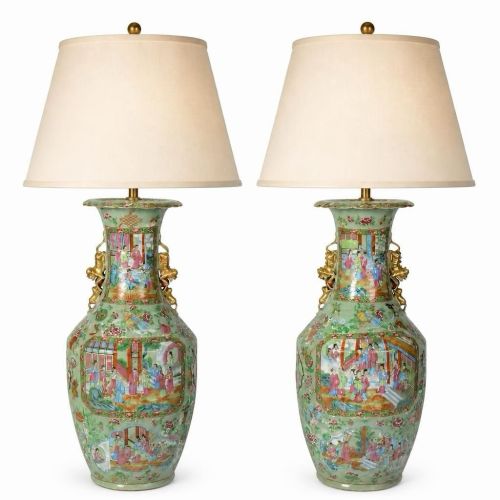


Famille Rose Porcelain Lamp
A famille rose porcelain lamp brings vibrant hand-painted enamel and historic ceramic form into a room.
Famille Rose Porcelain Lamp
When you search for a famille rose porcelain lamp, you are looking at ceramic vessels transformed into lighting. The selection on this page consists predominantly of nineteenth-century pieces, spanning ginger jars, baluster vases and rose medallion vessels converted into table lamps.
Many of these items originate from China, specifically Cantonese workshops, alongside European interpretations. You will encounter pairs as well as single table lamps, often mounted for electrical use while retaining their original hand-painted character.
How they were made
The foundation is hard-paste porcelain, shaped into vases or jars and painted with enamel colours characteristic of the famille rose palette. Artisans frequently combined these ceramic bodies with metalwork components.
Mounts in brass, ormolu and gilt bronze secure the porcelain and provide structural support for the lamp fittings. Silk and fabric shades complete the construction on surviving pieces.
Listings span the nineteenth and early twentieth centuries, incorporating materials such as porcelain, ormolu, brass and silk.
What varies in quality
Quality rests in the crispness of the hand-painted enamel and the integration of the metal mounts. Finer examples display detailed figural or floral scenes with precise brushwork across the porcelain surface.
The weight and finish of the brass or ormolu mounts also distinguish the range. Substantial, well-fitted bronze mounts indicate a higher tier of production than simple utilitarian fixings.
Samson
The Famille Rose Porcelain Lamp Glossary
- Famille Rose
- A palette of opaque enamels dominated by pink, introduced in Chinese ceramics during the Qing dynasty. It allows for subtle shading and detailed floral or figural compositions.
- Rose Medallion
- A specific decorative pattern featuring distinct panels of figures alternating with birds and flowers. This style became prominent on nineteenth-century export porcelain.
- Ormolu
- Gilt bronze applied to furniture and decorative objects such as lamp bases. It provides a rich golden finish that complements the coloured enamels of the porcelain.
- Baluster
- A vase shape with a rounded body that tapers towards the neck. This classical form provides a stable base for a table lamp.
- Ginger Jar
- A high-shouldered ceramic jar originally used for storage. These jars form popular bodies for conversion into lamps.
Famille Rose Porcelain Lamp: Frequently Asked Questions
Are these lamps converted from old vases?
Many items listed began life as nineteenth-century Chinese vases, ginger jars or oil lanterns before receiving electrical fittings. The process adapts antique ceramics for contemporary interiors.
Some pieces retain original mounts while others show later adaptations for modern wiring.
How do I date a famille rose lamp?
Dating relies on the ceramic body, the style of the enamel painting, and any associated metal mounts. Nineteenth-century pieces typically show specific Cantonese or Qing dynasty characteristics in the palette.
Comparing the hand-painted details against known period styles helps narrow the decade of production.
What is the difference between famille rose and famille verte?
Famille rose relies primarily on a distinctive pink enamel derived from colloidal gold, introduced in the eighteenth century. Famille verte uses a palette dominated by shades of green.
Both styles appear on nineteenth-century Chinese export porcelain adapted into lighting.
How should I clean a porcelain lamp base?
Dust the ceramic body gently with a soft dry cloth to protect the delicate enamel work. Avoid harsh chemical cleaners that might damage the antique glaze.
Metal mounts can be maintained with appropriate polish, taking care to keep liquids away from the electrical fittings.